Saturday, June 21, 2008

Losing Kei by Suzanna Kamata and Flight of the Dragonfly by Melissa Hawach

CATEGORY: Fiction

PAGES: 196

PRICE: $14.95 / Paperback Original

Pub Date: January 2008


This month I find myself reading two books with a similar theme - not by design, just mere coincidence. The theme? Child custody.

One, "Losing Kei", has been written by writer and fellow blogger Suzanne Kamata, whose blog "Gaijin Mama" I have been reading for a while now. Not only does it give me great insights to parenting but also shows me a Japan that one doesn't always read about in books.


"Losing Kei" is an easy-to-read contemporary story (fiction) about an American landscape artist (Jill Parker) who travels to Japan to get over a heart break. Whilst there she meets and marries a traditional Japanese man (Kukume).

Kamata, an American married to a Japanese man, does an excellent job showing the reader how when two very different cultures meet there could be clashes, especially in the area of marriage, inlaws, bringing up the children and so on.

The Japanese tend to be a highly homogenized society and very often will be wary with foreigners. Jill's inlaws did not approve their son's choice of a bride but accepted it because it pleased their son. Jill was expected to live in her inlaws' home and was also expected to play the role of a subservient wife and eager-to-please daughter-in-law, something that was totally alien to her independent upbringing. Cracks soon formed in the relationship forcing Jill to ask for a divorce. What she hadn't bargained on however, was that she would have to give up custody of Kei due to Japanese custody laws which state that a foreigner has no rights to custody! Indeed, even when both parents are Japanese it is not uncommon for children of divorced parents to be told one of their parents is dead - case in point, former PM Koizumi. When he divorced his pregnant wife he retained custody of his eldest son and the wife was never allowed to see or meet him. Anyway, so Jill sees no way out but to arrange to smuggle Kei out of the country....does she have the guts to do it? Will she get away with it? You'll have to read the book to find out!


Format: Hardcover

May 13, 2008

288 Pages

Harpercollins Canada, Limited


"Flight of the Dragonfly" is the true story of how Canadian mom Melissa Hawach fought to get her children (Hannah,5 and Cedar,3) back after they had been abducted by her Lebanese-Australian husband, Joe Hawach and taken to Lebanon during the height of the Hezbollah-Israeli war.

I remember reading about this incident (it was all over the papers) in 2006 and I thought Melissa's story would make a good book (especially because the way she went about bringing the girls back home was particularly dangerous and had a potentially nail-biting ending) but sadly, something about the tone of the book fell flat for me.


Try as I might, I just could not evoke feelings of anxiety for Melissa, nor did I find myself feeling any sort of tension through the proceedings. Even worse, despite the awful thing that happened to her, she didn't quite cut a sympathetic character in my eyes. Also, the book bounced about quite a bit taking us from Sydney in Australia to Calgary in Canada back to Sydney, to Lebanon and so on, in no particular order. Perhaps my ambiguity had to do with the writing which I am told was heavily edited for possible libel or perhaps it had to do with the fact that Hawach simply narrates the story..it's just details upon more details. What the reader is going to want and doesn't receive, are discussions of feelings and emotions..

No real explanation is given for why Joe Hawach felt he had to abduct his children despite having visitation rights...it certainly made me think about parental abduction and how and why it happens.
It saddened me to read that the mercenaries hired by Melissa to abduct the kids from Lebanon were family men themselves and while she managed to return to Canada safe and sound, the two men were arrested in Sydney and kept in jail for three months! What I did like about her however, is that she doesn't seem embittered by what she's gone through. She allows they girls to speak to their father once a week on webcam and even entertains the thought of taking them to visit him in Australia some day.

Wednesday, May 21, 2008

Genghis Khan and the Making of the Modern World, Mongol and "Idol Lover and other stories from Pakistan"


# Category: History - Asia; Biography & Autobiography - Historical

# Format:
Hardcover, 352 pages


# On Sale: March 16, 2004

# Price:
$25.95


Barbaric! savage! cruel! Those are the first, and probably only, adjectives that come to mind when I think of the Genghis Khan of my school history books.

Indeed, perhaps he was all of those, but for someone who had never been to school and belonged to an outcast family, to have conquered land twice that of Alexander the Great, he had to have had qualities of a leader, had to have been able to inspire loyalty, and here to make that case for him is a book and a movie - Jack Weatherford's revisionist history of Genghis Khan's empire titled
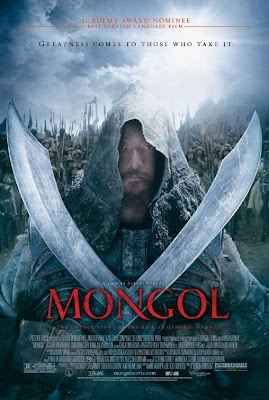
'Genghis Khan and the Making of the Modern World" and Sergei Bodrov's Oscar- nominated movie "Mongol" which will have its North American release on 06June.


The movie essentially covers The Khan's formative years. These are important years because it can be argued that it was the adversities faced in his childhood (the killing of his father at enemy's hands when he was 9; having to live in dire poverty and as an outcast with his mother and siblings in an isolated part of the Steppes (because a widow with children was of no use to the clan); being forced into slavery etc. that made Genghis Khan the determined, fearless and resourceful warrior that be became.


The movie ends with The Khan having defeated all of the Mongolian tribes to become the Chief Warlord, but in some ways, Genghis Khan's story is only just beginning. To read about how this Mongol warlord and his family took over the world it is essential to pick up Jack Weatherford's beautifully written and immensely readable, "Genghis Khan and the Making of the Modern World" which shows Khan as a firm, cruel at times, but progressive ruler. He abolished the caste system that existed in the Mongolia of his childhood, the sale of women, torture and established free trade, international law. He also promoted literacy and championed social/religious tolerance (although the Mongols themselves were animists, many took Buddhist and Christian wives)

One of the most intriguing facts to have come out of Weatherford's book is that Genghis Khan was a spiritual man and never embarked on a conquest without first getting the blessings of the Lord of the Mountains.
Genghis Khan dies in the first half of the book but Weatherford goes on to tell us how his descendants went on to conquer Russia, Iran, China and Europe. All in all, this is a rollicking good read. I have been so wrapped up in this genius of a book - waking up to it, going to bed with it - I will find it quite hard to replace Genghis Khan!

For a great review and a wonderful write-up on revisionist history do visit Id's blog here

Also discovered some wonderful Pakistani authors this month...

"The Idol Lover and Other Stories from Pakistan" by Moazzam Sheikh is a slim little book but let that not fool you for these original and fresh stories pack a punch! The book is divided into two parts, the first is group of stories set in the continent of Asia and the other takes you to San Francisco.

"Monsoon Rains", set in Pakistan was probably my most favorite story in the book - what is it about the monsoon that makes you realize your loneliness like no other season? Is it the incessant rain dropping like heavy tear drops against the window panes? Is it the smell of the earth - fragrant like a woman's perfume? Or is it just that it keeps people indoors and out of circulation? Whatever it may be, in "Monsoon Rains" the loneliness, the hopelessness that the protagonist feels is palpable, evoking a deep sympathy, tinged with repugnance for how he goes about trying to fill his empty days.

Another memorable story was "The Cow", set in the years of the British Raj in which Sheikh beautifully describes an unlikely friendship between two boys - one, the son of an Indian caretaker of a Bungalow (house) and the other, the son of the British government official that occupied it.

"Kissing the Holy Land" features in part two of the book and is the story of a young man from Pakistan on his first visit to the USA.
The story is set in New York airport as the protagonist waits to transit to San Fransisco. Writing with poignancy and wit, Sheikh touches upon several tender and moving moments through the story making it one you want to go back and read again.

I am still reading the book hence an incomplete review. If you wish to read a longer review please go to the one at Desi Lit.

The Idol Lover is published by Ithurial's Spear and this is what the publishers say about the book:

THE IDOL LOVER AND OTHER STORIES OF PAKISTAN.
Short stories by Moazzam Sheikh. These sexually-charged tales unfold against a backdrop of colonization and ethnic tensions in Pakistan and the Middle East, and they also explore the immigrant's dilemma in the United States. Sheikh "maps the ways in which South Asian identities cohere and threaten to disintegrate at the contradictory intersections of memory, desire, connection, and exploitation... Sheikh's voice too, is unique, bringing to the English short story the flavor and verve of the Urdu/Hindi tradition"--A. Chakladar.

I mentioned having discovered other authors from Pakistan and they are:

A Case of Exploding Mangoes by Mohammed Hanif.


The Making Of Mr. Hai's Daughter : A Memoir by Yasmin Hai

I haven't read either one yet, but they are both on my "to be read quickly" list!

Thursday, May 15, 2008

Bloggers Unite - Blogging for Hope


I do apologize for not having a "human rights" post to go along with this badge (I only heard of "Bloggers Unite: Blogging for Hope" this morning) but I wanted to help spread the word. I hope you will join the revolution!!!


Friday, March 21, 2008

The Age of Shiva by Manil Suri and " Unaccustomed Earth " by Jhumpa Lahiri


  • Publisher: Norton, W. W. & Company, Inc.
  • Pub. Date: January 2008
  • ISBN-13: 9780393065695
  • Pages :448pp


India, 1955: as the scars of Partition are just beginning to heal, seventeen-year-old Meera sits enraptured watching the performance of a young man on stage, Dev, singing a song so infused with passion that it arouses in her the first flush of erotic longing. As a rivalry between them ensues, she wonders if she can steal him away from Roopa, her older, more beautiful sister.

When Meera's reverie comes true, it does not lead to the fairy-tale marriage she imagined. Dev's family is steeped in the very kind of orthodoxy her father has long railed against and she finds herself having to tolerate their backward ways, her husband's drunkedness, and the unwanted attentions of his brother. Her only solace is in her sister-in-law Sandhya, with whom she comes to share a tenderness that is as heartbreaking as it is fleeting.

A move to Bombay, so that Dev can chase his dream of success as a Bollywood singer, seems at first like a fresh start, but soon that dream – and their marriage – turns to ashes. It is only when their son is born that things change. For the first time, Meera feels fulfilled. She is finally ready to shape her own destiny. To take control of her world.


What I liked about this book:

* That Manil Suri decided to make a woman the pivotal character. This is admirable because he had to think and be Meera for nearly 455 pages, no easy feat for someone of the opposite gender.

* The book spans nearly three decades...it opens in 1955 and closes in the 1980's. The entire story is played out against the backdrop of important political events of those decades...the readjustment to the Parition (Hindu-Muslim riots), the Indo-China war, the Bangladesh War of Independence, the Emergency of 1975 and so on.

* Suri is a wonderful parent to his characters. Each one of them is lovingly fleshed out complete with a background story, so that the reader knows what set of circumstances prompts them (the characters) to behave in the way they do. I truly admire Suri's dedication to his characters...you can see the work he puts into turning them from mere two-dimensional characters into larger than life figures. Because the book is essentially about relationships, having believable characters with a generous amount of flaws and few virtues is central to the story and Suri pulls that off beautifully.

* He is also an amazing storyteller...with lyrical and sensual writing he spends time building up a story so that before you know it you're not just reading the story but a part of it.

* As I mentioned before, this book is about relationships and motherhood...much of it is about the relationship of a mother with her son in particular. Much of the writing concerning hte mother and son is quite sensual, for instance, take the opening lines from the book:

"Every time I touch you, every time I kiss you, every time I offer you my body, Ashvin. Do you know how tightly you shut your eyes as with your lips you search my skin? Do you know how you thrust your feet towards me, how you reach out your arms, how the sides of your chest strain against my palms? Are you aware of your fingers brushing against my breast, their tips trying to curl around something to hold on to, but slipping instead against my smooth flesh?"

"Ashvin. Do you notice the wetness emerge from my nipples and spill down the slopes of my chest? Is that your tongue that I feel, are you able to steal a taste or two?"


It's really hard to tell if the narrator is talking to a lover or to a child. I'm sure Suri was very deliberate in setting this tone. I believe it was his intention to fashion Meera's relationship with her son on the Hindu goddess Parvati's relationship with the elephant-god Ganesh (Ganesh was made by Parvati to be her protector) and her darker relationship with her other son Andhaka who it is said fell in love with Parvati........

It is at this point I must mention that Suri dips quite generously into India's abundant myth pool to drive his story. As a lover or Indian mythology this was a huge draw for me.

(Shiv,Parvati and Ganesh)

******

What didn't work so well:

Meera, the main protagonist is a beautifully-drawn out character but I didn't like her very much.She was self-absorbed, held grudges and wasn't able to truly love anyone with the exception of her son, Ashvin, towards whom I think she gave such an outpouring of love it made all seem slightly unnatural. And then again, was it really love she fed Ashvin or was it her way of controlling him so he could meet her needs? She came off as cold, selfish, scheming and distrusting of men, but that's probably because the men in her life had failed her, besides she was a woman fighting for a place in a machismo society.

The first half of the book is written in the first person and flowed very smoothly. The second half is written in the second person (this is where Meera talks to her son Ashvin telling him all about the first years of his life and their early years in Bombay etc) and I found the soliloquies to be a little tedious. Meera's cloying devotion to Ashvin and his dependence and loyalty to her (to the extent of excluding his own playmates) was a little hard to swallow.

* Although I did like that the book spanned three decades I have to ask myself why so many Indian writers will, without fail, use the Indian Partition and sectarian violence as the backdrop against which their characters play out their lives?

I predict that the Indian readers will absolutely revel in this book...I'm not sure how it will appeal to Western readers...do write and let me know what you think of the book.

************************


  • Publisher: Knopf Publishing Group
  • Pub. Date: April 2008
  • 352pp
I'm also reading Jhumpa Lahiri's new book, "Unaccustomed Earth". If I remember correctly, Lahiri started her writing career with short stories writing "Interpreter of Maladies" for which she won the Pulitzer Prize. After that she wrote her first full-length novel 'The Namesake"
which was made into a hit movie by Mira Nair
. In "Unaccustomed Earth" she goes back to writing short stories some of which were published earlier in the Newyorker,
here and here. I have to say I am really enjoying most of the stories. Lahiri writes about the everyday life of immigrant (Bengali) families using simple prose that starts oh so quietly and sedately but which almost always holds a big surprise at the end. Definitely give "Unaccustomed Earth" a whirl.


Thursday, March 20, 2008

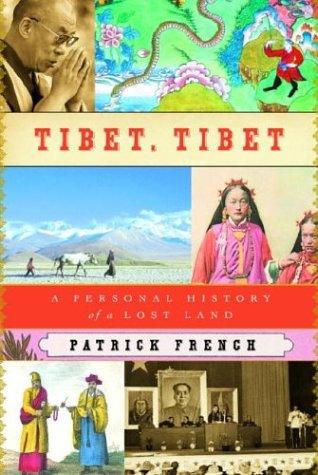
Book Review: Tibet,Tibet by Patrick French

Tibet is so much in the news these days so I thought it only fitting to republish the review I wrote for Patrick French's "Tibet,Tibet". My review was written in Sep 2005.

Tibet. What do you think of when you see or hear the word "Tibet"? For me, Tibet conjures up images of Lamas in bright purple and maroon robes, high mountains, beautiful men and women in braids with ruddy cheeks. I think of prayer wheels, beautiful monastaries, momos (tibetan dumplings), Buddhism, yaks and ofcourse, the Dalai Lama and his enigmatic smile. But after reading Patrick French's "Tibet,Tibet", I realize Tibet is so much more.

If any one should know Tibet, it is Patrick French. As a young man of 16, he had the opportunity to meet the Dalai Lama who visited the Christian monastery in Northern England where the author was studying. The Dalai Lama who was only 40, dark haired and uncelebrated at that time, made a huge impression on him and Tibet became the cause he became attached to, working as a political activist on behalf of its government in exile.


In 1999, French decided to go on a trip covering Tibet from west to east. THe purpose of this trip was to demythicise and deromanticise Tibet. He wanted to see it for what it really was and what he found may be disappointing to some because although it is every bit as scenic as we are led to believe, it is not the Shangri-la the Western world thinks it is. Also,although this a land adored for peaceful spirituality ("pacifist monks and nuns spending their days in learning, meditation and creativity..") it reveals a surprising early history of fierce war-making and its equally fierce monks aka. Dob-dobs.

"...Dob-dobs lived outside normal monastic rules, and were renowned for their aggressive behaviour. They exercised discipline in the monastaries and would paint rings of soot around their eyes, curl thier hair and smear it with butter. THey maintained order with the help of a curved blade and giant monastery keys, which were swirled like a martial arts flail...."


What makes this book so engaging is that Patrick French writes this as a part memoir, part history book, part travelogue, part narrative and part political analysis. As a historian he lays down a detailed and succint account of the Cultural Revolution in China and how it impacted Tibet, especially when the Dalai Lama had to flee Tibet and take refuge in India. His headquarters in the Himalayas is known as the Dharmshala. The author also reminds readers that the Tibetan empire once stretched as far as Afghanistan and its soldiers laid siege to Samarkand. As Tibet's influence waned, its king was dragged in shame through the streets of Baghdad, like, French writes, 'a downed American pilot.'

And as a narrator he recounts conversations with rugged nomads, courageous young nuns, Tibetan Muslims, entrepreneurs, former (Tibetan) Red Guards, remnants of the old aristocracy and returned exiles. He also meets one of the last remaining Ragyabas, a group of Tibetans that we social outcasts. They did the jobs that no one else wanted to do, like depose of corpses that had met their deaths in unnatural ways and so on.


As a travel writer he paints us a picture of Tibet as a harsh, remote untouched land and nearly the most sparesly populated. A land of blue sheep ringed by snow peaks and impassable high-altitude deserts, dropping to fields of jasmine and turquoise lakes...quite seductive , I have to admit!

However, it's his political commentary and predictions that I found most interesting: He has little faith in Beijing ever allowing the Dalai Lama to return to Tibet. Only a regime change in Beijing might make way for true autonomy. But, he laments, he doesn't see it coming any time soon. He opines that although the Dalai Lama has, in the past, let go of opporutnities to furthur Tibet's cause with Beijing, the cause will probably become totally irrelevant without his presence. As it is, Tibet's religious institutions have been damaged and its unique culture eroded. Also, India is under terrible pressure from Beijing to clamp down on the Tibetan exiles---it is only Indian cultural and religious reverence for the Dalai Lama which has so far stopped this from happening. When he dies, this protection will quickly disappear.


To me it appears that French has mixed feelings about the Dalai Lama. He has met the Tibet leader and spiritual father many times, and although he comes away feeling the Dalai Lama is well-meaning, he thinks the spiritual leader allows himself to be used as a marketing gimmick to sell everything from Apple computers to books that bear his image but are not written by him. He has this to say about His Holiness:

"...There’s an extraordinary aura and personal charisma about him. He uses his charm whilst reflecting on many serious questions. He knows how to relate to foreigners. In Dharamsala he is different, more like a father figure to his people. The Dalai Lama is hard to read: opaque, intuitive, wise, flippant, childlike, canny and disarming. After watching him for nearly 20 years I still felt some uncertainty about what motivated him, and what his real political strategy was for Tibet...."

In Patrick French's opinion, the only realistic hope for the future is for Tibetans to work within the Chinese system, to try to get as many of their countrymen as possible into good positions and wait for the day when there is reform in Beijing...

I consider this book a must-read for all those interested in Tibet, its history, land and people. With his competent research Patrick French has truly shed a magnificent light on this beleagured magic kingdom and I am grateful to him for doing so.

Monday, March 10, 2008

The Konkans by Tony D'Souza


  • Publisher: Harcourt

  • Pub. Date: February 2008

  • ISBN-13: 9780151015191

  • Pages: 308pp


Some time ago I decided I had overdosed on the Indian immigrant story and decided to take a break from that particular genre but Tony D'Souza's "The Konkans" (a semi-autobiographical story of an Indian Catholic family's migration and assimilation into the US in the early '70's ) made me change my mind. My husband being from the Konkan community, I have a special affiliation with these people and I felt the book gave me the opportunity to get to know them better.


So, who are the Konkans? They are a people whose ancestors inhabited the Konkan coast of India. The Konkan coast has some of the most amazing beaches and includes Bombay, Mangalore and Goa among others cities. The Catholic Konkans are set apart from other Indians mainly due to their religion, food (they are one of the few communities in India that eat both, beef and pork) and their custom of giving their kids Christian names. Their ancestors were Hindus and Muslims originally but converted to Catholicism in the 16th century with the arrival of the Portuguese explorer Vasco Da Gama and a priest called Francis Xavier who traveled along with him for the express purpose of gaining more Catholics for the Church.

There are two main protagonists (brothers) in the story and both leave India for a new (hopefully better) life in the US. The older brother, Lawrence D'Sai, does everything to shed his Indianness like it was an old tattered coat he was ashamed of. He embraces western clothes, buys a house in the suburbs, marries a white girl from Detroit and set his sights on getting membership to the local country club.

Sam, his younger brother, found it impossible to sever his ties with India. Although he now lived in the US he continued to eat his Indian food, dress in his traditional lungi (garment)when lounging at home and regaled his young nephew Francisco (also the narrator) with stories from India,especially the history of the Konkani people.

Even though both these brothers had such a different approach to assimilation in the US, neither one was accepted by their adopted country which leads one to ask the question : does race/skin color decide how successful one is at assimilating into American society? Do white people find it easier to integrate into a predominantly white society than colored people?

I think Tony D'Souza is a great storyteller...his tone is relaxed and laid back and he infuses his characters with enough strengths and flaws making them very human and not cardboard cutouts. I think he gets the immigrant experience right, but as with many second-generation Indians I think he slightly exaggerates the complexities of the Indian society with its caste and class structure and may offend some Indian (especially Konkan) males with his portrayal of them, still, on the whole, I think he does an admirable job of putting his story together.

Along with the compelling telling of the immigrant story, there are many illuminating passages in the book describing the history and culture of the Konkan people...I especially loved reading about the Konkan wedding. The author writes about it with such exquisite detail that it gave me goosebumps! Another favorite was the page-long explanation for why some of us Indians are prejudiced when it comes to skin color. One of the final chapters in the book "The Americans" is particularly hard hitting as it describes the Goa inquisition and the drive to abolish Hinduism on the Konkan coast.

This is a book I am going to have to keep for my daughters, after all, it contains a part of their history within its pages.


Saturday, March 01, 2008

In Arabian Nights: A Caravan of Moroccan Dreams by Tahir Shah

Category: Travel - Africa; Travel - Middle East; Travel - Adventure

Format: Hardcover, 400 pages

Publisher: Bantam

Pub Date: December 26, 2007

Price: $30.00


The book's alluring cover and beguiling title made it impossible not to pick up and for the most part I am glad I did.

Tahir Shah, son of Sufi poetry scholar and translator, Idries Shah, moved his young family from England for the sunshine and warmth of his childhood home, Morocco. "The Caliph's House" was Shah's first book written from his new home in Casablanca, Morocco and "In Arabian Nights" is the sequel.

"In Arabian Nights" continues the saga of the house called "Dar Khalifa", its guardians (servants) and its motley crew of visitors but it also involves Shah's search for the legendary story tellers of Morocco (
the Moroccans have a wonderful tradition of oral storytelling)and more importantly, his pursue of a time-honored Berber quest: to find the story in his heart. The quest for his heart's story takes him from the teeming streets of Tangier in the north, through the the ancient labyrinthine lanes and bazaars of Marrakech and Fez, to the solitary sands of the Sahara in the south.

The entrance to the 14th-century Bou Inania school and mosque, which like much of Fez is a place of legend and mystery.

The book is filled with an entourage of colorful characters ( including an exorcist, a blind-story teller and a Tuarag tribesman from the Sahara desert) and is packed to the brim with wondrous Arab tales and filled with the sights and sounds of Morocco which made me wish I could
summon my magic carpet and have it carry me away to this place.

Although "In Arabian Nights" is the successor to "The Caliph's House" it is very different in tone. I enjoyed seeing that there exists a corner of the world where the tradition of oral story telling is more popular than books. Also, Shah helps you realize that a story is so much more than entertainment. Here in the west we read because we want to be entertained and we want to be informed. There is no dearth of the printed word and as a result we are constantly speed reading through a book in order to get to the next one. In places where stories are passed on orally, people listen to the same story over and over and will move on to the next only after the story with its symbols and meanings is truly understood by the listener. Do we ever really "understand" the stories we read or do we just carry away a superficial message and then move on to the next book? In other words, are we being short-changed when we do not re-read a novel? Also, there is that question of committing stories to memory. Are there merits in doing that? These are just some of the questions Shah poses through the book making it a very thoughtful read.