Showing posts with label Pakistani writer. Show all posts

Thursday, March 26, 2009

In Other Rooms, Other Wonders by Daniyal Mueenuddin


  • Hardcover: 256 pages

  • Publisher: W.W. Norton & Co.; 1 edition (February 1, 2009)

  • Language: English

  • ISBN-10: 0393068005


I first came across Daniyal Mueenuddin's stellar writing when the New Yorker published his story "Nawabdin Electrician" in the July 2008 issue. So intrigued was I with the protagonist Nawabdin, Mueenuddin's lyrical writing and his ability to bring Pakistan and its people into our homes that I hungered to read more from him. Fortunately I didn't have to wait long, in February this year Norton published his first book of short stories titled "In Other Rooms, Other Wonders" and I am happy to say that Mueenuddin is not a one-story wonder...I have enjoyed reading all of the eight stories in this volume, which is saying a lot because I have read other books of short stories and there have always been a couple that I didn't care to finish..not this time!

The central figure of In Other Rooms, Other Wonders is K.K. Harouni, a rich landlord in the Punjab area of Pakistan, though he figures as a protagonist in only one of the eight interconnected stories. The others focus is on peasants, servants, drivers, land managers, privileged Westernized children in an upstairs-downstairs sort of theme

The book opens with "Nawabedin Electrician" but it is "Saleema", the second story which captured my heart and still refuses to let go. In "Saleema", Mueeneddin takes us into the servant quarters of a rich landlord and shows us how even in the kitchen there is a pecking order based on clan and god forbid you come from a clan which is not respected (Saleema came from the Jhulan clan of blackmailers and bootleggars) you are destined to be everybody's doormat. It is sad because Saleema has nothing but sexual favors to offer the menfolk to get ahead and when even that is gone, she is back to square one. What hope is there if you are never allowed to shrug off the heavy mantle of tribe or clan?

Provide, provide, is another excellent story of a small time landlord, Chaudry Jaglani, from Dunyapur, a place along the Indus river. Being an opportunistic man Jaglani manages to increase his lands steadily and become quite active in politics too. However, the story isn't just about him but rather his love (always to be confused with passion) for a servant girl named Zainab and how his love for her ruins them both.

As with the previous stories, I liked how the landscape is such an integral part of the story and enjoyed Mueenuddin's evocative and pastoral descriptions of "peasants bringing back their buffaloes from watering at the end of the day...the heavy bells hanging from the animals' necks making a mournful hollow gonging..." brought back hazy memories of warm summers in the villages of my country!

Perhaps this might be a good time to mention that Mueenuddin is the son of a Pakistani father and American mother and after completing boarding school in Massachusetts, returned to Pakistan at the age of 23 to help his aging father to safeguard some ancestral property that was in danger of being taken over by unscrupulous managers. The seven years he spent on the farm provided the fodder for some of the stories in this book.

"About a Burning Girl" made me wince because it shows you how corruption has come to play such a huge role in the sub-continent. It seems to me that justice can never be had unless you have the mullah to pay for it. This story also reminded me of Mueenuddin's flair for description, especially strong when describing the landscape or one of his characters:

"He wore a battered white skullcap, soiled clothes, a sleeveless sweater and shoes with crepe rubber soles, worn down to one side, which gave each foot a peculiar tilt. The deep lines on his face ran in no rational order, no order corresponding to musculature or to the emotions through which his expressions might pass, but spread from numerous points. The oversized head had settled heavily onto the shoulders, like a sandcastle on the beach, after the sea has run in over it." pg 106

"Our Lady of Paris", "Lily" and "A Spoiled Man" focus on urban Pakistan and while they are captivating in their own way, I preferred the stories set in rural Pakistan. Big cities don't lack for quirky tales or complex characters, but small towns and villages feel more accessible, the characters more colourful, the stories richer.

You can read some of Daniyal Mueenuddin's stories on the web...here are the links:

Nawabdin Electrician

In Other Rooms Other Wonders


A Spoiled Man


Wednesday, May 21, 2008

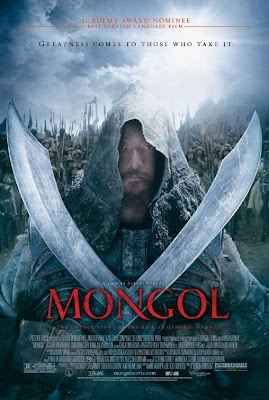
Genghis Khan and the Making of the Modern World, Mongol and "Idol Lover and other stories from Pakistan"


# Category: History - Asia; Biography & Autobiography - Historical

# Format:
Hardcover, 352 pages


# On Sale: March 16, 2004

# Price:
$25.95


Barbaric! savage! cruel! Those are the first, and probably only, adjectives that come to mind when I think of the Genghis Khan of my school history books.

Indeed, perhaps he was all of those, but for someone who had never been to school and belonged to an outcast family, to have conquered land twice that of Alexander the Great, he had to have had qualities of a leader, had to have been able to inspire loyalty, and here to make that case for him is a book and a movie - Jack Weatherford's revisionist history of Genghis Khan's empire titled
'Genghis Khan and the Making of the Modern World" and Sergei Bodrov's Oscar- nominated movie "Mongol" which will have its North American release on 06June.


The movie essentially covers The Khan's formative years. These are important years because it can be argued that it was the adversities faced in his childhood (the killing of his father at enemy's hands when he was 9; having to live in dire poverty and as an outcast with his mother and siblings in an isolated part of the Steppes (because a widow with children was of no use to the clan); being forced into slavery etc. that made Genghis Khan the determined, fearless and resourceful warrior that be became.


The movie ends with The Khan having defeated all of the Mongolian tribes to become the Chief Warlord, but in some ways, Genghis Khan's story is only just beginning. To read about how this Mongol warlord and his family took over the world it is essential to pick up Jack Weatherford's beautifully written and immensely readable, "Genghis Khan and the Making of the Modern World" which shows Khan as a firm, cruel at times, but progressive ruler. He abolished the caste system that existed in the Mongolia of his childhood, the sale of women, torture and established free trade, international law. He also promoted literacy and championed social/religious tolerance (although the Mongols themselves were animists, many took Buddhist and Christian wives)

One of the most intriguing facts to have come out of Weatherford's book is that Genghis Khan was a spiritual man and never embarked on a conquest without first getting the blessings of the Lord of the Mountains.
Genghis Khan dies in the first half of the book but Weatherford goes on to tell us how his descendants went on to conquer Russia, Iran, China and Europe. All in all, this is a rollicking good read. I have been so wrapped up in this genius of a book - waking up to it, going to bed with it - I will find it quite hard to replace Genghis Khan!

For a great review and a wonderful write-up on revisionist history do visit Id's blog here

Also discovered some wonderful Pakistani authors this month...

"The Idol Lover and Other Stories from Pakistan" by Moazzam Sheikh is a slim little book but let that not fool you for these original and fresh stories pack a punch! The book is divided into two parts, the first is group of stories set in the continent of Asia and the other takes you to San Francisco.

"Monsoon Rains", set in Pakistan was probably my most favorite story in the book - what is it about the monsoon that makes you realize your loneliness like no other season? Is it the incessant rain dropping like heavy tear drops against the window panes? Is it the smell of the earth - fragrant like a woman's perfume? Or is it just that it keeps people indoors and out of circulation? Whatever it may be, in "Monsoon Rains" the loneliness, the hopelessness that the protagonist feels is palpable, evoking a deep sympathy, tinged with repugnance for how he goes about trying to fill his empty days.

Another memorable story was "The Cow", set in the years of the British Raj in which Sheikh beautifully describes an unlikely friendship between two boys - one, the son of an Indian caretaker of a Bungalow (house) and the other, the son of the British government official that occupied it.

"Kissing the Holy Land" features in part two of the book and is the story of a young man from Pakistan on his first visit to the USA.
The story is set in New York airport as the protagonist waits to transit to San Fransisco. Writing with poignancy and wit, Sheikh touches upon several tender and moving moments through the story making it one you want to go back and read again.

I am still reading the book hence an incomplete review. If you wish to read a longer review please go to the one at Desi Lit.

The Idol Lover is published by Ithurial's Spear and this is what the publishers say about the book:

THE IDOL LOVER AND OTHER STORIES OF PAKISTAN.
Short stories by Moazzam Sheikh. These sexually-charged tales unfold against a backdrop of colonization and ethnic tensions in Pakistan and the Middle East, and they also explore the immigrant's dilemma in the United States. Sheikh "maps the ways in which South Asian identities cohere and threaten to disintegrate at the contradictory intersections of memory, desire, connection, and exploitation... Sheikh's voice too, is unique, bringing to the English short story the flavor and verve of the Urdu/Hindi tradition"--A. Chakladar.

I mentioned having discovered other authors from Pakistan and they are:

A Case of Exploding Mangoes by Mohammed Hanif.


The Making Of Mr. Hai's Daughter : A Memoir by Yasmin Hai

I haven't read either one yet, but they are both on my "to be read quickly" list!

Monday, May 07, 2007

The Reluctant Fundamentalist by Mohsin Hamid


Title: "The Reluctant Fundamentalist"

Author:
Mohsin Hamid;

Publisher: Bond Street Books;

Genre:
Fiction

Pages:
192;

Price: $29.95;

Pub. Date: March 7, 2007


Listen to the author on NPR's "Fresh Air"


Over the past five years, bookshelves in stores are becoming increasingly heavy with titles that draw on 9/11. SOme books deal with the incident itself...what happened, how it happened and the bravery of the victims, the firefighters and the police force; others deal with the politics that may have caused the incident and still others deal with how it affected seemingly ordinary people directly or indirectly. Books in the latter category can be both, fiction or non fiction and a recent one that jumped out at me and which came highly recommended by both Laura and Sanjay is "The Reluctant Fundamentalist" by Mohsin Hamid (please click the name to find out more about this brilliant Pakistani novelist)


Written in first person it tells the story of Changez, a 22-year old Princeton graduate from Lahore in Pakistan. Months before 9/11, as an employee of an elite and reputed firm in New York, Changez seemed destined for the fast, jetsetting life of a young executive, but after the incident Changez couldn't help but notice that people (New Yorkers) treated him differently. It was subtle at first, but when he returned from a vacation in Lahore with a beard, their attitudes seemed to grow more hostile. This unfriendly reception, initially simply on account of his physical appearance, made him question his purpose in America, his goals, his loyalties, his patriotism, the cultural barriers between the east and the west and most of all, his identity. When formerly it would have been true to describe himself as a citizen of the world, he was now finding himself pulling for the people of his clan, which indicates to me that no matter how "globalised" the world gets, when it comes to the crunch many of us align with our tribal identities.


What I liked about the book:

  • Hamid employs a wicked narrative strategy...telling his story (a monologue) to an unamed American over the course of a meal at a Pakistani cafe in Lahore. The concilliatory but patronising tone that Hamid gives Changez as he talks to the American contrasts sharply with the upbeat tone gives him while Changez was pursuing the American dream. Also, by employing a first-person narrative the reader gets a wonderful insight into how a person from the east might view 9/11.

  • It had the power to make me feel uncomfortable (and I like books that will do that to me) because Changez is quite critical of the American way of life, its culture, society, values, and government...criticisms most of us would shy away from bringing up in our conversations.

  • Also, it made me look at young Muslim men more compassionately realizing that it isn't always easy to walk in their shoes in this part of the world.

  • I liked reading a Pakistani perspective on India...it helped me see the Indo-Pak situation from the "other" side.

  • On a personal level, Hamid's book caused me to think about my dual identity and what it means to me to be a citizen of two countries.

  • FInally, who can resist a love story? Yes, it is that...read and find out more!
This is a wonderfully-written novel and depending on your viewpoint you will either love it or be discomforted by it, but I can't see anyone being indifferent to it.

At the time of writing this review, The Reluctant Fundamentalist was # 13 on the NYTimes' bestsellers list.