Thursday, October 12, 2006

Giller Prize 2006 (Short List)

Now that we have the Man Booker (winner Kiran Desai) and the Nobel Prize for Literature (which went to Turkish writer Orhan Pamuk) out of the way and before we receive the nominees for the Governer General's Award on Oct 16, we can concentrate on Canada's Booker known as the Giller Prize. I have resurrected a post from 04 Oct with the shortlist - the winner will be announced on Nov 7. I am sure there will be several blogs discussing books on the shortlist, for the moment I know Michelle @ ipublishpress will be doing some reviews and maybe Kate @ Kate's Book Blog.

Let me know if there are others, thanks.

Now to the post from Oct 04

As a Canadian book blogger, I would be terribly remiss if I didn't post the short list for Canada's
Giller Prize. The Giller Prize is Canada's most prestigious book prize and it aims to award excellence in Canadian English language - literature. The winner of the the literary prize stands to receive $40,000 and the runners-up get $2,500 each.

According to the Globe and Mail, the five candidates are largely unknowns (rookies in two cases) published mainly by small or medium-sized presses. Gasps were heard as the nominees were announced.

Moreover, two of the five shortlisted titles are French-to-English translations, and two are collections of short stories. Traditionally, the Giller has been the province of established anglophone novelists such as Margaret Atwood, Mordecai Richler and Richard Wright affiliated with larger publishers such as McClelland & Stewart, Doubleday Canada and Random House.

The five nominated books are: De Niro's Game, a debut novel by Montreal's Rawi Hage, published by Toronto's House of Anansi Press;


Bloodletting and Miraculous Cures
, a debut collection of short stories by Torontonian Vincent Lam, published by Doubleday;


The Perfect Circle, a novel and the second work of fiction by Montreal-born Pascale Quiviger, first published in French in 2004 (for which it won the Governor-General's prize for francophone fiction), and now in an English translation by Sheila Fischman for Toronto's Cormorant Books;


The Immaculate Conception, a novel by Montrealer GaƩtan Soucy that was first published in French in 1994 and now in an English translation by Lazer Lederhendler for Anansi;


Home Schooling, a collection of eight stories by Nanaimo's Carol Windley, published by Cormorant.


Save for "Bloodletting and Miraculous Cures", I haven't read any of the books on this particular shortlist ( I do plan on reading "De Niro's Game", but for the rest I'll just read Kate's reviews)

Wednesday, October 11, 2006

Kiran Desai wins Booker!

Culled from the Globe and Mail:

Indian writer Kiran Desai won Britain's prestigious Man Booker Prize Tuesday for The Inheritance of Loss, a cross-continental saga that moves from the Himalayas to New York City.

Desai, daughter of novelist Anita Desai, had been one of the favourites for the $93,000 prize.

Born in 1971 and educated in India, England and the United States, Desai published her first novel, Hullabaloo in the Guava Orchard, in 1998.

The 35-year-old, who was considered to be among the front-runners for the prize, held off the challenge of five other nominees, including the favourite Sarah Waters for her novel The Night Watch.

The other finalists were In The Country Of Men, Hisham Matar's semi-autobiographical first novel about childhood in Moammar Gadhafi's Libya; The Secret River, Kate Grenville's tale of life in a 19th-century Australian penal colony; Carry Me Down, the story of an unusual boy, by Irish-Australian novelist M.J. Hyland; and Mother's Milk, a portrait of a rich but dysfunctional family by English writer Edward St. Aubyn.

**Picture:
Winner of the Booker Prize, Indian author Kiran Desai displays her book after a ceremony at The Guildhall in London. (Kirsty Wigglesworth/AP)

Monday, October 09, 2006

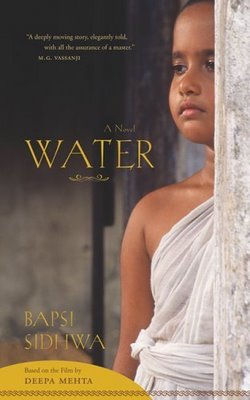
Water: A Novel by Bapsi Sidhwa


Publisher: Milkweed Editions

Published: 2006

Genre: Fiction

Pages: 240

(click on the cover image for a trailer of the movie "Water")


Many movies have been based on books, but it's interesting when, every now and again, there comes along a book based on a movie, like Pakistani writer, Bapsi Sidhwa's "Water: A Novel" which is based on Deepa Mehta's film "Water" which incidently is Canada's entry for the Oscars (2006) in the "Foreign Film Category"

The book opens in pre-Independent, tumultous India. The year is 1938, Gandhi is jogging the Indian people from their apathy urging them to fight against British rule and to relinquish archaic Hindu laws like child marriage, the caste system etc; eight-year old Chuiya (Little Mouse) has just become a widow after the 41-year old man her parents married her off to, succumbed to the deadly thyphoid. Chuiya hardly even remembers being married to the man, but as tradition demands, she has to accompany his dead body to Varnasi, where he will be cremated by the Holy Ghats, after which she is expected to live in a widow's ashram.

The ashram is not a pretty place. The widows are expected to shave their heads, give up all their material possessions and clothe themselves in a plain white cotton sari without the benefit of even a blouse; they live on just one meal a day. On festival days they are given paltry alms by temple-goers and on regular days they are given a cup of rice and a fistful of lentils for every 8-hour session of singing and dancing in temple. For many widows, this was their only means of sustenance.On those days when a widow was too sick to perform, she starved.

As a widow, Chuiya is not allowed to touch non-widows, she has to take care that even her shadow doesn't fall on them because she and her shadow are considered polluted. She is expected to spend most of her time inside the ashram, praying or fasting in atonement for whatever sins caused her husband's death (the Hindus believed that widowhood was the direct consequence of a sinful past life). As widows were not allowed to remarry, 8-year old Chuiya could very well expect to spend her entire life confined to the ashram...

Why were widows treated this way in India of the 1930's? In Brahminanical tradition, a woman is recognised as a person only when she is one with her husband. Outside of marriage the wife has no recognized existence, so, when her husband dies, she should cease to exist. The same thinking is responsible for the barbaric act of Sati (the self-immolation of a wife on her husband's funeral pyre), which fortunately was outlawed in 1846.

The same thing didn''t hold true for the men,however. Men were allowed to remarry, keep mistresses or visit prostitutes. As one Brahmin man in the book justifies it, "Our holy texts say Brahmins can sleep with whomever they want, and the women
they sleep with are blessed."

The novel exposes the hypocrisy and double standards of Indian society in the 1930's, especially where it concerned women, in particular unfortunate widows - the novel and movie explore a dark, morbid side of human society, but it has its tender moments and funny ones, too.

"Water" is a must read for anybody interested women's issues, cultures and customs of India (especially pre-independent India) and in the art of crafting a novel from a film script. It is also a wonderful opportunity to immerse oneself in the delicious language so peculiar to the Indo-Anglian authors of the sub-continent. Bapsi Sidhwa has written a truly stunning novel and I recommend it highly, infact, I would go so far as to call it an "essential" read because even today there are widow ashrams in Varnasi. Their inhabitants may not be as young as Chuiya, but the very fact that they still exist in 2006 should rankle us.

Friday, October 06, 2006

Look what I won...

...at the BAFAB event hosted by booklogged at "A Reader's Journal" - it's Kiran Desai's "The Inheritance of Loss"!


Every participant of the BAFAB event had their own way of celebrating it: Booklogged asked us to name a book we would like to win and she conducted a draw. There was supposed to be just one winner, but the generous person that she is, she pulled three names and I happened to one of the lucky ones, thank you Booklogged!!!

Kiran Desai will be reading at the International Festival of Authors in Toronto later this month and I have tickets - so, ofcourse, I am going to ask her to sign my wonderful prize - what a treat!

Thanks again to booklogged and to all the other booklovers hosting the event. Congratulations to all the other winners,too!

Thursday, October 05, 2006

Return to the Classics

Raindrops on roses, whiskers on kittens...these are a few of my favorite classics!

Wuthering Heights
Jane Eyre
Madame Bovary
Pride and Prejudice
Dr. Jekyll and Mr. Hyde
Anna Karenina
Of Human Bondage
Alice's Adventures in Wonderland

While I have read and reread my favorites, I'll admit it's been a while since I have read anything new from the classics - like I commented to Lesley, who I admire so much for setting herself the "Back to school Classic Challenge", I seem to be on a contemporary literature merry-go-round from which I can't get off!

I have my reading for October all cut out for me, but starting November I would love to add a classic or two to my monthly reading dose. I'd love to hear what your favorite classics are and if you have a favorite publisher.


Booklogged, are you still planning to host a "Back to Classics" challenge? Let me know!

Tuesday, October 03, 2006

The Love of Reading Online Book Fair (Oct 3-5, 2006)

Go ahead, try your luck - open to residents of North America only.

Half of a Yellow Sun: Chimamanda Ngozi Adichie


# Category: Fiction - Literary
# Format: Hardcover, 448 pages
# On Sale: September 12, 2006
# Price: $24.95 (U.S.)

At first glance one might imagine that "Half of a Yellow Sun" (HOAYS), Chimamanda Adichie's second book, is the story of the Nigeria-Biafra war, but really, although the war takes up a huge chunk of the book, it is more the story of a group of Nigerian people and their lives before and during the secession of Biafra. The story is told through the lives of three main characters: Ogwa, the 13-year old servant boy of a revolutionary college lecturer; Richard, an Englishman and a Biafra sympathiser, in Nigeria to study the Igbo people and who falls in love with an Igbo girl and Olanna, daughter of a rich industrialist who gives up a very pampered life to help her revolutionary lover in the fight for Biafara. Ms. Adichie, I believe, very deliberately chose this mix of characters from different stratas of Nigerian society because she wanted to explore the war from the point of view of different classes.

A little about the war:

Nigeria won their independence in 1960, but after claims of fraud, there was a military coup in 1966 mostly organized by the people from South-East Nigeria or the Igbo clan. The Igbos were were thought to have promoted many of their own in the Army at the expense of Yoruba and Hausa officers. Ethnic tensions resulted in the Northerners executing a
counter-coup six months later which led to the large-scale massacres of Christian
Igbos living in the Muslim north, which in turn led to theIgbo people demanding to secede Nigeria to live in Biafra.

Adichie tells the story of the Igbo ("Jews of Africa") people with candor, compassion amd impressive research. I used the word candor to describe her writing because she doesn't soften the realities of the war in order to make it more palatable for her readers. Some of the events described are so graphic, it made me cringe and I had to close the book for a few moments, just to be able to get away from those awful scenes, but, on the whole the narrative is engaging, rich in detail and flows along so smoothly you'll be turning the pages quicker than a bill counter. I especially like how she steeps much of the narrative in the local Igbo dialect - it adds so much to the authenticity of the read. Also, her descriptions of Nigeria, the landscape, culture and the people are so vivid, it creates much curiosity on the part of the reader to knowNigeria better.

Adichie has often been asked why she chose to write a book about the Biafran war as a successor to her Orange Prize (shortlisted) novel "The Purple Hibiscus" and the reasons are personal - both Adichie's grandfathers were in the war and one even died in a refugee camp. Being able to write about the horrors of the war, which has been described by some historians as a genocide, has enabled her to to confront her family's history and the history of her people. Also, she felt it was time for Nigeria to talk about the war, something they are usually loathe to do.

This book is not just for lovers of history or for people who enjoy reading about Africa - its universal lessons of survival, courage, betrayal, infedilty,forgiveness and power make for powerful reading and will leave the reader so much richer.

In closing this is one of those books that engaged me so much I will always be a little envious of anyone about to embark on this wonderful read. Sure, I could read it for the second time, but I am not sure it could have the same magic, wonder and power of the first read.

Addendum: The book's title refers to the sun on the flag of independent Biafra: it was either midway through rising, or (in hindsight), setting before it was fully able to rise.