
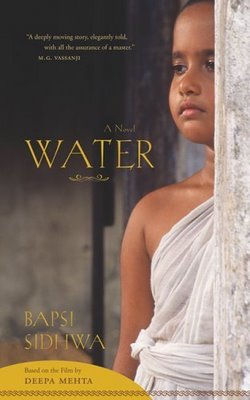
Publisher: Milkweed Editions
Published: 2006
Genre: Fiction
Pages: 240
(click on the cover image for a trailer of the movie "Water")
Many movies have been based on books, but it's interesting when, every now and again, there comes along a book based on a movie, like Pakistani writer, Bapsi Sidhwa's "Water: A Novel" which is based on Deepa Mehta's film "Water" which incidently is Canada's entry for the Oscars (2006) in the "Foreign Film Category"
The book opens in pre-Independent, tumultous India. The year is 1938, Gandhi is jogging the Indian people from their apathy urging them to fight against British rule and to relinquish archaic Hindu laws like child marriage, the caste system etc; eight-year old Chuiya (Little Mouse) has just become a widow after the 41-year old man her parents married her off to, succumbed to the deadly thyphoid. Chuiya hardly even remembers being married to the man, but as tradition demands, she has to accompany his dead body to Varnasi, where he will be cremated by the Holy Ghats, after which she is expected to live in a widow's ashram.
The ashram is not a pretty place. The widows are expected to shave their heads, give up all their material possessions and clothe themselves in a plain white cotton sari without the benefit of even a blouse; they live on just one meal a day. On festival days they are given paltry alms by temple-goers and on regular days they are given a cup of rice and a fistful of lentils for every 8-hour session of singing and dancing in temple. For many widows, this was their only means of sustenance.On those days when a widow was too sick to perform, she starved.
As a widow, Chuiya is not allowed to touch non-widows, she has to take care that even her shadow doesn't fall on them because she and her shadow are considered polluted. She is expected to spend most of her time inside the ashram, praying or fasting in atonement for whatever sins caused her husband's death (the Hindus believed that widowhood was the direct consequence of a sinful past life). As widows were not allowed to remarry, 8-year old Chuiya could very well expect to spend her entire life confined to the ashram...
Why were widows treated this way in India of the 1930's? In Brahminanical tradition, a woman is recognised as a person only when she is one with her husband. Outside of marriage the wife has no recognized existence, so, when her husband dies, she should cease to exist. The same thinking is responsible for the barbaric act of Sati (the self-immolation of a wife on her husband's funeral pyre), which fortunately was outlawed in 1846.
The same thing didn''t hold true for the men,however. Men were allowed to remarry, keep mistresses or visit prostitutes. As one Brahmin man in the book justifies it, "Our holy texts say Brahmins can sleep with whomever they want, and the women
they sleep with are blessed."
The novel exposes the hypocrisy and double standards of Indian society in the 1930's, especially where it concerned women, in particular unfortunate widows - the novel and movie explore a dark, morbid side of human society, but it has its tender moments and funny ones, too.
"Water" is a must read for anybody interested women's issues, cultures and customs of India (especially pre-independent India) and in the art of crafting a novel from a film script. It is also a wonderful opportunity to immerse oneself in the delicious language so peculiar to the Indo-Anglian authors of the sub-continent. Bapsi Sidhwa has written a truly stunning novel and I recommend it highly, infact, I would go so far as to call it an "essential" read because even today there are widow ashrams in Varnasi. Their inhabitants may not be as young as Chuiya, but the very fact that they still exist in 2006 should rankle us.
