Tuesday, August 24, 2010

Saraswati Park by Anjali Joseph

On Sale: 10/08/2010; Format: Trade paperback;  Publishers:  Harper Collins;  Fiction (South-Asian)


Mumbai with its chaos, complexities, concrete blocks housing hundreds of people, cosmopolitan population and where the  richest of the rich and poorest of the poor live side by side, continues to be a very popular city to write about.  Infact, in the last decade or so, there's been a spate of books about the city, "Maximum City" by Suketu Mehta,  "Shantaram" by Gregory David Roberts, "Sacred Games" and "Love and Longing in Bombay" by Vikram Chandra...the more recent one to join the list is Anjali Joseph's "Saraswati Park".

Just the title was enough to draw me to this book.  Saraswati is the goddess of knowledge and the Arts in Hindu mythology and she has always been my favourite deity.  In the book, "Saraswati Park" is the name of a housing complex in a suburb somewhere deep in the heart of Bombay.  The story revolves around  empty-nesters, Mohan and Laxmi Karekar, whose lives are pretty humdrum and unremarkable.  Mohan is a letter writer ( one of those quaint jobs which is almost non-existant today) and from his seat under some tarpaulin near the main Post Office he sits and writes letters for those who are illiterate - anything from heartfelt letters to the completion of bureaucratic forms, while Laxmi is a homemaker. 

When we first meet Mohan and Laxmi their days are mundane with set routines and nothing much happens to alter it.  Both seem frustrated by this mundane existance.  An avid reader, Mohan wishes he could do more than just write letters....his secret desire is to write stories worthy of publication and Laxmi, frustrated by how his dreams make him distant from her turns to the television for company. 

I love how Joseph details Laxmi's frustration with their emotional detachment in this nicely-written excerpt:

"Four of Mohan's shirts, collected this morning from the ironing boys, lay on the bed. She looked at them in exasperation. It was still there, the mild ring of dirt inside his collars, like a smudged pencil line. It wasn't his fault; nothing could be done. She had scrubbed at some of them to remove the mark, but it had been the collar, not the stain, that had begun to despair and fray. It was in these things, which didn't talk or, strictly speaking, have lives, that her days played out: her relationship with the shirts, neatly ironed and folded, was so much more direct that any other interaction these days."

One day the couple receive a call from Mohan's sister lamenting the fact that her son Ashish failed his college exams (due to poor attendance) and would have to retake them (unknown to the family, the poor attendance was due to Ashish's dalliance with a fellow classmate called Sundar).  Since they (Ashish's parents) were being transferred to a city to the north of India, would it be possible for Ashish to stay with Mohan and Laxmi for the year?  Mohan and Laxmi readily agree and soon the focus of the story moves to 19-year old Ashish - his life, his friends, his fears, his relationships, his secrets.   Despite there being "secrets" in this novel it has a very calm tone with a quietness and melancholy that emanates like faint perfume from every page, making it linger on with the reader long after the last page has been read and the book closed.

For those of you who grew up in Bombay (mid '80's)  this novel will be especially precious because of the author's wonderful observations and descriptions of this wonderful city I call home.  The strength of this novel is its everyday observations of a couple approaching their twilight years; of a youngster just starting to find his feet in this world and discovering his sexuality and last, but not least, of a city that is home to atleast 14 million people and who expands (like a rubberband) to accommodate thousands more everyday.

It is also a book about family love and obligations; growing old together, about love and loss and goodbyes.  All these may seem like heavy topics but they are handled deftly and delicately by Ms. Joseph and there is none of that masala or twists and turns that we have come to associate with other Bombay novels - just an initmate journey into the lives of everyday people who happen to live rather quietly in this bustling metropolis.   As much as I liked the other Bombay novels mentioned above, none of those plots seemed real to me.  My Bombay was like the Bombay one finds in Saraswati Park...of trees and birds; ordinary  people, school, college, the market, weddings, neighbours, old books, corner shops and so on.  This novel is a celebration of everyday life and seeing some beauty in it.

I'd like to close with a beautifully written passage found on page 253.  This is when Ashish is getting ready to leave for California for his future studies.  This passage resonated so much with me because, I, too, had to bid Bombay farewell around the same age Ashish did and it hurt so much:

"...he felt melancholic;  finally he understood what life was like, the meetings and partings it entailed.  It was a thought that only made him more attached to his life and the people in it.

From his window seat he looked with hungry eyes at the dirty worlds next to the tracks:  the brigtly painted shacks, the grubby faced children, the ugly concrete tower blocks, the smells...

It was his city, his world; it might be imperfect but it was home.  Yet he knew that only his imminent departure nurtured this sudden passion for Bombay which sometimes was a neutral environment in which he existed, and at other moments felt like a trap he'd never escape."

Tuesday, August 17, 2010

Pearl of China by Anchee Min

The month of May coincidentally saw the publication of  two books, both of which tell the story of  the much-loved American writer, Pearl Buck's life.  Anchee Min's "Pearl of China" is the lighter one of the two and an excellent novelisation of Buck's early- to- mid years in China, but those wanting a more indepth version of Buck's life would likely be satisfied with Hilary Spurling's biography "Burying the Bones".

The story of how Anchee Min came to write this fictional account of Nobel Prize-winning author Pearl S. Buck’s persecutions during Chairman Mao’s Cultural Revolution, is very touching.  When Anchee Min was still a school girl in Shanghai, China, she was asked to denounce Pearl Buck.  Anchee Min had no idea how to go about denouncing someone she had never met or whose books she had never read (her request to read Buck's "The Good Earth" before writing the denouncement had been turned down).  Fast forward to 25 years: at one of Anchee Min's readings in a bookshop in the US a lady pressed a copy of "The Good Earth" into Anchee Min's hands and stated that Pearl Buck had made her love the Chinese.  In her hotel room that night, Anchee Min finally got a chance to read "The Good Earth" and was so moved and felt so guilty for denouncing Buck all those many years ago she decided to write this biography as a means to atone for that sin.

I have always enjoyed anything written by Anchee Min.  This lady has such a flair for historical fiction, she makes it fun, informative and so,so real, you never forget a thing.  Also, she is a meticulous researcher, so although her work is labeled fiction, chances are that a lot of the details are true.  For instance, in the case of Pearl Buck's life, Anchee Min, apart from pouring over public records and Buck's personal correspondence, she also visited Pearl Buck's family home in Chin-Kiang, China and interviewed families that had contact with Pearl's family.

The character, Willow, also the narrator of this story, is an amalgamation of the friends that Pearl had in China.  Through Willow we learn that Pearl's father Absolam was a missionary to China and that his whole life was spent trying to convert Chinese people to the Christian faith.  His long-suffering wife Carie was terribly homesick for America but because Absolam refused to leave China she stayed on too and her work with the Chinese people made them so indebted to her that many of them converted to Christianity just to show Carie their gratitude.

Ever since she was very young Pearl wanted to be Chinese and not American, so much so, she had her Chinese nanny make her a crocheted, black cap which she would wear all of the time to keep her blonde hair covered.  She spoke Chinese like a native and even preferred to eat Chinese food over anything western.  Pearl and Willow became friends after Willow's father, a beggar, decided to join Absolam's church for the free food. Later, he was genuinely converted and became a Christian.

Pearl and Willow remained good friends despite Pearl's various long trips to the US and Willow's unhappy marriage to a man who was several years her senior.  When Pearl came back for a longer stay (married and with a mentally-disabled child, Carol) their friendship became even stronger although it was not without its trials.  You see, for a while both Pearl and Willow were in love with the same man: Hsu Chih-mo who was considered to be China's Shelly. When it was obvious that Hsu Chih-mo loved Pearl, Willow decided to let go of him.   Part of Pearl's attraction to Hsu Chih-mo was the fact that he was a Chinese man who was unafraid to speak his mind...his passion for poetry and life really appealed to her, but also, her American husband Lossing Buck didn't seem at all interested in their marriage and soon deserted her for a young Chinese woman called Lotus.

Willow in turn married Hsu Chih-mo's friend and admirer who worked in  the Communist party. Those were very trying times for Willow as Mao and especially, Madame Mao seemed to have made it their mission to dishonour Pearl Buck and turn her into an enemy of the Chinese people.  Knowing Willow was Buck's friend they asked her to denounce Buck as a cultural imperialist, something Willow refused to do and  was imprisoned, tortured, starved and set to cleaning sewers (something that is very believable if you've read historical accounts of lives during Mao's rule of China)

 "Pearl of China" provides a quick glimpse into Chinese history in the 20th century.  We are taken through 80-plus years of China's history from the Boxer Rebellion to the Japanese invasion;  the war between the Nationalists and Communists and the establishment of the Mao era and on to the Cultural Revolution and China's opening to the West and surprisingly none of it feels rushed...I guess that is a testament to the great skill of Anchee Min as a fictional writer of history.  Her descriptions of places, people and time are always so engaging, you hardly notice the passing of the years!

Pearl Buck's life has been the subject of  many books but most of her biographers have been Westerners. Anchee Min hopes her book will allow readers to see how Pearl Buck is viewed in China by the Chinese people.   You come away from this book realizing the extraordinary hold China had on one of the most influential women of the 20th century, and how much she empathized with the Chinese people (especially the peasants).  She was the first author to write about the Chinese peasants and anyone who has read "The Good Earth" knows she did so movingly, empathetically and powerfully.  Not only is "The Good Earth" a very moving read, but one could say it was a very powerful force in helping Americans move beyond the bigotry, contempt and ignorance with which they had long viewed the Chinese.

Had Pearl Buck not been forced to leave China for the US during the Boxer Rebellion I feel certain she would have lived in China for the rest of her life. She always, always wanted to return to China and forty years later she came close to returning (as part of Nixon's entourage on a State visit to China in 1972) but Madame Mao saw to it that Pearl was refused a visa. Pearl died the next year at home in Pennsylvania. I wouldn't be at all surprised if she died from a broken heart.

If "Pearl of China" whets your appetite for more of Pearl Buck (and I have no doubt it will), I would highly recommend reading Hilary Spurling's " Burying the Bones"....I heard an audio version of the book and was very satisfied.

Friday, August 06, 2010

Girl in Translation by Jean Kwok

Read by Grayce Wey
Category: Fiction
Published by: Penguin Audio
Format: Audiobook
On Sale: April 29, 2010

Synopsis provided by Publisher:

Introducing a fresh, exciting Chinese-American voice, Girl in Translation is an inspiring debut about a young immigrant in America, a smart girl who, living a double life between school and sweatshop, understands that her family’s future is in her hands.

When Kimberly Chang and her mother emigrate from Hong Kong to Brooklyn squalor, she quickly begins a secret double life: exceptional schoolgirl during the day, Chinatown sweatshop worker in the evenings. Disguising the more difficult truths of her life—the staggering degree of her poverty, the weight of her family’s future resting on her shoulders, her secret love for a factory boy who shares none of her talent or ambition—Kimberly learns to constantly translate not just her language but herself, back and forth, between the worlds she straddles.

Through Kimberly’s story, author Jean Kwok, who also emigrated from Hong Kong as a young girl, brings to the page the lives of countless immigrants who are caught between the pressure to succeed in America, their duty to their family, and their own personal desires, exposing a world we rarely hear about. Written in an indelible voice that dramatizes the tensions of an immigrant girl growing up between two cultures, surrounded by a language and a world only half understood, Girl in Translation is an unforgettable and classic novel of an American immigrant—a moving tale of hardship and triumph, heartbreak and love, and all that gets lost in translation.

My thoughts:

It's been so long since I've read either an immigrant or a coming-of-age story and this sweet little book by Jean Kwok more than made up for the long wait.   Our little heroine, Kimberly or Ah Kim as her mother calls her, has to endure a lot: a roach and mouse-infested home without any heating in Brooklyn; dire poverty; the embarrassment of being a "FOB" and not knowing a word of English; having to work in a factory/sweat shop after school and having the responsibility of guiding her Chinese mother through an English-speaking world.  What makes this even more complicated is she has to tread the tightrope between the two cultures and balance the Chinese desire for filial devotion and obedience with the American spirit for independence with the proficiency of a professional tightrope walker, and all this at the tender age of eleven!  But she possesses such spirit, such earnestness, you fall for her immediately.
Some reviewers have complained that the writing is too plain, but really, I think the "plainness" suited the story.  After all, this is an immigrant 11-year old girl, a non-speaker of the English language, surely one can't expect her to employ literary acrobatics?  The simple speak provides an air of authenticity to the story....what also provides authenticity is the fact that the author herself had a similar childhood.  In an interview with The Buzz, this is what the author had to say in answer to the question, "To what extent is the book autobiographical?"

It was certainly inspired by my own life, and by the worlds I had seen. My family moved from Hong Kong to New York when I was 5 years old and we, like Kimberly Chang and her mother, needed to start all over again. We began working in a sweatshop in Chinatown, which was filled with small children like myself. And we did live in an apartment without central heating, where we needed to keep the oven door open in order to have a bit of warmth through the bitter New York winters. Like Kimberly, I had a talent for school. I was also tested by a number of exclusive private schools and won scholarships to them, yet I was also accepted by a public high school for gifted children, which is where I went. After that, on a similar path to Kimberly’s, I was accepted to Harvard.

This story opened my eyes!  I didn't know for instance that so many people from Hongkong moved away   when the take over by China was imminent.  Infact, we (my family and I) were in Hongkong during the transition (1997) and we did notice a huge influx of peasants from the mainland but we didn't hear of anyone (except for the British, some expats and Chinese with British passport-holders) leaving the colony.  Also, I didn't know New York had sweatshops that employed children especially as recently as 1997!!!  That came as a huge shock to me. Something we don't talk about a lot, but which a lot of immigrants experience, is the exploitation by a family member.  In the novel, Kimberly's aunt, Paula, gets Kimberly and her mother to work for peanuts at her garment factory to pay off the money she (Paula) spent on bringing them to the United States.  I know of people here in Canada who are sponsored by relatives and then the very same relatives make them work in the home as cooks or nannies for little or no pay. Makes me realize that freedom is relative, you can be as much of a slave here in North America as in the country you are running away from.

What I did know and what the author reiterates in her story is that in the early '90's, racism due ignorance was alive and thriving. Kimberly, was picked on constantly for looking and sounding different. I am so glad that a "zero tolerance" dictate on bullying and racism has been put into place now.  About time!

Kimberlee was an extremely bright student.  One might be tempted to think of that as an Asian stereotype, but from what I see around me, Asian students are bright because they have such a wonderful work and study ethic.  Many of my daughters' friends, the Asian ones, keep long days at school and even their extra curriculars involve some form of academics or music.

This is a beautiful coming-of-age story, one that will definitely touch your heart and has been compared to "A Tree Grows In Brooklyn".   In the print version of the book Kwok cleverly employs phonetic spellings to illustrate Kimberly's growing understanding of English and wide-eyed view of American teen culture, the audio version (which is what I used) is performed by Grayce Wey, who is wonderful at giving a Chinese-American intonation to the character's voices thus bringing them alive for the listener!   The book is written in the first person narrative from the point of view of Kimberly though at times I couldn't help wishing that I had her mother's perspective too.  Kimberly's mother, who was a gifted violinist back in Hongkong was forced to lower her station in life once her much-loved husband passed away.  It would have been wonderful to read about her life in the US and her crashed American dream from her perspective as well.

Finally, besides being a wonderful coming-of-age story this is also a beautiful love story, one that doesn't quite end with stars in the eyes, but which will burrow its way into your heart and stay there a long,long time.

Tuesday, August 03, 2010

The Lovers by Vendela Vida

 
Formats:  HardcoverPublishers: Harper Collins Canada


I am always excited to hear Vendela Vida has a new book out.  Her stories are usually set in exciting locales and her characters are strong women determined to navigate life on their own after a tragedy befalls them. In  "And Now You Can Go", partly set in the Phillipines, a young woman talks a suicidal gunman out of killing them both;  in Let the Northern Lights Erase Your Name,  set in Lapland, the crime is rape; and in "The Lovers" it is an accident that drives our 53-year old protagonist (Yvonne) to return to Datcha, a coastal village in Istanbul.  Spot the common link?  Rage and violence and then a trip to a foreign land in search of oneself. Apparently, this is deliberate and Vida is very conscious of creating a trilogy of sorts with these three titles.  Now, back to the story:

After Yvonne loses Peter, her husband and love of her life, to a "hit and run", she decides (after a period of mourning) to return to Datcha, a coastal village in Istanbul, which is where they had their honeymoon twenty-eight years ago.  She was scheduled to stay there for a week until the cruise ship that her son and his wife were sailing on, picked her up from Datcha. Her reasons for returning to Datcha are clear: she wants to know if the grief she feels at Peter's death can be obliterated by the good memories of their honeymoon...
Like with most places, time hadn't been real kind to Datcha and everything she saw, the beach, the houses, the roads, just seemed shabbier and less vibrant..."the beach was filthy. Small plastic bags, gelatinous in the sun, had been deposited by the tide on the strand."  
and
“Half the restaurants had been shut down. The remaining ones displayed sick-looking fish on beds of crushed gray ice. With soiled rags, waiters shooed away mangy cats trolling for food. A sprinkling of tourists speaking German sat outside the cafes, their skin sunburned to a peculiar shade of orange.”

Still, she stays on in a nice house that she rented from Turkish businessman Ali Celik and soon became friends with his wife Ozlem.  Ozlem and Ali were in the process of getting a divorce and Yvonne soon became Ozlem's sounding board for all the wretchedness that was going on in her marriage.  But it was a symbiotic relationship because in Ozlem Yvonne found someone who could show her the ropes and a non-judgmental curiosity about her life with Peter.

Along with Ozlem and Ali, other people that pass through Yvonne's life as she holidays in Turkey is a 10-year old boy who reminds her of her son Matt when he was small.  Ahmet's grandmother is the owner of of one of the resorts in Knidos but because she is too busy for the boy, Ahmet spends all day on the beach collecting shells from the Aegean Sea....the lonely figure he cuts on the beach is what endears him to Yvonne and soon she is befriending him much to the dislike of some of the locals, until tragedy strikes and she is forced to face their hatred head on.

There is undeniably a very melancholic air to the book with a few menacing details, but one that is nonetheless uplifting.  I will admit to taking a while to get into the book - I found the protagonist a little too gloomy with a penchant for navel gazing and/or looking backward - but once I was over that hump, I was able rediscover the Vendela Vida magic. Because it's more of a novella and has very interesting descriptions of Turkey, I will even recommend this as a great summer read!

What you take away from Vendela Vida's "The Lovers" will depend on what stage of life you're at.  A young person reading this is likely to have a very different view of the book than a middle-aged woman. Regardless of the age, however, I feel quite certain that every reader will enjoy the book and the way it explores memories.  The title might be a little misleading though, because although there are many "lovers" in the book, including an owl pining for its mate, you realize that Yvonne herself seems lost and unanchored and probably, saddest of all, she concludes that her marriage it not what she thought it was.

I am very grateful to Harper Collins, Canada for making a copy of this book available for me to read.

Tuesday, July 27, 2010

Hotel Iris by Yoko Ogawa

Picador, March 2010

"Hotel Iris" by Yoko Ogawa is one of those novels you want to read with one eye closed.  In other words, the subject matter can be bizarre and grotesque and at the same time, you cannot stop reading because the story, the plot and the mood is so compelling, it draws you in almost against your will.

Our protagonist is 17-year old Mari who works in her mom's rundown hotel, "Hotel Iris" at a seaside resort in Japan.  (Well, atleast I think it's Japan but because the details of where the place is is so sparse it could be any seaside town, anywhere).

The novel opens on the cusp of Japan's hottest summer and also the busiest time of the year for Hotel Iris.  One evening as Mari tends to the front desk a commotion breaks out in Room 202 and soon she sees a "lady of the night" bounding down the steps in fear and anger and yelling out to the occupant in the room who it seems was intent on having rough sex with her.  Mari catches a quick glimpse of  the middle-aged customer as he leaves the room and throws two bills on the reception desk on his way out. 

Some days later Mari sees him again and to her great surprise she realizes he is not the commanding figure she thought he was when she saw him in the hotel that night, instead she sees he is a middleaged- to- old man (almost 50-years older than her), about her height and frail-looking.  She has this urge to follow him for not only is she curious about him, but on page 11 she tells us her thoughts upon hearing the customer shouting back at the prostitute in the hotel "I was confused and afraid, and yet somewhere deep inside I was praying that voice would someday give me an order, too."

You know how they say, be careful what you wish for?  Well, Mari's sinister wish came true.  She meets the gentlemen (we are never told his name) in town again and finds out  he is a translator of Russian pamphlets, medical documents and administrative papers and in his spare time he is translating a Russian novel whose heroine is named Marie.  The translator lives in an old isolated house on an island which is only accessible by boat and it there in his house that these sado-masochistic trysts between him and Marie take place. Note the restraint in Ogawa's writing with the prose being refined yet penetrating:

"He had undressed me with great skill, his movements no less elegant for all their violence. Indeed, the more he shamed me, the more refined he became — like a perfumer plucking the petals from a rose, a jeweler prying open an oyster for its pearl."

The narrator describes himself as a widower; a rumor in town says he murdered his late wife. Mari does consider the thought that the narrator might be a murderer but the thought seems to excite her as much as scare her.

Although the reader might wish to feel sorry for Mari, it is a little difficult to do so given that she really seems to enjoy these torture sessions. One is not entirely sure why though. Could it be that it adds some excitement to her otherwise dull life? Or is it because in some twisted way these interactions with the narrator make her feel loved  (something her mother seems incapable of doing?), or, does Mari feel this is what is due her because of her damaged sense of self?  Really not sure what her trigger is.  Perhaps it is none of the above and that she enjoys the pain purely for its physical sensation, after all, isn't pain supposed to release certain neurotransmitters, including natural painkillers like endogenous morphine?

Adding colour to this mouldy seaside resort story are a motley crew: Mari's mother (again nameless) whom I have already mentioned ( a thoroughly dislikable woman who works Mari like a slave without a single day off); a kleptomaniac maid; a blind guest and the translator's nephew who is tongueless and a student of architecture who Mari finds rather interesting.

This book was written in 1996 but was only recently translated from the Japanese into English by Stephen Snyder. Ogawa has won accolades in Japan for the two novels she wrote previous to this one, "The Housekeeper and The Professor" and "The Diving Pool". Ogawa's writing style is sparse and minimalistic, but she is so good at setting moods, providing a sense of place and manipulating a readers' senses with her spare words, that I almost want to say she is the writer equivalent of Alfred Hitchcock. Also, for all the torture, lust and obsessive behaviour that takes place between the pages of this book, the narrative tone comes across as being rather detached, even clinical, but because it is in sharp contrast to the behaviors it actually makes the read that much more interesting.  This is a bleak novel but exquisitely imagined.  I cannot wait to read Ogawa's previous two books.

Saturday, July 24, 2010

Happy 75th Birthday Penguin Books (and a giveaway!)


July 30th marks the official 75th anniversary date for the launch of Penguin Books, and Penguin is going all out to celebrate this summer. For a list of festivities,stories and events, go here. 

Penguin’s founder Allen Lane started the paperback revolution with that little flippant but dignified Penguin (his secretary came up with the name and he sent another colleague off to the zoo to make sketches). One year later, 3 million Penguin paperbacks had been sold. Today, the  Penguin imprint alone has over 4000 books in print. To learn more about their history, see here and here. 


Penguin has generously offered me the chance to give some lucky reader a Penguin book to commemorate their 75th anniversary.  I was asked to pick two titles from a list of 75. One was for me to keep (thank you Penguin) and the other is to give away.


Choosing one title out of seventy-five choices was no easy feat indeed, but after a little deliberation I decided to go with "Tortilla Curtain" by T.C. Boyle. 


I read "Tortilla Curtain" many years ago and the plight, misery and yet courage of the Mexican couple- protagonist, Candido and
America, never ever left me.  Today with Arizona's  immigration bill on everyone's tongues I thought this would be a very topical read.  If you're on the fence regarding this bill, believe me, this book is going to help you make your mind up, one way or another.


I include a synopsis of the book courtesy the publishers:

Topanga Canyon is home to two couples on a collision course. Los Angeles liberals Delaney and Kyra Mossbacher lead an ordered sushi-and-recycling existence in a newly gated hilltop community: he a sensitive nature writer, she an obsessive realtor. Mexican illegals Candido and America Rincon desperately cling to their vision of the American Dream as they fight off starvation in a makeshift camp deep in the ravine. And from the moment a freak accident brings Candido and Delaney into intimate contact, these four and their opposing worlds gradually intersect in what becomes a tragicomedy of error and misunderstanding


And here is a slightly more detailed run down of the book from Wikipedia.

And one from the Penguin Reading Guide.


In order to win a copy simply write a comment telling me you would like to be included in the draw.  The draw will take place on 02 August and you will be notified here, so please check this space.  Thanks!


******UPDATE********


And the winner is, "Sai Speak"


Congrats Sai, I will be e-mailing your for your address!!!  Hope you like the book!

Thursday, July 22, 2010

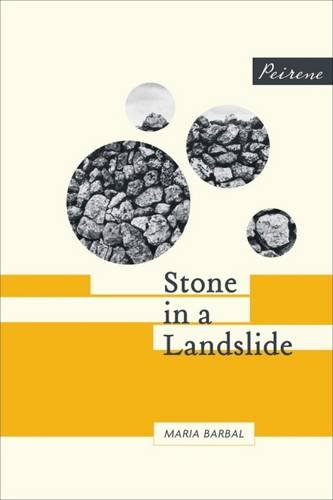
Stone in a Landslide by Maria Barbal

Publication:   Peirene Press (2010), Paperback, 108 pages
ISBN: 9780956284013

Today I place in your cupped hands a gem of a book titled "Stone in a Landslide" by renowned Catalan writer, Maria Barbal.   The book, which was originally written in Catalan and translated into English by Laura McGoughlin and Paul Mitchell, narrates the story of a 13-year old Catalan girl, Conxa, who is sent to live with her childless aunt Tia in a different village on the Catalan Pyrenees at the beginning of the last century. 

The story is not extraordinary, in that, she traces her life at her aunt's house (her aunt and uncle are farmers and although they are comfortably off, the work is physically grueling), her first love Jaume who she later marries, her children, the onset of Spain's civil war and how they were taken prisoners for a while for Jaume's involvement with the Communist revolutionaries and finally her twilight years as a grandmother in Barcelona, hardly needed, rarely listened to.

So like I said, the story itself is not all that different or remarkable, what puts this book at the top of my reading list (and you will thank me if you place it at the top of yours too) is the narrator herself...her voice..her ability to tell a tale and to mark a passage of time with so much credibility, muted emotion, an enviable conciseness (the novel is only 126 pages) and a surprising gentleness and yet, as you read, the story and her emotions are so fiercely felt, it leaves you deeply affected. 

Also, Barbal writes the way most of us would write should we look back on our lives....she doesn't bother herself or the reader with the big events that went on around her, rather it is the little everyday events that fill her book.  When I look back on my life, I find that I have forgotten so much and the events I do remember are the small, everyday things and if  I were to recount those, I am sure I would find many who would relate to what I was saying.  And that's what Barbal does...even though she is narrating the story of a woman who lived in a different century with a completely different background from most of us, her way of telling this tale has a certain timeless quality about it which I enjoyed very much.

"Stone in a Landslide" is published by Peirene Press in the UK who do a fabulous job of publishing contemporary (translated) European Literature.  "Stone in a Landslide" was first published (in Catalan) in 1985.