
 Director: Dr. Chandra Prakash Dwivedi
Starring: Urmila Matondkar, Manoj Bajpai, Priyanshu Chatterjee, Sanjay Suri, Sandali Sinha, Ishaa Koppikar, Kulbushan Kharbanda, Lillette Dubey, Farida Jalal, Alok Nath and Seema Biswas
Saw this wonderful movie yesterday. Based on well- known Punjabi writer Amrita Pritam's novel "Pinjar" (Skeleton), this visually beautiful, emotionally stirring and historically sound movie had me glued to the TV screen for the full length of the film (unusual for me, I usually take lots of breaks when watching a Hindi movie.)
It has been well documented that the Partition (the division of India along religious lines into India and Pakistan by the ruling British in 1947) was the single largest uprooting of people in contemporary history and where atleast a million people lost their lives, not surprisingly,it (the Partition) has perhaps been the most widely- explored subject in Indian cinema however, what makes the film "Pinjar" different is that it deals with a practice that unfortunately became quite common during the partition of India - the abduction of Hindu, Muslim and Sikh women (usually brides-to-be) , by men from religious communities other than theirs and being forced into marriage with these men. These abductions and forced marriages took place as a means to "settle scores" between enemy and aggrieved parties (religious strife was rife in the months leading up to the Partition of India).
Sleeping with the Enemy
The unlucky girl not only had to bear the misfortune of marrying her kidnapper and bearing him children, but also, she was made to change her religion to that of her husband's. After Independence, the authorities would try to arrange the repatriation of a rescued bride to her home, but the family of such a woman were very reluctant to take her back, for having borne the children of the "enemy" she was a "fallen" woman and could bring great shame upon the house. There are no reliable figures, but social workers at that time put the figure of abducted women at 75,000 to a 100,000.Scores of vulnerable women committed suicide or were killed by their own menfolk to stop themselves from falling into enemy hands.
The Film
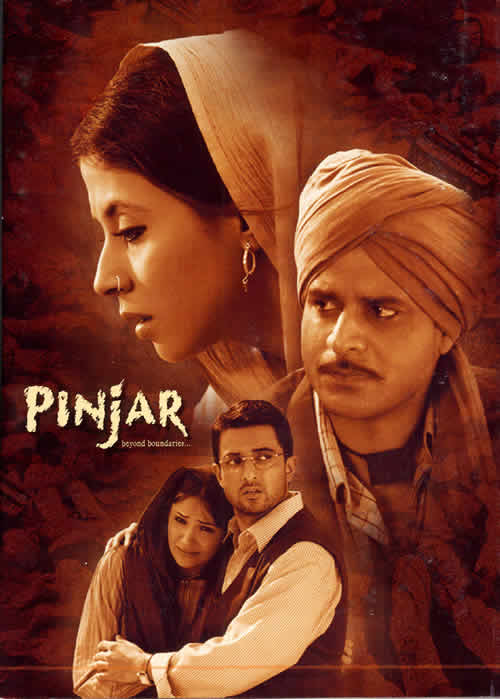 The protagonist of Pinjar is Pooro, a Hindu girl. On the eve of her wedding she is abducted by a Muslim man (Rashid) who was pressured by his family to avenge the kidnapping and rape of his aunt by Puru's uncle many years before. Puru is devastated at first, but after being rejected by parents and realizing that she only has Rashid (who fortunately has fallen in love with her), she slowly settles down in her new life and becomes a kind of a woman's activist - taking up the cudgels for women weaker than herself. I won't give away anything more about the movie, except to say, be prepared to be moved.
The book:
I haven't read it yet, but here's the opening lines of the nouvella, courtesy Amardeep Singh
"The sky was a colorless grey. Pooro sat on her haunches with a sack spread beneath her feet. She was shelling peas. She pressed open a pod and pushed out the row of peas with her finger. A slimy little slug stuck to her thumb. She felt as if she had stepped into a cesspool; she ground her teeth, flicked off the slug and rubbed her hand between her knees.
Pooro stared at the three heaps in front of her: the empty husks, the pods, and the peas she had shelled. She put her hand on her heart and stared off into space. She felt as if her body was a pea-pod inside which she carried a slimy white caterpillar."
 |
Addendum: Nomadica suggested I watch "Khamosh Pani", a Pakistani movie with a similar theme and I am so glad I did. The movie explores the life of one of these abducted women - it's definitely well worth a watch!
