Thursday, May 03, 2007

"Kriti 2007" South-Asian Literature Festival, Chicago

I just got back from "Kriti" the South-Asian Literature Festival held in Chicago at the University of Illinois and boy, I'm so glad I went! Kriti is a four-day event using panel discussions, readings, music, storytelling, dance,workshops, movies and more to celebrate South Asian and diaspora literature. This year's guest of honor was Anita Desai. I attended as many discussions as I could but since the program was choc-a-bloc with events it was physically impossible for me to attend them all. It would be a herculian task for me to include a full write-up on each discussion that I attended so I am just going to give you what I thought were the highlights, with an introduction to each panel taken from the official "Kriti" site.


Ok, here are some of the panels and discussions:

Contemporary South Asian Literature in the World:
How does South Asian writing shape the way in which South Asians are regarded by the world? Does it facilitate the stereotyping of individuals? Does it open up new concepts to readers? How are local South Asian and diaspora writers perceived by international (especially Western) readers?

Note: Wasn't able to attend this one but would love to hear from anyone that did. Or, if you are a Western reader and would like to talk about how Indian literature has influenced the way you think of India or the Indian people, please feel free to chime in.


Class Issues in South Asian Literature:

Authors like Hanif Kurieshi and Monica Ali deal with middle class and working class English life from an immigrant perspective, while Jhumpa Lahiri's characters live in a financially comfortable, destined-for-the-professional world. How visible are class issues in South Asian literature? Are comfortable middle-class stories more likely to be published (and celebrated)? Do immigrant upper-middle- class readers become uncomfortable when asked to admit the existence of working-class South Asians?

Note: Since one of the panelists was unable to attend, this ended up being a very informal discussion with Deepak Unnikrishnan and about 4-5 of us. We discussed how many South-Asian writers are not familiar with the working classes (or lower classes) hnece making it difficult for them to write about it. In India, very often, someone from the working class might not be educated enough to write a book and if they do it is quite possible that they will write it in a regional language which unfortunately does not have a very wide audience. A need for more translations therefore exists.


Reading: Monica Pradhan "The Hindi-Bindi Club"

Note: Felt really sorry to have missed this reading because a novel with recipes is my favorite kind of book. I definitely intend picking it up. Click on the title for more info.


Politics and Writing: A Panel and Open Discussion

Writers discuss their goals in writing about politics. (Is any writing not political?) Are they attempting to create change in the world? What changes would they like to see? What have been the visible effects of their work, if any? Should writers be political on a large-scale? What are the inherent dangers of that work? A facilitated open discussion of the ways in which writers engage political issues in their work, and the ways in which readers respond to those issues.
(facilitated by a representative from the South Asian Progressive Action Collective)

Note: Great discussion especially as the four writers, Deepak Unnikrishnan, Sita Bhaskar, Anil Menon, Sankar Roy and Archana Chowhan had very different viewpoints on what constitutes a political novel. Sci-fi lovers look out for Anil Menon's book,`The Beast With Nine Billion Feet'

Dirty Laundry:

There is a clear market in the West for a certain kind of expose/ pathos story from South Asia: child prostitutes, wife beating, widows in Brindhavan, untouchables, street kids, etc. When does exposing an evil move over into exploitation? What responsibilities does the writer have (if any)?

Note: I really wanted to attend this one, but couldn't. Here's an appeal to anyone out there that might have done...would love the salient points of this discussion because I truly believe that a lot of Indian writers are pressured to use exoticism in their books in order to make it more appealing to a Western audience.


Creative Nonfiction:

To what extent are we willing to expose ourselves? Do we have the right to expose the lives of our family and friends? Is the need to tell a true story, to be honest, more important than the need to consider the feelings of others? And what happens when you're not sure you're remembering the story right to begin with? How much freedom do you have to change the details and still call it nonfiction? Writers discuss the challenges of writing creative nonfiction.
Panelists: Hari Lamba, Sushil Nachnani, Visi Tilak and Hemant Mehta.


Notes: This was a particularly interesting discussion. Most of the panelists were in agreement that pure non-fiction can be hard to write because, 1. lots of fact checking needs to be done, 2. Memory is such a subjective thing and no two people will see the same incident in the same way (this applies mostly to a memoir) 3. non-fiction as a genre doesn't sell as well as fiction. Hence most writers and publishers are more comfortable with the genre of "creative non- fiction" where although most of the facts are true, there are certain artistic liberties that are taken with the facts, turning it into a much more entertaining read. The panelists were also in agreement that anecdotes are a necessary component of creative non-fiction.


Hemant Mehta, author of "I Sold My Soul on Ebay: Viewing Faith Through an Athiest's Eyes" was particularly interesting and I definitely intend buying his book ...it should be a lot of fun to read.


Sex and the Word:

In recent years, more and more South Asians have started writing explicitly around sexuality. Mary Anne Mohanraj, Ginu Kamani, the authors in _Desilicious_, the participants in _Yoni ki Baat_, and many performance poets all explore the sexual arena. What are the challenges of working with this material? What are the rewards? Are you willing to read an erotic story? How about in public, on a bus or train? Do you take the books off the shelves when your parents visit? Authors and readers discuss the pleasures and problems of writing and reading sex.
(Panelists:Visi Tilak, Mary Anne Mohanraj (m.), Sharmili Majmudar)
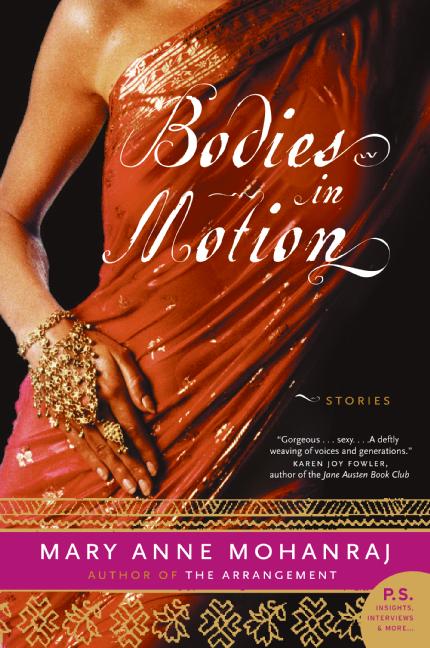

Notes: This was another eye-opener of a discussion. It made me realize that because our South-Asian society is so sexually repressive it is a very difficult road for writers of erotic fiction, especially if they are women. I also learned that when it comes accepting erotic fiction, readers are more likely to want to read stories by women rather than men and that many men have to use aliases if they want their stories published. After the discussion we got MaryAnne Mohanraj to sign our copies of her book "Bodies in Motion".


Making Cooking a Priority:

Join cookbook author Alamelu Vairavan for a discussion of how to add easy-to-prepare, flavorful dishes to your daily life, incorporating more vegetables, dals, and spices in your cooking repertoire. Hear about the history of spices, how to assemble a basic spice pantry, availability, cost, and how to prepare dishes in thirty minutes or less -- plus the story of how aromas and friendship turned into cookbooks!

Note: Really enjoyed this talk. Alamelu is a passionate foodie and it was an absolute delight to hear her talk about how she goes about introducing South Indian food to a western audience. I was very tempted to buy her book because it holds over 150 recipes with a nutritional analysis for each one; she has also managed to condense each recipe to no more than 4 steps which is perfect for our busy lives.


Recommended Children's and Young Adult Literature:

Writers and editors discuss what writers they love to read, and what makes a story stand out as exceptional children's literature.
Sandhya Nankani (m.), Rachna Vohra, Marina Budhos

Notes: A very helpful discussion although I did miss the first 30 mins of it. Found some very useful book recommendations for my 12-year old. Thank you ladies!

P.S. Sandhya, I came looking for you after the discussion but you had gone into another one so I missed meeting you...sorry!

*********************

Another highlight of my Chicago trip was being able to meet my lovely blogger friend, Laura of "Maude and Mozart" who took me on a beautiful drive past the stunning Chicago waterfront. It was great meeting her, she is such a bubbly, happy person. She very generously gifted me three books that I am eager to delve into as soon as time permits. Thank you, fabulous Laura!

Thursday, April 26, 2007

Leaving on a Jet Plane


But, Im leavin' on a jet plane
Don't know when I'll be back again
Oh babe, I hate to go
~John Denver

Well, I do know when I'll be back...see you Tuesday or Wednesday. Take care everyone!!!

Wednesday, April 25, 2007

PROVOKED (the movie)


Director:
Jag Mundhra

Cast: Aishwarya Rai,
Miranda Richardson, Naveen Andrews,
Nandita Das, Robbie
Coltrane

Release: April 2007


In 1989, Kiranjit Ahluwalia housewife of Indian(Punjabi) descent living in London, set fire to her husband, Deepak, as he lay in a drunken stupor in the bedroom of their house in Southall, London. Kiranjit admitted to killing him in self-defence (she was afraid for her life after he came close to killing her several times in their abusive 10-year marriage). She was sentenced to a life in prison because the judge ruled that self-defence could not be used in her case as her last physical beating from her husband occured more than two hours before the killing signifying that the murder was premeditated and not in self-defence....


The rest of the review is on my Anthropologist Wannabe blog.

Monday, April 23, 2007

Restaurant Tag and "On Chesil Beach" by Ian McEwan

On Chesil Beach by Ian McEwan

Category: Fiction

Format: Hardcover, 176 pages

Publisher: Knopf Canada


The year is 1962, the place, England. Florence is a prim and proper young lady, a violinist from an affluent family who loves Edward, a history graduate from an ordinary background, and is looking forward to marrying him and spending a lifetime together, but there is one small problem...Florence is repulsed at the thought of consumating the marriage!

I'm surprised she didn't think to talk this over with Edward before the wedding, but then again, this was 1962, before the sexual revolution of the '60's and I am sure it wasn't easy for people to discuss these issues then. ALso, she naively believed that loving your partner should be enough to make the marriage work. Edward, not having had too much experience himself had noticed her reticence the few times he tried to touch her, but mistook it for shyness. So they marry and needless to say their honeymoon (on Chesil Beach in Dorset, after which the book was named) was a bit of a disaster.

As I read Ian McEwan's thirteenth book, "On Chesil Beach", I had to wonder what Florence would have done differently today. Is a lack of sexual desire or even a repulsion of the act easy to talk to about now that we're in the 21st century? Are you considered less of a woman if you cannot bring yourself to have intercourse?

"On Chesil Beach" is an intimate look at a couple's marriage..their expectations, their fears and their frustrations with flashbacks to the time they met and were dating...these flashbacks (which I won't go into here) help explain their complex relationship.

Truthfully, I don't know if I liked this nouvella (it is only 176 pages). I think the writing was just a tad too perfect and exacting (every word in its correct place and not an extra, unecessary word) for my taste. The characters, too, were a little too naive, a little too believing, which made them boring. Also, the source of Florence's disgust is never spelled out.

I think this might have made a good short story...although it is a nouvella (176pages) it has the rare distinction of feeling too long and too short at the same time. Boring might be a good word to describe this book but feel free to disagree with me.


Restaurant Tag:

I was tagged by the lovely ml of
Zee's Space to do this restaurant meme, so here goes.

The rules:
1. Add a direct link to your post below the name of the person who tagged you. Include the state and country you’re in.

Nicole Tan (Sydney, Australia) Also, originator of the tag, thanks, Nicole!
velverse (Kuala Lumpur, Malaysia)
LB (San Giovanni in Marignano, Italy)
Selba (Jakarta, Indonesia)
Olivia (London, England)
ML (Utah, USA)
Lotus (Toronto, Canada)

2. List out your top 5 favorite places to eat at your location.

3. Tag 5 other people (preferably from other countries/states) and let them know they’ve been tagged

Chez Cora:

I would like to start with one the childrens' favorite places to eat. Chez Cora is a brunch place with many branches all over Toronto and the GTA. We go there early enough for breakfast and devour their delectable French crepes. My favorite crepe is the one featured here, the "April '89" because it's packed with seasonal fruit in a yummy custard sauce ( I tell them to leave out the chocolate spread) and I usually choose to have it in a gauze- thin buckwheat crepe. The kids love their banana and hazelnut spread crepe, which I will admit is yummy, but terribly sinful!

Lahore Tikka House:

As the name suggests, this is the place to go for Pakistani cuisine. It is located on Gerrard Street, or the hood as we fondly refer to it. I am partial to this inexpensive restaurant not only because of its melt-in-the-mouth kebabs and its delicious, fragrant biriyani, but also because my dad was born in Lahore and every time I tuck in to one of the delicious butter naans, my thoughts go my him and my grandmother in whose house I ate my first teaspoonful of butter chicken with naan. If you ever chance to visit this place, don't forget to order some Lahori Kulfi (kulfi is Indian icecream and the house special has malai (cream) and badam (almonds). I have to put out a grease alert on this particular restaurant because many of their dishes come swimming in oil.


Rose Garden Tea House:

This is the tea house at the Royal Botanical Gardens in Hamilton, Ontario. To be able to sit out on a patio right in the middle of some of the prettiest and most fragrant rose bushes in North America being served "propah" Earl Grey English tea, crustless cucumber sandwiches, hot scones with homemade jam and Devon cream and Victorian jam cake is a little slice of heaven right there. I love "High Tea" and never miss the opportunity to bring friends to the Rose Garden Tea House. If you visit me, I promise to take you there! :)

Boujadi:

The Boujadi restaurant located in the Jewish quarter of Toronto is a MUST try if you enjoy Moroccan food. Heady smells of fruit, cinnamon and mint greet us as we enter the restaurant and soon I am attacked by a hunger so fierce that I'm literally gnawing on my hand till the chicken medina tagine arrives with the kafta couscous. "Medina" refers to the thick spicy onion/tomato sauce imbibed with saffron and coriander. All the crockery and cutlery used here are traditional Morroccan pieces which add to the dining experience. The Mint tea is to die for!


Asian Wok 'n' Roll:

is another family favorite because it serves delectable Hakka Chinese cuisine with a decidely Indian touch. Hakka cuisine is favored by most connossieurs of spicy food because it bursts with pungent flavors and some kickass garlic-chilli spice. Our favorite dish to eat there is the tangra Masala chicken, a lovely fusion of Chinese and Indian spices, and don't forget the aromatic ginger fish, it will leave you wanting more.

In turn, I would love to tag (in alphabetical order):

Bybee of Naked Without Books: Seoul, South Korea

Milan of Zzz's Creative Mess: Serbia

Radha of Petty-Change: Dubai, UAE

Tanabata of In Spring it is the Dawn: Saitama, Japan

Yianna of Karma Canyon: Athens, Greece

Saturday, April 14, 2007

Let's Make : Chicken Vindaloo


According to Lizzie Collingham in her book "Curry: A Tale of Cooks and Conquerors", the British discovered vindaloo in 1797 when they invaded Goa. By then the British, Dutch, and the French had joined the Portuguese in India and were jostling for control of the lucrative spice trade. During their 17-year long occupation of Portuguese India, the British discovered the delights of Goan cookery. They were relieved to find that the Goan (Catholic) cooks were free from the irritating caste or religious restrictions that prevented Hindus and Muslims from cooking beef and pork and, when the British left in 1813, they took their Goan cooks with them. In this way Vindaloo made its way to British India and from there back to Britain..pg 68

Vindaloo is normally regarded as an Indian curry, but in fact it is a Goan adaptation of the Portuguese dish "carne de vinbo e albos" or meat cooked in vinegar and garlic. The name vindaloo is simply a garbled pronunciation of vinho e albos.

Vindaloo is traditionally made with pork but the British liked it best with duck; I prefer it with chicken, so the recipe I am going to share is one modified for chicken and taken from Bridget White Kumar's, "Flavours of the Past : The Very Best of Classic Colonial Cuisine" which I bought from the author on my last visit to Bangalore. I made this for lunch and the family loved it, I hope you do, too.


Chicken Vindaloo

1 kg Chicken cut into medium pieces

3 big tomatoes pureed

2 big onions chopped

3 medium potatoes peeled and cut into quarters

1 tsp mustard powder

3 tsps chilly powder ( or 1 tsp kashmiri chilli powder and 2 tsps paprika)

2 tsps cumin powder

1 tsp pepper (powdered)

1 tbsp garlic paste

1/2 cup vinegar (malt vinegar preferrable)

1/2 tsp haldi or turmeric powder
Method:

Heat oil in a heavy bottomed pan and fry the onions until golden-brown. Add the garlic paste and fry well. Add the chilly powder, turmeric, cumin, mustard powder, pepper and a little water and fry well till the oil separates from the masala. Add the tomato puree and salt and fry some more. Now add the chicken, potatoes and vinegar and mix well. Add more water depending on how much gravy is required and cook till chicken and potatoes are done.

If you enjoy this, I will share more recipes and extracts from both, Collingham and Kumar White's books.

For an excellent review of "Curry: A Tale of Cooks and Conquerors" by Lizzie Collingham, please check out Niranjana's review at ECLECTICA


p.s. I hadn't planned on this post so I didn't take a picture of the chicken vindaloo made in my kitchen, so I borrowed one of mercuryvapour's pictures from flickr. Hope he doesn't mind.

Monday, April 09, 2007

BBC Radio 3:World Music Awards and "Tropical Fish: Tales From Entebbe" by Doreen Baingana


BBC Radio 3 announced the winners of their World Music Awards recently and to my great joy, K'Naan, orginally from Somalia but living in Canada now, was chosen at the "Best New Comer".

Debashish Bhattacharya from India won the Asia/Pacific album of the year..Debashish, the inventor of the 22 string Indian slide guitar is so deserving of this award...take a listen to one of his tunes, you will be mesmerized with his playing.

Camille, the young French singer, walked away with the award for Europe and I couldn't be happier! She's got a lovely,quirky singing voice and loves singing acapella at her live shows...you've got to take a quick listen to the song she won the award for, "Ta Douleur"

Camille - Ta Douleur
Uploaded by reumtalaveusho

And here's another Camille favorite of mine, "Au Port"... click on the title of the song for the video.

As you can tell, I love listening to "World Music" so if you have any recommendations, do send them my way, please!


And, now on to the Book of the Week:

Tropical Fish by Doreen Baingana


Written by: Doreen Baingana

Category: Fiction

Publisher: Harlem Moon

Format: Trade Paperback, 208 pages

Pub Date: September 2006


Tropical Fish details the coming of age of three sisters in Entebbe, Uganda after the fall of dictator Idi Amin. As we read about the sisters Christine, Patti and Rosa, we the readers, are commanded by Doreen Baingana's wonderful prose to consider how politics, faith, culture and the new AIDS epidemic impacted the lives of these three young ladies as they journeyed into adulthood.

Although all 8 stories are gems, there are three that stood out for me:

In "A Thank-You Note" Baigana uses a letter written by Rosa (the eldest of the three sisters) to her lover to tell us of the AIDS crisis in Africa. By having Rosa (who is now dying from AIDS) write the letter, Baingana does a terrific job of humanizing and personalizing this tragedy. The reader comes away from the story feeling angry that AIDS is such a big price to pay for a little adolescent promiscuity. The descriptions of dying from this dastardly disease are vivid and will stay in the reader's mind for a while to come.

(** I was reading a British volunteer's Ugandan Diary and she states that despite the raging AIDS epidemic in Uganda, it is very difficult to provide sex education in schools because workers or teachers are not allowed to discuss homosexuality or masturbation. Masturbation could possibly prevent a lot of teenagers from running out and having sex, but because a discussion of it is not encouraged, sexual promiscuity is rampant. You can read more of Lizs Diary here)

"Green Stones" is a beautiful story about a child (Christina), who believes with child-like innocence and optimism that because her father buys her mother jewels, he must love her mother very much...unfortunately her notions dispelled with the revelation of infedility and alcoholism. Passages where Christina dresses up in her mother's jewels and pretends to be her are very moving and will probably take you back to the time when you played dress-up. The author has done a great job of capturing the voice of a 7-year old in this story.

"Tropical Fish" deals with interracial love...here Christine gets a much older American boyfriend, Peter, who is an exporter of tropical fish. It is plain Christine doesn't love this man, but she goes along with the "romance" trying, in her own way, to figure out her place in society as a woman, and a black woman at that. With Peter, she has glimpses of a lifestyle her middle class African upbringing would never have been able to afford her...you see further glimpses of Christine trying to eke out her place in the world when she immigrates to the US and has to come to terms with being an African woman in a sea of Americans. In the final story, Christine returns to Uganda after 15 long years and tries once again to see where she fits in as an American-returned, African lady.

What is striking about all of these stories is that with the exception of the one story on AIDS, they do not focus on tragedy, poverty, war, famine, corruption and all the other things we have come to assoicate with Africa. Doreen Baingana wants us to see that there is another Africa that exists, one that the media won't allow us to see and in writing these stories she hopes to give alternatives to the media's negative narrative on the continent.


Tuesday, April 03, 2007

Let The Northern Lights Erase Your Name by Vendela Vida

# Hardcover: 240 pages

# Publisher: Ecco (January 2, 2007)

# Language: English

Vendela Vida's last book "And Now You Can Go", didn't have all that much to write home about, but the writing was so quirky and clever, the characters so unusual and unique that I made a mental to note to hunt down her next book just to treat myself to more Vendila Vida, and I am glad I did!!!

"Let The Northern Lights Erase your Name" borrows its title from a Sami poem, by Mary Ailonieda and it, together with the cover art, effectively captures both the setting as well as the theme of the novel. Most of the book takes place in Lapland, the place where Norway, Finland and Sweden come together aboove the Arctic circle and is the abode of the Sami or indigenous population of Northern Scandanavia. I was excited that Vida chose to set this book in Lapland, because this fabled home of Santa Claus and his reindeer, is an irresitable draw.

THis is a hard book to write a review for because, like with any mystery novel, giving even a little away might be too much..in a nut shell, Clarissa, the protagonist of the novel, was abandoned by her mother in a shopping mall when she was 14, in an excruciating painful way...the two were out Christmas shopping together and when suddenly her mother disappared, leaving a goodbye message with a store clerk (“She said to tell you she got tired of waiting”) leaving Clarissa and her brother who suffers from "Down's Syndrome" to be brought up by the father.

Upon her father's death, Clarissa accidently learns that he wasn't her real father , which takes her on a journey to Lapland in the hope of uncovering her identity, instead, she learns of several more secrets, deceptions and lies...

This book is filled with characters you are going to despise and yet, you are going to want to read more about them...the atmospheric descriptions of Lapland and the Sami people with their reindeer herd, their JOeks ( a personal song that sounds like a yodel) are beautiful and enlightening. I was particularly excited to be given a ringside view of the Ice Hotel...spending a couple of nights at the ice hotel has always been on my list of "must-experience" and after reading about it here I know it has to be done sooner than later! Just make sure you bundle up well and grab yourself a mug of hot chocolate before reading the book because her descriptions of the cold and snow are so vivid, you almost feel the cold artic air as you read.

While secrets and lies are the pervading themes of this book...the author also addresses issues of abandonment, one's quest for one's identity, mothers and daughters, reinventing oneself, communication, or rather the lack of it... this book is a multi-dimensional one and will present a lot of questions as you read, but the good news is that it will answer all of the questions it presents.

If you're looking for something quick and something a little different, give this book a try, you might be happy you did.