Monday, February 12, 2007

The Recipe of Love: An Ethiopian Cookbook

Addis Ababa Restaurant
1184 Queen Street West
Toronto

I didn't get any reading done this weekend which is very unusual for me. Friday evening to Sunday was jam-packed with things to do and it was difficult to make time for a book.

One of the highlights of our weekend was the trip to our favorite Ethiopian restaurant in Toronto, "Addis Ababa". We love going there because from the time you enter its doors it feels like you've entered a different world. I love the subtle fragrance of the frankencense that greets us as we enter and the soft African music humming in the background. The walls are covered with gorgeous African art, with each piece telling its own story. Aster Ketsela Belayneh, the owner of this 15-year old establishment greets each guest personally and chats a little while we decide if we want guava, mango or some other exotic juice. I tell her I enjoy some of the spicier Ethiopian dishes because it rests well on my Indian palate and that I just wish I knew how to cook them. To my good luck, she has recently published her own recipe book,
"The Recipe of Love: An Ethiopian Cookbook" and I grab the opportunity to take one home.

As usual my family and I opt for the
"gebata" or the communal platter with a chicken, beef, lamb and vegetable dish served on "injera", sour dough crepes if you like, which you break off and use to scoop the delicacies into your mouth. The delicacies include the "Dora Wet" (chicken) and the spiced chilli pepper that gives this dish its distinctive flavor is itself a mixture of 11 various spices making for a richly savory and fiery hot dish - my taste buds are on fire, but I wouldn't have it any other way.

Our beef dish was called "Ye Tibs Wet' - it's a fiery red dish, again, with berbere spieces, ginger-garlic, nutmeg, cardamom and spiced butter. Along with the meats come a whole host of vegetable dishes - my favorite is the "Keyseir Bedinich" or Beet and Potato Stew with onion, garlic, and ginger, there also the delectable "Gommen Wet" - collard greens with a ginger-garlic mixture. My daughters loved the "Yekik Alicha Wet" (boiled yellow split peas in a mild savory sauce) .

After the dinner I ordered coffee while the kids ordered "Muz Bemar" or fried banana with honey topped with roasted sesame seeds (YUM). Be warned, the "Bunna" or coffee can take a while to arrive because it is roasted and brewed only after the order is placed. I love the coffee roasting ceremony where Aster brings the roasted coffee beans to our table and we breathe deeply enjoying the aroma. When the coffee arrives with Nat, Aster's charming son, it comes in clay pot with a lit resin (probably frankencense) in a clay burner. I savor every drop of the wonderful beverage.


The gracious and beautiful Aster with Moi

My daughters and I with Aster - note the precious cookbook in my hand!

For more information on Aster's cookbook (and sample recipes) please visit her site www.recipeoflove.com and here's a tiny review of the book from NOW Magazine.

I love the cookbook because its recipes are really easy to prepare and also, it has nice glossy pictures which makes it easy for you to see what your dish might look like. Also, it has some wonderful information on Ethiopian culture, history, cuisine and philosophy. Finally, in this month of Cupid, who can resist a cook with the title "Recipe of Love"? I couldn't! :)


Thursday, February 08, 2007

International Readings Harbourfront Centre 07 Feb


An Invitation


Wednesday, February 7, 2007
Vikram Chandra, Sacred Games
Neil Smith, Bang Crunch
Colm Tóíbin, Mothers and Sons

Two-time Commonwealth Prize winner Vikram Chandra reads from Sacred Games, the story of a notorious Hindu gangster and a police inspector whose lives unfold and intersect with cataclysmic consequences; Canada's Neil Smith debuts his first collection of short stories, Bang Crunch, where the title story zeroes in on a girl whose age expands and contracts like the universe; and Ireland's Colm Tóíbin reads from his new collection, Mothers and Sons, a beautifully written meditation on the dramas surrounding this elemental relationship.

All readings begin at 7:30 pm
Brigantine Room, York Quay Centre
235 Queens Quay West

Tickets are $8, free for members and students with valid ID
Box Office | 416.973.4000


What a special treat it was to attend these three readings yesterday! As I entered the Brigantine Room at the York Quay Centre, I was greeted by some wonderful Hindi music playing over the loudspeakers. It was hard to identify the songs initially because people had already settled into their seats and were talking to each other animatedly, but soon I realized they were playing Bollywood tunes and the knowledge of that both surprised and pleased me. I thought the venue was nicely conceived...it was contemporary and had the appearance of an amateur theatre. I thought it provided a nice intimate setting for the readings.

The first reader was two-time Commonwealth Writers Prize-winner Vikram Chandra.
With his cute boyish looks he was definitely easy on the eyes. He had a black jacket (definitely a sherwani of some kind) over a white shirt. He seemed very composed and got straight to the point reading three different (longish) passages from his tome of a book "Sacred Games".

I have skimmed the book and was very curious to see how a 928-page book with a strange foreign setting (Bombay), hundreds of Hindi terms and phrases sprinkled through the book and about 30 odd characters (all with hard-to-pronounce Indian names) would go down with a western audience, but judging by the copies being bought at the end of the reading, I would say he's got another bestseller on his hands. I had a dog-eared copy (given to me by Anocturne who has also written a fabulous review of the book) and I took it up to him to sign which he graciously did. He remarked that he was happy to see it so well thumbed through! :)


Next up was Montreal authorNeil Smith. His offering was a selection of Short Stories titled "Bang Crunch"which has received rave reviews from critics. I have to say I was completely blown away by his reading. He totally engaged the audience and has a huge sense of humor to boot. Best of all, he's friendly! During intermission, he was the only one of the three writers to mingle with the audience, signing books and chatting with everyone. I was most impressed and kicked myself for not buying his book. Remember his name, I predict he is going to do very well as a writer.


Last, but certainly not least, was Ireland's Colm Toibin ( of "The Master" fame). He was reading from his new collection of short stories titled "Mother and Sons". He was a very engaging reader, too, and I was delighted to be able to exchange a few words with him as he signed my copy. I am about halfway through the book and I recommend it very highly. Toibin's beautifully-observed stories all of which are based in contemporary Ireland, will truly touch a chord.

A thank you to Random House for making it possible for me to attend the readings!


(Pic of Vikram Chandra at the book launch in India courtesy hinduonnet
Other pictures, courtesy Random House Canada)

Tuesday, February 06, 2007

Completed the Winter Classics Challenge!

Hooray for me, I have completed the Winter Classics Challenge


The Strange Case of Dr. Jekyll and Mr. Hyde by Robert Louis Stevenson

Here are short write-ups for the last two:

Some Prefer Nettles by Tanizaki Jun'ichiro

Interesting story of a young Japanese married couple who grow out of love with each other and instead of the usual tears, accusations or stony silences, they sit down and decide they need to get a divorce. Not too shocking today maybe, but when you consider this book was written in the 1920's in a country known to be rigidly traditional, it is. The wife goes on to take a lover with the knowledge and approval of the husband who feels no passion whatsoever for her.

Although separation has been spoken about,neither husband nor wife seem to want to do anything concrete about it. At first they claim they are still together for appearances sake and for the sake of the son they had together. But as time goes by, the reader senses that they are, both of them, procrastinating about making the divorce final. What one doesn't get is why. Do they fear the unknown? Is it just apathy? Passiveness? This theme of indecision runs through the entire book, which made for very strange (I would hesitate to use the word, disturbing) reading.

While there is nothing outstanding in this story or in the writing, I would say there are some rather nice side stories of kabuki dances, puppet shows, clove-scented baths,love suicides of Chikamatsu and other aspects of Japanese culture.

I guess this was just a mediocre read for me. I realize I just haven't learned to appreciate or understand Japanese literature the way it should be appreciated, oh, Nessie, do help me!

The Strange Case of Dr. Jekyll and Mr. Hyde

Listened to this on audio and it was gripping! I really cannot afford to give anything away for fear it will spoil your experience of the book. I'll just say it makes the suggestion that we all possess the dual natures of good and evil within us, as well as the underlying suggestion that evil is potentially more powerful than good.Though it was written in 1886, the language isn't that old fashioned. THis is an immensely enjoyable read or listen!

Sunday, February 04, 2007

Alice in Wonderland and Through the Looking-Glass by Lewis Carroll

Publishers: Parragon Publishing, U.K.

Text: Unabridged

Pages:287

Illustrations: June Goulding

First Published: 1865

This Edition: 2006


I just finished reading the very weird, but extremely wonderful "Alice in Wonderland" and its sequel, "Through the Looking Glass" by Lewis Carroll for booklogged's "Winter Classics Challenge". My edition includes an unabridged text and is published by Parragon Publishing in the UK, with illustrations by June Goulding. I think "Alice In Wonderland" is one of those books that must always be accompanied by illustrations or pictures, because, as Alice herself said: "And what is the use of a book, without pictures or conversations?"

I have always maintained that everyone should read "Alice in Wonderland" atleast twice in the their lives, once as a kid to enjoy the nonsensical tale with its wonderful characters,poems and jokes and once as an adult to enjoy the satire, the puns and the cultural references. Having said that however, I wonder if kids are still reading "Alice in Wonderland" today?

I'm sure almost everyone here has read Alice in Wonderland,but to refresh the memory, here's a tiny synposis:

Alice, a little girl with bright blonde hair and a blue dress with a white apron, is sitting with her sister who is reading a book. Having nothing to do she pursues a White Rabbit (wearing a waistcoat and carrying a pocket watch) passing by down a rabbit hole. She falls a long, long way and lands in Wonderland. Whilst there, she experiences a host of puzzling changes and meets some very strange characters who guide her through Wonderland:

(Alice plays crouquet with the Red Queen on the most curious croquet-ground ever)

The Cheshire Cat, who is always grinning and vanishing and reappearing mysteriously.To say a person looks like a Cheshire Cat is to say that he or she is grinning from ear to ear, looking mysterious and feeling quite pleased with himself or herself.

The Mad Hatter, The March Hare, and the sleepy Dormouse whom Alice joins uninvited at a Tea Party. They make her dizzy with their riddles, their conversations filled with puns and other delicious nonsense. Carroll did not invent the term "Mad Hatter", it was already in existence. Truth is, Hatters really did go mad. The chemicals used in hat-making included mercurous nitrate which caused mercury poisoning. Victims developed hallucinations and other psychotic symptoms. In the case of our Hatter, time has stopped working for him so he is always on tea time!

The curmedgeonly, but wise, Caterpillar who smokes a hookah and gives Alice the valuable gift of the mushroom (one side making her bigger, and the other making her small), which gives her control of her size in Wonderland.

The Queen of Hearts who when crossed in any way, screams "Off with his head!" or "Off with her head!"!!!

The Mock Turtle, a very melancholy character. The Mock Turtle is always crying, and he and the Gryphon tells stories loaded with puns.

In Alice Through the Looking Glass, the sequel, written by Carroll seven years later, Alice wonders what life must look like through a mirror and is able to climb through it to find a world in reverse. Interestingly, Alice's adventures in "Through the Looking Glass" are like a game of chess, in which she starts as a white pawn and finally comes out a queen "in the eighth square" where she gives a very mad dinner party in honour of the event.

Some of the well known characters from the sequel include:

Alice with Tweedledum and Tweedledee

Tweedledum and Tweedledee: The two brothers that Alice meets in the forest. They are pictured as fat twins who are identical in speech, attitude, and appearance. Today Tweedledum and Dee have come to mean two people who are so alike they are indistinguishable.

"Don't you think you'd be much safer down on the ground?" Alice went on.."That wallk is so very narrow".


Humpty Dumpty: Yes, the same guy from the Mother Goose nursery rhyme. He and Alice have a wonderful discussion about semantics, also, Humpty Dumpty claims to be able to interpret all kinds of poetry.


The White Knight: is the kindliest of Alice's guides and advisers, indeed the truest hero of her story; and it is their encounter, we are told, that she will always remember most clearly. Some experts say that Lewis Carroll meant for the White Knight to be him.


Alice and the kindly White Knight

Through the years, critics and psychologists believing the work to have many levels of interpretation, have dissected "Alice in Wonderland" in a quest to decipher its hidden, deeper meanings. However, as a result, this work is now surrounded by so much mystery and hoopla that it is a difficult book to traverse on one's own, without the aid of interpreters. I found myself constantly referring to the Alice page on Wikipedia. It's a useful guide on the plot summary, the character allusions and for the interpretation of the songs and poetry.

However, if you just want to read it as a tale of inspired nonsense, go ahead, suspend disbelief and enjoy it. I guarantee it will make you laugh and if you don't, well, "Off with your heads!'


Sunday, January 28, 2007

Sightseeing by Rattawut Lapcharoensap

Publisher: Grove Press

Subject: Short Stories/FICTION /Social life and customs/Thailand

Publication Date:January 2005

Binding:Hardcover

Interview with the author courtesy The Guardian UK (mp3 File)


All seven stories from American-Thai writer,Rattawut Lapcharoensap's, debut collection have been set in Thailand and because they are so engaging they present the reader with an interesting dilemma - do you devour them all in one sitting like a bag of popcorn at the movies, or do you savor them like expensive chocolate, bit by bit? I decided to go with the second option and I read them slowly enjoying the flavors and sounds of Thailand, as I read.


The book opens with the "Granta" prize winning story "Farang" (Westerner or tourist in Thai) about an adolescent Thai boy who works in the tourist trade and how he can't help falling in love with young bikini-clad American tourists even though all of them, without exception, will break his heart when they return to the US by forgetting he even exists. This story beautifully shows the love hate relationship that the Thais have with the farangs:

Ma laments. "You give them history, temples, pagodas, traditional dance, floating markets, seafood curry, tapioca desserts, silk-weaving cooperatives, but all they really want is to ride some hulking gray beast like a bunch of wildmen and to pant over girls."

"Sightseeing" finds the young narrator and his mother becoming farangs themselves as they travel to a remote island in Thailand called Trawen. The title of the story becomes more meaningful and poignant when we learn the mother might be losing her sight.

"Don't Let Me Die in this Place" is about a wheelchair-bound American who uproots himself from all he has ever known in the US and travels to Thailand to live with his son and his Thai wife and family. This is a powerful story of how Jack learned to overcome his prejudices and culture shock and actually grows to love his "mongrel" grandchildren.

"Priscilla The Cambodian" is another story that will tug at your heartstrings - it examines the contempt of the Thai people for the Cambodian refugees thus making this story an interesting lesson on the racism and snobbery that exists in Thailand.

I could find something wonderful to say about each of the seven stories, but my favorite was "Draft Day" - a story of how money,power and influence can drive a wedge into even the strongest of friendships. The narrator's voice, his guilt and shame at what he had to do to his best friend is will stay with me for a long,long while.


pic of author: courtesy Village Voice.com
Five out of these seven stories are told in first person from the point of view of a young narrator in the story. When young people recall events there is a certain innocence to it that tugs at our heartstrings, drawing us into the events until we're resonating as one with the story.

Although all these stories talk about situations that at first glance appear to be unique to Thai culture, the universal themes of family relationships, love and loss, death, injustice, prejudices etc. run through the book allowing to relate completely to the characters.

Having spent quite a bit of time in Bangkok and other parts of Thailand, I can attest to the influence of tourism in the country. You cannot go anywhere without being reminded that Thailand's entire economic infrastructure is reliant upon the presence of tourists and their fat wallets...and when rich tourists rub shoulders with people so poor that they would do anything for a little money, it makes for very interesting and often very sad and dangerous, situations. Everytime I am in Bangkok, I cannot help but be reminded of a verse from the Murray Head song "One Night in Bangkok"


One night in Bangkok makes a hard man humble
Not much between despair and ecstasy
One night in Bangkok and the tough guys tumble
Can't be too careful with your company
I can feel the devil walking next to me


Sightseeing, as you will have guessed by now, is no happy tourist guide, but it's a view of Thailand from the vantage point of the Thai people. I found it to be a fascinating read.

You can read ,"At The Cafe Lovely", one of the seven stories from "Sightseeing" here


Tuesday, January 23, 2007

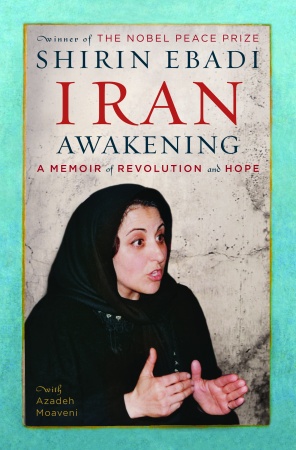
Iran Awakening: From Prison to Peace Prize: One Woman's Struggle at the Crossroads of History by Shirin Ebadi


# Category:
Biography/Personal Memoirs/Current Affairs


# Format: Hardcover, 256 pages

# Publisher: Knopf Canada

# Pub Date: April 5, 2006

Iran to me is such a fascinating and complex country. Being the only Persians in the region, speaking Farsi and practising the Shiite form of Islam has meant that the Iranians don't identify with their neighbours very much which gives them a strong and complex self identity. So when Random House asked if I would like to read Shirin Ebadi's ( the first Iranian and the first Muslim woman to be awarded the Nobel Peace Prize 2003) memoir I jumped at the chance to learn more about the lady and her beloved Iran.

Shirin Ebadi was a young woman judge in Iran when the Islamic Revolution took place. Tired of the Shah and his western ways, she became a staunch supporter of the revolution but was bitterly disappointed when shortly after Ayatollah Khomeini came to power, he brought with him sweeping radical changes which eliminated the existing Iranian legal code and introduced sharia or Islamic law. As per the Shariah Law a woman was declared insubordinate to her husband. Around the same time the regime decided that women were unfit to serve as judges. Ebadi found herself as a clerk in the court over which she had once presided as a Judge.

In this powerful and gripping memoir Shirin Ebadi recounts the return of the Ayatollah Khomeini, the revolution and the descent of Iran into a madness no one anticipated. She also vividly describes the horrors of the long Iran-Iraq War where Iran lost some 500,000 Iranians, her description of Saddam's Hussain's cruelty against the people of Iran sent shivers up my spine. I found it interesting that she claims the war is one of the main reasons why Iranians are so distrustful of the Americans.

pic courtesy: Random House Canada

According to Ebedi, one of the biggest consequences of the revolution was the brain drain that Iran suffered. After Khomeini came to power millions of educated and wealthy Iranians left for foreign shores, splitting almost every family in half. Shirin, her husband and children decided not to leave Iran and she has found it difficult to forgive (my assumption) those that left. Her thoughts on emigration spoke volumes to me.

After the war, the regime allowed women to take up law again, but Shirin opted instead to become a champion for women's rights. The second half of the book takes us through that period of her life, including her imprisonment, the execution of her bro-in-law, the winning of the Nobel Peace Prize and the courageous way she exposed Iran's brutal regime by fighting for justice for Zahra Kazemi's family (Zahra Kazemi was an Iranian-Canadian photographer arrested in Tehran for taking pictures and who died in the custody of Iranian offcials - her death made big news in Canada) and many,many others.

If you like stories of strong and gutsy women who believe in exposing wrong even at the cost of their lives; if you're curious about Iran and life there before and during the revolution (especially where it concerns women) and if you want to be inspired by a courageous life, you might be interested in this book. Do let me know if you would like me to send you my copy.

And with that, ciao until the weekend folks!


A clarification: As I read, I got the impression that the author couldn't forgive the friends that left, (although that was certainly not the word she used). She felt like they had deserted her and abandoned Iran. She was both, angry and sad at losing her friends. In her words, "...when someone leaves Iran, it's as though that person has died to me."
And years later when her friends travelled back to Iran for short visits, this is what she had to say
"...we still spoke Farsi, the same blood still ran through our veins,but they were living on a different planet than I was. In reality, I had lost my friends."

Monday, January 22, 2007

A Little Non-Fiction anyone?


I'm very partial to the non-fiction genre but will admit I don't often read as many as I once used to. So when Joy of "Thoughts of Joy" spoke of hosting a "NON-FICTION FIVE CHALLENGE", I couldn't resist (thank you, Joy!). From what I know the challenge will be held from July-September and in that period all you need to do is read 5 non-fiction books. Easy? More details to follow.

Speaking of non-fiction, Sanjay of Karmic Musings has an excellent review of the book "The Looming Tower: Al-Qaeda and the Road to 9/11" by Lawrence Wright (writer for "The New Yorker").

I've also enjoyed reading Jenclair's impressions on Suketu Mehta's "Maximum City: Bombay Lost and Found". She has a great review and several updates as she read along.

I am excited about having to pick 5 non-fiction titles for the challenge - knowing me, it will probably include some biographies, travelogues and science history. I am going to start combing book blogs for suggestions.

pic. courtesy: nilgravity.com