
# Category: Biography/Personal Memoirs/Current Affairs
# Format: Hardcover, 256 pages
# Publisher: Knopf Canada
# Pub Date: April 5, 2006
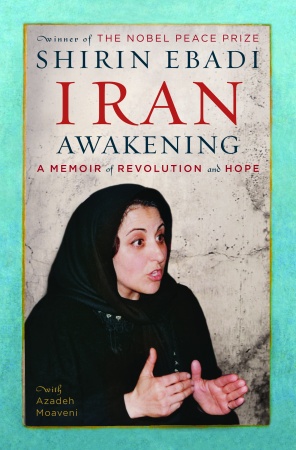
Iran to me is such a fascinating and complex country. Being the only Persians in the region, speaking Farsi and practising the Shiite form of Islam has meant that the Iranians don't identify with their neighbours very much which gives them a strong and complex self identity. So when Random House asked if I would like to read Shirin Ebadi's ( the first Iranian and the first Muslim woman to be awarded the Nobel Peace Prize 2003) memoir I jumped at the chance to learn more about the lady and her beloved Iran.
Shirin Ebadi was a young woman judge in Iran when the Islamic Revolution took place. Tired of the Shah and his western ways, she became a staunch supporter of the revolution but was bitterly disappointed when shortly after Ayatollah Khomeini came to power, he brought with him sweeping radical changes which eliminated the existing Iranian legal code and introduced sharia or Islamic law. As per the Shariah Law a woman was declared insubordinate to her husband. Around the same time the regime decided that women were unfit to serve as judges. Ebadi found herself as a clerk in the court over which she had once presided as a Judge.
In this powerful and gripping memoir Shirin Ebadi recounts the return of the Ayatollah Khomeini, the revolution and the descent of Iran into a madness no one anticipated. She also vividly describes the horrors of the long Iran-Iraq War where Iran lost some 500,000 Iranians, her description of Saddam's Hussain's cruelty against the people of Iran sent shivers up my spine. I found it interesting that she claims the war is one of the main reasons why Iranians are so distrustful of the Americans.
 |
pic courtesy: Random House Canada
According to Ebedi, one of the biggest consequences of the revolution was the brain drain that Iran suffered. After Khomeini came to power millions of educated and wealthy Iranians left for foreign shores, splitting almost every family in half. Shirin, her husband and children decided not to leave Iran and she has found it difficult to forgive (my assumption) those that left. Her thoughts on emigration spoke volumes to me.
After the war, the regime allowed women to take up law again, but Shirin opted instead to become a champion for women's rights. The second half of the book takes us through that period of her life, including her imprisonment, the execution of her bro-in-law, the winning of the Nobel Peace Prize and the courageous way she exposed Iran's brutal regime by fighting for justice for Zahra Kazemi's family (Zahra Kazemi was an Iranian-Canadian photographer arrested in Tehran for taking pictures and who died in the custody of Iranian offcials - her death made big news in Canada) and many,many others.
If you like stories of strong and gutsy women who believe in exposing wrong even at the cost of their lives; if you're curious about Iran and life there before and during the revolution (especially where it concerns women) and if you want to be inspired by a courageous life, you might be interested in this book. Do let me know if you would like me to send you my copy.
And with that, ciao until the weekend folks!
A clarification: As I read, I got the impression that the author couldn't forgive the friends that left, (although that was certainly not the word she used). She felt like they had deserted her and abandoned Iran. She was both, angry and sad at losing her friends. In her words, "...when someone leaves Iran, it's as though that person has died to me."
And years later when her friends travelled back to Iran for short visits, this is what she had to say
"...we still spoke Farsi, the same blood still ran through our veins,but they were living on a different planet than I was. In reality, I had lost my friends."
