Showing posts with label Middle East. Show all posts

Sunday, August 23, 2009

The Locust and The Bird by Hanan Al-Shaykh and a "GIVEAWAY*

Category: Biography & Autobiography - Personal Memoirs

Format: Hardcover, 320 pages

Publisher:
Pantheon

Pub Date: August 25, 2009

Price: $28.95

Translated from the Arabic by Roger Allen


Having lived for years in the west I know that many people here don't "get" the concept of arranged marriages. For many of us, falling in love is the only reason one should get married. Having someone pick a match out for you is more like a business transaction....where's the romance, the passion, in something like that, right? But for many, arranged marriages are a way of life. Falling in love amounts to nothing, it carries no weight as Kamila, a beautiful and impetuous girl from a village in in South Lebanon was about to find out.


Although Kamila was in love with one Muhammad, her family decreed that she should marry her dead sister's aging husband
(the sister was bitten by a rabid rat) . Kamila was only 14 years old but was deemed a suitable match because she was strong enough to look after her husband's kids, cook his food and warm his bed. More importantly, her sister's widower was the patriarch of the family and it almost seemed as if Kamila was sacrificed to him for the sake of her extended family who lived under his roof. Kamila's husband, Abu- Hussein Muhammad, was pious and strict whereas Kamila was free-spirited and irreverent. She defied him every chance she got and no matter how hard the family tried, they were unable to tame her.

It wasn't long, however, when she managed to reconnect with the love-of-her-life, Muhammad and very soon the two were planning secret rendezvous in Muhammad's bedroom in the house he shared with his family or in darkened cinemas. I'd love to tell you what happens next, but I can't for fear of giving away the story.

Kamila's story is narrated to us in the first person but written by her daughter, well known Arabic writer, Hanan Al- Shaykh. Al Shaykh says that the first person narrative was a deliberate choice, she said, “My mother wrote this book. She is the one who spread her wings. I just blew the wind that took her on her long journey back in time.” I found this to be a tenderly-crafted memoir and even though the faults of our protagonist Kamila are quite glaring, you cannot help but fall under her spell, and that is a tribute to the writer who has made Kamila an utterly irresistible character.

Although the protagonist's personality towers over the book it doesn't dwarf it. I found myself thinking a lot about different issues that this book bring up, like "First Loves", are they really as special as they are made out to be or they over-romanticized? "Child Marriages", granted, this was Beirut in the 1930's but even they knew better than to allow a man to get his 15-year old wife pregnant? "Child Abandonment", at what point does a mother's happiness become more important to her than her children and how do you ever explain that to your children? "Illiteracy", what role it plays in establishing one's status in the hierarchy of life. Would Kamila's life have been any easier if she could read and write?
"Legacy", towards the end of her life Kamila was frantic about having her life recorded, how important is it to us to be remembered fondly and accurately?

The cover art is striking and, to me it looks like a vintage movie poster. Because Kamila could neither read nor write, going to the movies was her only entertainment and the reader will note that she gleaned everything she knew about love and life from the movies. Which brings us to the interesting question of how much does art influence life? You will ponder over all these issues and more in this beautiful memoir, so if you would like your own copy simply write me a line here and I will be happy to put your name in a hat for a draw that will take place in about two weeks from now.

**************WE HAVE A WINNER*************

DRUM ROLL PLEASE........................................

It's Apu of "Apu's World". Congratulations Apu, please send me your address and I would be delighted to put a copy of this book in the mail to you!

A Q & A session with the author:

What does the title, The Locust and the Bird, refer to?

The Locust and the Bird is a fable about a king who was taking a stroll in his gardens when a Locust flew into the wide sleeve of his robe. A bird, in hot pursuit, flew in after it. The king sewed up the sleeve, sat on his throne and asked his people: “What is up my sleeve?” No one knew the answer. But it so happened that a man named Bird, who was desperately in love with a woman called Locust, was standing in the crowd. He came forward, only the face of his beloved in his mind, and proclaimed to his king:

Wails and Tales.

My life story is one long revelation.

Only the Locust can capture the Bird.

This is a story my mother told me. The locust signifies famine, hunger, destruction and unhappiness. Birds signify spring, love, hope and song. All these states describe my mother’s life.

Why did you finally decide to write and share your mother’s amazing story? Did she read any parts of it before she died, and what did she think of it? Did you sit down with her on a couple occasions right before and while writing the book, or are most of these tales your recollections when she told them to you growing up?

My mother left me when I was seven years old. This was her way of telling me why. As she unburdened, her story became an epic tale.My mother was illiterate, so she couldn’t read or write. But when we knew the book was going to be published, she had second thoughts: she didn’t want people to know how poor she’d been. When she was a child, she had to comb the fields after the harvest to find corn to eat. But after I read her a couple of chapters over the phone, she gave me her blessing.Yes, we sat together many times so she could relate her story, and then we continued over the phone, between Beirut and London . She’d wake up in the middle of the night and remember something and ring me at four in the morning.

Movies play an interesting and pivotal role in the book. What do you think movies represented for your mother? Do you think books played the same role in your own life?

Movies educated my mother. She learned everything about life through movies; about history, wars, countries, love, human bondage and relationships. She mimicked the movies: dressing, walking and talking like the stars she saw on the screen. She even learnt that pearls are found in the sea, and not in the ground. She escaped her stifling world through movies, as I later, entered a magical world through books.

You are primarily a fiction writer, how was it writing a non-fiction book, and one so personal as the memoir of your mother? Was it easy or difficult to find her voice and put it on paper?

I never felt writing The Locust and the Bird, that I was writing non-fiction. I felt all along it was a novel, the only difference being, in that when you write a novel, you don’t necessarily know how it’s going to end. In this book, I knew all along where I was heading. In my fiction I usually inherit the soul of my characters to such an extent that I inhabit them for a while, and the same thing happened when I was writing this, I stepped into her shoes. What made it easy, is that my mother had the spirit of a novelist, she was a natural storyteller, and she remembered small details, like the color of a stone. It didn’t come easily at first. I struggled with her voice at the beginning. I wrote the first chapters with myself as narrator, but that didn’t work, and then I tried writing in the third person, but it lacked immediacy. Then when I realised that my mother had been burdened all her life by her illiteracy, I realised I was her voice in the sense that I was simply a conduit, and I all I had to do was put the pen on the page, something she’d never been able to do.

Though The Locust and the Bird takes place in Lebanon , how is it a universal tale?

The Locust and the Bird is a universal story in the sense it’s about families, and everything that surrounds them: love, divorce, adultery, abandonment, poverty, injustice. But most importantly, for me, it’s a story about forgiveness.

There is a line in the book that your mother, “transformed her lies into a lifetime of naked honesty.” What did you mean by that line, and what does it say about your mother and her life?

My mother lied all her life, she was crafty and deceitful; but of course she did this to survive, and escape the confines of society and home. She used to be called a seductress, and I was worried, when I began the book, that she’d seduce me too, out of bravado, or to cover up the painful parts of her life. But in fact, she told me her story with an astonishing directness and honesty. And that’s when I got to know her for the first time.

Monday, March 09, 2009

Children of Jihad: A Young American's Travels Among the Youth of the Middle East.


  • Hardcover: 288 pages

  • Publisher: Gotham Books (Oct 30 2007)

  • Language: English


As most of you have probably noted already, global terrorism has spawned a whole battalion of young men in the Middle East willing and able to fight for the cause, or Jihad as it is known to many. Again, for many of us, these young men (and women) will never be more than a name (sometimes, not even that) ...they are just a group of young people prepared to give up their lives for a cause. Haven't you often wondered who these young people are? Where they come from? Why they do what they do? Have you ever wondered what it might be like to meet them on a social level and to just get to know them as people rather than fighters or terrorists?

Jared Cohen, a 25-year old Connecticut native did precisely that. He traveled to the Middle East in 2004-2006, met with young members of the Hezbollah, student activists in Iran and Palestinian refugees in Lebanon. His travels are chronicled in the excellent memoir and travelogue, 'Children of Jihad: A Young American's Travels Among the Youth of the Middle East".

So, what did he find?

In Iran he found the young people a very resilient lot. This group did not experience the revolution directly. Nor did they suffer under the Shah’s rule that preceded it. They did not fight in Iran’s brutal and lengthy war with Iraq. They have grown up exclusively under Iran’s strange blend of theocracy and democracy and they are far from happy with it, despite all that however, they refuse to give up on Iran. The Iranian young people Cohen met refuse to have their identities hijacked by oppressive and narrow-minded political or religious entities. According to Cohen - and this is really interesting - Iranian young people have emerged as the de facto opposition in that country, in the sense that by virtue of mass action they brought about (and continue to do so) a number of social and recreational changes in the country..

A female Dervish performs the Sufi Dance before a mixed-sex crowd at a dinner in a private house in North Tehran. Women are not allowed to dance in public and Sufi mysticism is strongly discouraged by the authorities,

Just reading about the resilient spirit of these young men and women makes me very hopeful for a new and gentler Iran. The other revelation Cohen makes is, that contrary to the anti-US propaganda that the political machine of Iran likes spewing, Iranian youth have absolutely no quarrel with America. They like Americans and they want us to know that! In part, the reason why the Iranian population is the most pro-American of any of the other Middle Eastern states Cohen visited is because the youth population is guided by a core principle which is, we'll love anything our government hates and we'll hate anything our government loves!


In Lebanon, Cohen found that the youth are only just coming together as Lebanese and taking immense pride in doing so. During the 20-year long occupation of Lebanon by Syria most Lebanese youth suffered from an identity crisis. Because they were controlled by Syria they were afraid to discover who they really were. However, after Syria pulled out most youth now feel Lebanese. The troubling bit about Lebanon is the influence of Hezbollah (Children of Jihad contains a fine chapter on the origins of the Hezbollah- one of the finest I have ever read) on the youth. What makes the Hezbollah so dangerous and troubling is that its members have managed to infiltrate Lebanon's universities and other institutions so seamlessly that no one ever knows they're there until it's too late. The author asks, could it be that they are also in the US "being" Americans, doing regular things that all Americans do, like attending school, eating at restaurants etc. unbeknown to the rest of us?

Lebanese Hezbollah supporters, listen to Hezbollah leader Sheik Hassan Nasrallah who speaks via a video link to a rally. AP Photo by Hussain Malla

Cohen's visit to the Palestinian camps (especially the Ayn al-Hilwah camp which houses the extremists) on the outskirts of Lebanon is probably the moving and chilling account of them all. According to Cohen, as the adult generations of Palestinians fight for a return to their homeland, it seems that many of the youth are fighting simply for a better life! Lebanon is one of the most westernized countries in the Middle East, yet the Palestinians are made to feel like second-class citizens, a burden on the society. The youth would like to contribute to society but because they are not given permission to move out of their camps, they have few options but to turn to the Cause. Extremist groups offer young Palestinians an outlet for adventure and a sense of belonging, not to mention, a heroic aftermath. You can't completely blame them for going that route...very often it's all they can do! Is the international community listening?

Syrian youth are highly nationalistic and pride themselves on their love of country. It's not that Syrian youth have it easier than their brethren in Lebanon it's just that their government has managed to seduce them into believing that patience, not agitation, brings about change. There are signs, however, that there is a limit to this patience and some Syrian youth are pushing for greater reforms, although they are still in the minority.

The author was happiest whilst in the Iraqi Kurdistan Region, also known as, 'The Other Iraq". Not only does it have the most magnificent landscape with large canyons, gorgeous mountains and impressive waterfalls, but The Iraqi Kurds are full of gratitude to the American army whom they see as liberators, not occupiers. The young Kurds do not indulge in the same wild,crazy and defiant parties like the young Iranians and Lebanese, nor are they submissive like the Syrian youth, instead, they are very focused on building themselves a democratic society. They have a vision, they love their country - Kurdistan - and have a developed sense of citizenship. Of all the youth in the Middle East they are the least likely to want to leave their country for greener pastures.

Kurdish Youth

So after meeting youth from Iran, Lebanon, Syria, Iraq, Palestinian and Kurdish youth, how does Cohen feel about the future of the Middle East?

According to Cohen, the widely broadcast images of violent, angry and fanatical Muslims are hardly representative of the majority of the Middle East. Middle Eastern youth are politically savvy and and find it easy to distinguish between governments, people and religion. Most know the difference between Americans and the American government and wish that Americans, too would make the distinction between the people of the Middle East and their tyrannical regimes.

Unlike the earlier generations the youth of today are heavily into technology and are using it to communicate,not just with one another but with the rest of the world...in other words, Middle Eastern youth are accessible and will listen if the rest of the world engages them. At the moment, extremists have already made inroads into shaping the opinions of these young people, the international community needs have greater communication with these youth..they are sure to help us find creative solutions for peace in that region someday.

If you are interested in the affairs of the Middle East, or simply enjoy a good travel book packed with history and conversations, you might want to give this book a whirl.


Tuesday, January 23, 2007

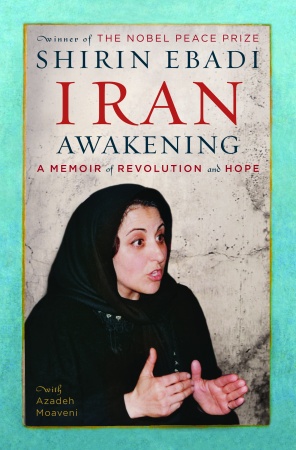
Iran Awakening: From Prison to Peace Prize: One Woman's Struggle at the Crossroads of History by Shirin Ebadi


# Category:
Biography/Personal Memoirs/Current Affairs


# Format: Hardcover, 256 pages

# Publisher: Knopf Canada

# Pub Date: April 5, 2006

Iran to me is such a fascinating and complex country. Being the only Persians in the region, speaking Farsi and practising the Shiite form of Islam has meant that the Iranians don't identify with their neighbours very much which gives them a strong and complex self identity. So when Random House asked if I would like to read Shirin Ebadi's ( the first Iranian and the first Muslim woman to be awarded the Nobel Peace Prize 2003) memoir I jumped at the chance to learn more about the lady and her beloved Iran.

Shirin Ebadi was a young woman judge in Iran when the Islamic Revolution took place. Tired of the Shah and his western ways, she became a staunch supporter of the revolution but was bitterly disappointed when shortly after Ayatollah Khomeini came to power, he brought with him sweeping radical changes which eliminated the existing Iranian legal code and introduced sharia or Islamic law. As per the Shariah Law a woman was declared insubordinate to her husband. Around the same time the regime decided that women were unfit to serve as judges. Ebadi found herself as a clerk in the court over which she had once presided as a Judge.

In this powerful and gripping memoir Shirin Ebadi recounts the return of the Ayatollah Khomeini, the revolution and the descent of Iran into a madness no one anticipated. She also vividly describes the horrors of the long Iran-Iraq War where Iran lost some 500,000 Iranians, her description of Saddam's Hussain's cruelty against the people of Iran sent shivers up my spine. I found it interesting that she claims the war is one of the main reasons why Iranians are so distrustful of the Americans.

pic courtesy: Random House Canada

According to Ebedi, one of the biggest consequences of the revolution was the brain drain that Iran suffered. After Khomeini came to power millions of educated and wealthy Iranians left for foreign shores, splitting almost every family in half. Shirin, her husband and children decided not to leave Iran and she has found it difficult to forgive (my assumption) those that left. Her thoughts on emigration spoke volumes to me.

After the war, the regime allowed women to take up law again, but Shirin opted instead to become a champion for women's rights. The second half of the book takes us through that period of her life, including her imprisonment, the execution of her bro-in-law, the winning of the Nobel Peace Prize and the courageous way she exposed Iran's brutal regime by fighting for justice for Zahra Kazemi's family (Zahra Kazemi was an Iranian-Canadian photographer arrested in Tehran for taking pictures and who died in the custody of Iranian offcials - her death made big news in Canada) and many,many others.

If you like stories of strong and gutsy women who believe in exposing wrong even at the cost of their lives; if you're curious about Iran and life there before and during the revolution (especially where it concerns women) and if you want to be inspired by a courageous life, you might be interested in this book. Do let me know if you would like me to send you my copy.

And with that, ciao until the weekend folks!


A clarification: As I read, I got the impression that the author couldn't forgive the friends that left, (although that was certainly not the word she used). She felt like they had deserted her and abandoned Iran. She was both, angry and sad at losing her friends. In her words, "...when someone leaves Iran, it's as though that person has died to me."
And years later when her friends travelled back to Iran for short visits, this is what she had to say
"...we still spoke Farsi, the same blood still ran through our veins,but they were living on a different planet than I was. In reality, I had lost my friends."