Monday, October 30, 2006

This is Paradise! Hyok Kang with Phillipe Grangereau


# Paperback: 176 pages

# Publisher: Little, Brown (7 Jul 2005)

# Language: English (translated by Shaun Whiteside)

# Classification: Autobiography/Non-fiction


North Korea, The Hermit Kingdom, is not exactly welcoming of foreigners and nor does it allow its people out, hence books about daily life in this small and very poor country are scarce, but in recent years owing to a number of defectors willing to tell their stories and publishers willing to give them a platform, there are now a few of North Korean memoirs on the market, but because none of their stories can be corroborated , these books probably don't meet the expected standard of reliability that one has come to expect from other biographies and memoirs (let's pretend we didn't have a James Frey, shall we?)

Hyok Kang was born in North Korea in 1986 and lived there until 1998 which is the year he and his family escaped to China. In this book he recounts the struggles of his family and friends to survive the cruel and hard life that was North Korea. To start with, his family, because they were among numerous North Koreans that were willing to be repatriated from Japan,were favoured by Kim Il-Sung, but when the famine set in 1993, they gradually lost all the wealth they acquired and were reduced to begging (and sometimes stealing) just in order to live.

Famine does terrible things to people. It turns reasonable people into selfish, indifferent people with no conscience "...the misfortune of others, even your own family, leaves you completely indifferent when you have nothing in your belly. Your stomach becomes a thousand times more important than your conscience" For a long time the reader will be haunted by images of people willing to do anything for something to eat, even if it meant prostituting themselves, stealing or maiming others; cannibalism and killing someone to get a meal was not unheard of.

What I find distressing is that the isolated North Korean people are made to believe that despite the food shortages, they have it better than the "Southern Puppets" (South Korea) and the "long-nose imperialists, (USA). Due to intense propaganda and consistent brainwashing, the people genuinely believe that This (North Korea) is Paradise!

When, owing to a disagreement at work, Hyok Kang's father decides to escape to China, he realizes that unlike what they believed, the people in China actually had food to eat and clean clothes to wear and he makes up his mind to take the whole family across the border. Things in China are definitely better than up north, but they are constantly looking over their shoulder and having to change schools and houses for fear of being picked up by the Chinese police and repatriated to North Korea where death for treason is a certain fate.

This book is not for everybody. The content is disturbing,difficult and dark, but very compelling. In my case, it shocked me out of my complacency and has made me want to volunteer with "Host a Newcomer" program here in Canada,so just for that I am going to have to give this book a high rating.

Out of respect for my more sensitive blogger friends, I have deliberately refrained from discussing some of the human right violations that go on in North Korea, however, for the purpose of reference I will be making study notes which I shall post on my LotusReadsBeta blog a few days from today.

For more reading on North Korea try:

Under the Loving Care of the Fatherly Leader: North Korea and the Kim Dynasty by Bradley K. Martin (non-fiction)

North Korea Through the Looking Glass by Kongdan Oh and Ralph C. Hessig

Kim II Sung: North Korean Leader by Dae-Sook Suh

Literature from the Axis of Evil and Other Enemy Nations by Alan Mason

The Aquariums of Pyongyang: Ten Years in the North Korean Gulag by Kang Chol-Hwan, Pierre Rigoulot, Yair Reiner

Pyongyang: A Journey in North Korea
by Guy Delisle (An Illustrated Memoir)

Would welcome any new suggestions.

Thursday, October 26, 2006

The perfect excuse to read!

Totally indebted to Bibliobibuli for pointing me to this article.

According to the British Psychological Society ( BPS), The more fiction a person reads, the more empathy they have and the better they perform on tests of social understanding and awareness. By contrast, reading more non-fiction, fact-based books shows the opposite association.

The more authors of fiction that a participant recognised, the higher they tended to score on measures of social awareness and tests of empathy – for example being able to recognise a person’s emotions from a picture showing their eyes only, or being able to take another person’s perspective. Recognising more non-fiction authors showed the opposite association.

The researchers surmised that reading fiction could improve people’s social awareness via at least two routes – by exposing them to concrete social knowledge concerning the way people behave, and by allowing them to practise inferring people’s intentions and monitoring people’s relationships. Non-fiction readers, by contrast, “fail to simulate such experiences, and may accrue a social deficit in social skills as a result of removing themselves from the actual social world”.

However, a weakness of the study is that the direction of causation has not been established – it might simply be that more empathic people prefer reading novels.

Wow, now if that's not the perfect excuse to read, I don't know what is! ;) I tend to read an equal number of non-fiction and fiction books - just hope that means I'm balanced!


Wednesday, October 25, 2006

IFOA Readings 24th October @ Harbourfront Center

Sasgirl (who desperately needs to update her blog!) and I attended the IFOA -International Festival of Authors last night and had the great pleasure of listening to Kiran Desai, Anita Rau Badami, Kate Grenville and Stephanie Johnson read from their latest novels.

The evening began with Catherine Belyea ,the host of CBC Radio’s "The Singer and the Song", paying tribute to a Burmese Writer ( I wish I could remember his name) who is under house arrest and encouraged us to sign the petition for his release. She then introduced Anita Rau Badami who started us off with her latest book "Can you Hear the Nightbird Call?".


"Can You Hear The Nightbird Call?" is the story of three women linked in love and tragedy that sweeps from the Partition of India and Pakistan to the explosion of Air India Flight 182. Anita Rau Badami is a very elegant-looking lady and her serene face belies a great sense of humour. I am extremely eager for a taste of her new book. Her previous two, "Tamarind Mem" and "The Hero's Walk" were excellent reads and when someone asks me for book suggestions from the South-Asian literary genre, "Tamarind Mem" is always in my top 5.

Next up was Stephanie Johnson, one of New Zealand's most accomplished writers and co-founder of the Auckland Writers' Festival. Her new novel, "John Tomb's Head" is a unique work told from the perspective of John Tomb, a man dead for 200 years.


After an intermission of 15 mins during which I got chatting with a young woman who had travelled all the way from the UK for this literary festival (and I thought they only did that for rock stars!), we were comfortably tucked into our seats again readying ourselves for a reading with Kiran Desai, this year's Man Booker winner.


Kiran Desai is an engaging reader. She reads quickly and with a lot of energy and expression. Her body language is casual and she uses her hands a lot while reading, (just thought it worth mentioning because it's something I didn't see the others do). When she's not using her hands to make a point, she rests her chin on them, again, so different from the reading style of other authors I have seen. She's extremely effervescent , greeting most people with a hug wherever she went. I'm not sure if she's always been this friendly or if she is just buoyed by her recent success. Either way, it was wonderful to see an author this approachable....I'd love to go see her read again.

The last reader of the evening was Kate Grenville and she read from "The Secret River" which was shortlisted for the 2006 Man Booker Prize and winner of the Commonwealth Writers' Prize and the Christina Stead Award. "The Secret River" is a historical novel set between the slums of 19th-century London and the convict colonies of Australia.


She gave us a detailed and informative introduction to the novel explaining that the character William Thornhill in "The Secret River" was based on her great-great-great grandfather Solomon Wiseman who was a waterman on the Thames. In 1804 he was caught stealing a load of timber and was transported to New South Wales (Australia) , but once pardoned, he found himself falling in love with the country and continued to stay on becoming quite a wealthy man. In researching her grandfather from official records, Grenville found there was no mention of the Aboriginal people in the records -just silence. She says, her book aims to mend that, it aims to give the Aborignal people a voice with which to tell their part of the story. Both sasgirl and I agreed she had the most soothing and melodious voice of the four - perfect for storytelling!

After the readings we were encouraged to browse through the collection of books in the mobile bookstore after which we stood in line for the signings. As expected, the line for Kiran Desai was a mile long, so I went across to Anita rau Badami instead. Told her how much I had enjoyed "Tamarind Mem" and she very graciously signed my book. I so wanted to ask her if she would grace our bookclub with a visit, but my courage failed me at the last moment!

An update: Sasgirl has updated her blog! ;)

Tuesday, October 24, 2006

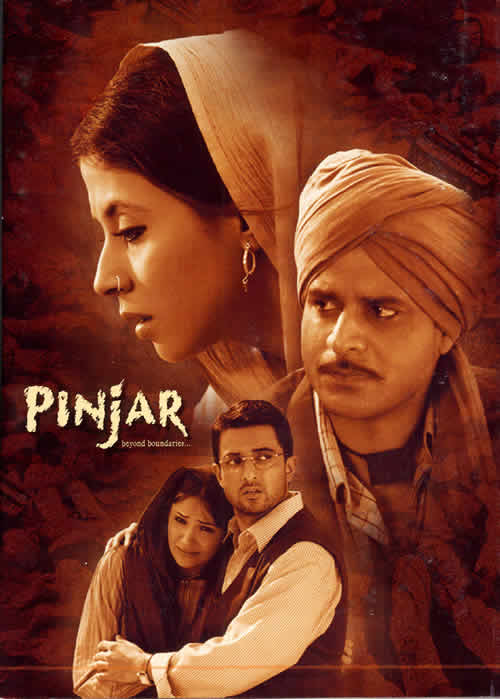
Pinjar (Movie)

Director: Dr. Chandra Prakash Dwivedi
Starring: Urmila Matondkar, Manoj Bajpai, Priyanshu Chatterjee, Sanjay Suri, Sandali Sinha, Ishaa Koppikar, Kulbushan Kharbanda, Lillette Dubey, Farida Jalal, Alok Nath and Seema Biswas

Saw this wonderful movie yesterday. Based on well- known Punjabi writer Amrita Pritam's novel "Pinjar" (Skeleton), this visually beautiful, emotionally stirring and historically sound movie had me glued to the TV screen for the full length of the film (unusual for me, I usually take lots of breaks when watching a Hindi movie.)

It has been well documented that the Partition (the division of India along religious lines into India and Pakistan by the ruling British in 1947) was the single largest uprooting of people in contemporary history and where atleast a million people lost their lives, not surprisingly,it (the Partition) has perhaps been the most widely- explored subject in Indian cinema however, what makes the film "Pinjar" different is that it deals with a practice that unfortunately became quite common during the partition of India - the abduction of Hindu, Muslim and Sikh women (usually brides-to-be) , by men from religious communities other than theirs and being forced into marriage with these men. These abductions and forced marriages took place as a means to "settle scores" between enemy and aggrieved parties (religious strife was rife in the months leading up to the Partition of India).

Sleeping with the Enemy

The unlucky girl not only had to bear the misfortune of marrying her kidnapper and bearing him children, but also, she was made to change her religion to that of her husband's. After Independence, the authorities would try to arrange the repatriation of a rescued bride to her home, but the family of such a woman were very reluctant to take her back, for having borne the children of the "enemy" she was a "fallen" woman and could bring great shame upon the house. There are no reliable figures, but social workers at that time put the figure of abducted women at 75,000 to a 100,000.Scores of vulnerable women committed suicide or were killed by their own menfolk to stop themselves from falling into enemy hands.


The Film

The protagonist of Pinjar is Pooro, a Hindu girl. On the eve of her wedding she is abducted by a Muslim man (Rashid) who was pressured by his family to avenge the kidnapping and rape of his aunt by Puru's uncle many years before. Puru is devastated at first, but after being rejected by parents and realizing that she only has Rashid (who fortunately has fallen in love with her), she slowly settles down in her new life and becomes a kind of a woman's activist - taking up the cudgels for women weaker than herself. I won't give away anything more about the movie, except to say, be prepared to be moved.

The book:

I haven't read it yet, but here's the opening lines of the nouvella, courtesy Amardeep Singh

"The sky was a colorless grey. Pooro sat on her haunches with a sack spread beneath her feet. She was shelling peas. She pressed open a pod and pushed out the row of peas with her finger. A slimy little slug stuck to her thumb. She felt as if she had stepped into a cesspool; she ground her teeth, flicked off the slug and rubbed her hand between her knees.

Pooro stared at the three heaps in front of her: the empty husks, the pods, and the peas she had shelled. She put her hand on her heart and stared off into space. She felt as if her body was a pea-pod inside which she carried a slimy white caterpillar."


Addendum:
Nomadica suggested I watch "Khamosh Pani", a Pakistani movie with a similar theme and I am so glad I did. The movie explores the life of one of these abducted women - it's definitely well worth a watch!

Monday, October 23, 2006

Hindu Mommy

Just want to extend a big thank you to Hindu Mommy for her very helpful blog. As an Indian mother bringing up kids here in Canada, I find Hindu Mommy's posts always very informative and useful.

In her own words:

"...This blog is an effort to reach out to other Indian parents trying to raise their kids outside India and also a general placeholder for any information I may like"

Do visit her blog, I am sure you'll be very pleased you did!

Also, want to thank her for the wonderful "Diwali Dhamaka" event she organized recently which included two random prize drawings, I am one of the lucky winners and will be receiving Meena Pandya's "The Indian Parenting Book: Imparting Your Cultural Heritage to the Next Generation". I am very excited about the book because this is exactly what I need, thank you so much Hindu Mommy!!!

What Amazon had to say about the book:

For Indian parents juggling two careers and two cultures, while wondering how and what part of their cultural heritage to pass on to their children, now there is help. In this book, Meenal Pandya has offered insight into raising culturally balanced children who are both confident about their own heritage and respectful of other cultures. In these pages, you will find:  How to celebrate Indian festivals creatively in your own home  How to turn everyday matters into opportunities to teach cultural values to your children  How to decide what values are important to you  How to address some common misconceptions about India and its culture  What are the significant Hindu Samskara ceremonies and when to perform them  How to select Indian dance and music classes for your children

Wednesday, October 18, 2006

Happy Diwali! दीवाली

I won't be getting much reading done between tomorrow and Sunday because we're celebrating the Indian Festival of Light or Diwali as it is called. If you want to know more about Diwali and how my family celebrates it, feel free to visit my Anthropologist blog, I will probably be posting something there later this evening.

See you Sunday everyone! :)

(pic. courtesy, my unknown angel on flickr)

Small Island by Andrea Levy

Genre: Fiction

Publisher: Picador ($14)

Author's Website: http://www.andrealevy.co.uk/


(It was a recent review on Nomadica's blog that prompted me to pick this book off my shelf, dust it off and read it)


Winner of the Orange Prize for Fiction, 2004 and the Whitbread Prize the same year, this novel by Andrea Levy takes place in post-war Britain and is told through the point of view of four narrators Hortense Roberts and Gilbert Joseph, Queenie and Bernard Bligh. Hortense and Gilbert are from Jamaica. Gilbert, intensely patriotic to "mother country" England, travels to London and joins England's forces in its war against Germany. Hortense, a cultured school teacher, sensing Gilbert could be her ticket out of poverty-racked Jamaica, decides to marry him and follows him to London several months after the war. Unfortunately, London isn't anything like Hortense imagined. The English, instead of being grateful for the service provided by the Caribbean men in the war against Hitler, resent the new immigrants, or "darkies" as they call them. Hortense, along with Gilbert, find England an extremely racist society, for instance, while walking on the sidewalk they are expected to step onto the road to make way for a white person. They also had to get used to cries of "Golliwog, golliwog" when out on the streets!


Ofcourse, there are readers who have made the observation that perhaps this book deals with racism in reverse, in that the Jamican characters are treated more charitably than the English, and not always deservingly so.

Queenie is a working class Londoner. Although white, she has been a little in love with Africa ever since she encountered an African display at a "British Empire Exhibition" when she was a little girl. During the war, Queenie finds it difficult to meet ends meet and much to the consternation of her racist neighbors, takes Gilbert and Hortense in as lodgers. Bernard is Queenie's husband and he was a soldier in India during the war.

THe story is wonderfully written - warm and funny at times, desperately depressing at others but it is almost always engaging. The three main themes of the book are the migrant experience, racism and integration, and within those themes you learn about the class system which prevailed in Britain at the time, the British Empire's treatment of the inhabitants of its Caribbean and Indian colonies and America's segregation of black GIs . Also, fascinatingly, the novel moves back through the war years, showing the sheer awfulness of war...

While I enjoyed the novel and felt like I learned so much, I will have to admit the author lost me as a reader in the last quarter which is mostly devoted to Bernard's narrative; of all the characters, I like Bernard the least because he comes across as a weak person, arrogant only because he thinks as an Englishman he is superior to the "darkies". Having to read his point of view broke the sweet harmonious relationship I as a reader had with the three other strong characters as they told their intertwining stories.
**********

Also read Lesley's (of Lesley's Book Nook) review for Small Island here