Monday, September 12, 2011

Beautiful Thing: Inside The Secret World of Bombay's Dance Bars by Sonia Faleiro


Publisher:  Penguin House, India
Genre:       Non-Fiction
Published   27 OCT 2010


 In 2005, as part of a "Morality Drive", the government of Maharashtra (India) banned bars from featuring dancing girls.  As a result of the edict some 75,000 girls lost their jobs. The government accused the bars of being "brothels" and the girls of prostituting themselves, however, in reality 
 while the girls did sell sex, they didn't do so inside the bars. On the bar premises the girls always danced fully-dressed and customers were never allowed to solicit the girls while they were working.  They could watch them dance and throw money at them, but that was all. If the girl did want to service a customer she was to do it outside the bar premises and in her own time.

The ban, instead of being a move for the good, actually deprived the women (many of them single mothers or victims of rape)
of a regular job, one in which they felt protected, and threw them into the clutches of unscrupulous brothel owners or pimps. Some ended up having to walk the sidewalks alone, with no protection - a surefire way of getting raped, kidnapped or even killed.
I'll be honest, like most people, when I read about the ban I wasn't too perturbed as I bought into the "reasons" given for shutting
down the bar, but I had always wondered about these dancers - who were they?  Where did they come from?  Why did they choose such a career?  Did they ever fall in love? Get married? 
So when I read Sonia Falerio had written a book on these bargirls, I knew it would satiate my curiosity and I asked my sister to send me a copy from India ( I don't think the book has had its US release yet).

  Leela, the protagonist of Faleiro's book "Beautiful Thing: Inside the Secret World of Bombay's Dance Bars", like most of the other bar girls, had been sold to the local policemen for sex by her own father when she was only 13. Uneducated and young she many have been, but she was smart and she soon
figured out that for as long as she stayed in her father's house her body
would be his to do with as he pleased.  Since she had already been "defiled" she reasoned she could continue with the same occupation but keep her
earnings for herself and so she ran away from home and
ultimately made her way into one of Bombay's famous dance bars.

Again, at the bar she lived by her wits, she befriended the bar owner and enjoyed quite a cushy means of existence thanks to him. As long as she made money for the bar and kept an eye on the other girls, he was prepared
to turn a blind eye while she solicited the occasional customer outside of the bar. The relationship seemed to suit them both

But after the ban came into force, even her bar-owner boyfriend could do nothing to save Leela who was 19 at the time and she soon found herself on the streets and at the mercy of people who exploited her.  This continued
until she was able to get to a shelter.

As I read the book, I kept looking for Leela to curse her fate..I kept waiting to hear her cuss her mother and father for the predicament she found herself in, but I don't think I ever saw her do that, infact, she was a great believer in destiny:

  "Bad luck is in my blood.  It is true what they say - destiny us as strong as iron, it is tougher than steel;
 nothing can change what is written for you" 

Perhaps that is what  purged her of any bitterness and gave her the will to go on. Also, a lot of the bar dancers came from families that has always been 
involved in the business of dubious entertainment - like street dancers or acrobats, trapeze artists in the circus, dancers at private parties and so on,
so in Leela's mind, she actually believed she had done quite well for herself.

I kept reading to see if the book would reveal what Leela wanted for her future for while all the girls hope to get a good man/boyfriend who will be their ticket out of that profession, the truth is, few ever get away.
In the end, the most lofty goal a dancing girl can have is getting a job at a Mujra bar in Dubai where she can hope to make more money and receive more gifts.  Youth is highly prized in this industry and once the girls
reach their prime (early 20's perhaps) many will move on from dancing to keeping dancers (if they have saved up enough money), or if they have a daughter they will probably introduce her to the profession and live off her earnings!
  

"Beautiful Thing" puts a very human face on a profession most of us wouldn't touch with a disinfected bargepole.  Sure, these girls are seducers, liars, cheats, addicts and everything else we have read about them in the media,
but this book helps us see why they are that way.
Most have been sexually abused as children and exploited beyond belief as young adults and, as a result, have developed these coping mechanisms to ensure they don't get hurt over and over again. The book also reveals to the reader how much crime and corruption envelope the industry
and how close the link between bargirls and the underworld dons are.

Faleiro gives centre stage to her subject Leela, unobtrusively asking questions of her and letting her speak  - hallmark of a good reporter. The novel has a lot of dialogue and I enjoyed the author's reproduction
of Leela's Bombay vernacular full of bawdy wit, cuss words and a rough tenderness that may make some readers blush! 
 
 In order to write this book Faleiro had to spend a lot of time, not only with Leela and her friends but also with the other groups that make up this industry, like the hijras (eunuchs), the pimps, brothel owners, bar owners, men who frequented the bars and last, but not least, the thugs that bought and sold these girls to the various bars and clubs - I salute her for being so brave!
  
Even though this is a book is a work of non-fiction, it is a breezy read and in this day of "India Shining", where never a day goes by without reading a newspaper article wax lyrical about India's booming economy, this book is a good reminder of those sections of society which have been totally left out of   India's economic miracle.  

Friday, September 09, 2011

Tiny Sunbirds, Far Away by Christie Watson


Publishers: Other Press
Genre:       Literary


After a long drought where the only books I read were about Paris, in preparation for our vacation in the City of Light, I was finally able to sink my teeth into a novel that gripped me right away and refused to let go.  I'm sure as readers we all go through a non-reading phase, but mine was particularly painful because I cannot remember going a day without reading a book since I was six years old!  At first, when I found myself having difficulty concentrating on a book, I didn't let it worry me too much, I thought my reading mojo would return in a few days...it's been close to six months!  Phew!

Anyway, back to the book. I'm not attempting a review here, but I cannot let the book that saved my reading life go by without a mention.  "Tiny Sunbirds, Far Away" by Christie Watson is set in the Niger Delta, the oil-rich region of Nigeria.  Its protagonist is a 12-year old girl who has to move from the big city of Lagos to her grandparents' house in the Niger Delta after her parents got a divorce.  Not only was it difficult for her and her brother to come to terms with the change in their geographic status, but also, they went from being considerably well off to hovering just above the poverty line and from a Catholic household (their father was Catholic) to having to pray in the mosque as her mother's family were (Ijaw) Muslim.

Blessing, our protagonist, soon gets caught up in the politics of a big family: a polygamous and patriarchal grandfather; a grandmother who practises midwifery; a brother who gets involved with the Sibeye boys (young, misguided local boys who are given arms with which to sabotage an oil pipeline or to kidnap a foreigner working with one of the large oil companies.)  Central to the story is how oil (first discovered in 1956)  is ruining the lives of the people of the Delta.  Where it should have been a blessing, it is now a curse.  Read this article in the National Geographic for greater insights into the curse of the black gold.

This book has a lot to recommend it: not only is the storytelling spectacular but also, it's set in an area most of us rarely get to read about (sure, there is a lot of literature coming out of Nigeria these days but not too many stories are based in this volatile area of  the country which is rich in oil-deposits and yet its people are among the poorest in the land.  Casting Blessing's grandmother in the role of a midwife was a clever strategy because the reader gets to learn all about female circumcision, another evil that plagues Africa.  The medical details are interesting to read and let me tell you why:  Ms. Watson is a nurse by profession so she certainly knows how to keep it accurate and at the same time her lyrical storytelling ensures we are never bored.  All is not gloom and doom however. Her novel celebrates the happy and gregarious Nigerian spirit in a way few books have done before...it was a delight to read.

Saturday, March 05, 2011

Blog Hiatus


Hello everyone!  This blog is going on a short holiday...hopefully I will have some reviews to share after the 19th of this month.  Many thanks and see you soon!

Tuesday, February 15, 2011

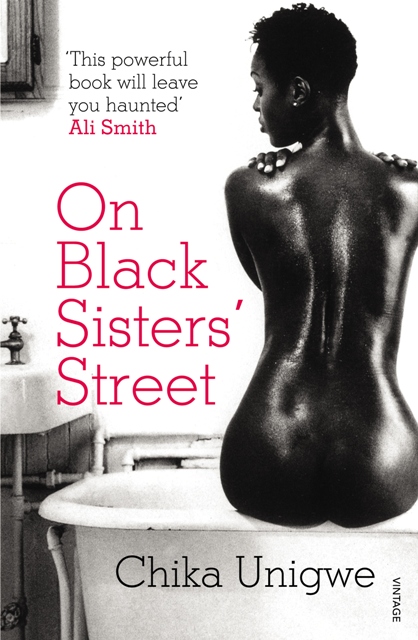
On Black Sisters' Street by Chika Unigwe

  • Paperback: 304 pages
  • Publisher: Vintage

That Nigeria is a failed state is no longer in question.  However, a major consequence of that is the organized exodus of Nigerian girls and women to Western Europe, where they are promised exciting jobs but end up trapped in brothels run by their own nationals - Nigerian “Madams”.

"Black Sisters' Street" by Chika Unigwe is a fictional account of four such women - Sisi, Efe, Ama and Joyce - each of whom left Nigeria for Belgium, with dreams of a better tomorrow, only to find themselves working as prostitutes in the red light district of Antwerp, or "Black Sisters' Street" named for the inordinately large number of African woman that work the street.  To tell you that none of the four went to Belgium voluntarily or that they didn't expect to be prostitutes would be to mislead the reader...however...what makes one angry is the fact that these girls felt it necessary to leave their homes, parents (in some cases, children) and enter this sordid industry only because they could barely make ends meet in their home country.  It is sad these girls had to take up a job that stripped them of all self-respect just so that they could be respected back home in Nigeria.

The character sketches of the four girls are detailed and intimate and yet, at the end of the book, none of them feels like a 'best friend', for despite the tiny details - how they dressed, their family lives, their thoughts, dreams and so on - one really doesn't get to "know" them well. For that matter, even though the girls live togther, they are strangers even to each other until one tragic event brings them together.

Unigwe's prose is clear and calm - although some terrible things take place in the book, the reader doesn't feel weighed down by it.  Unigwe is also skilled at introducing into the narrative issues that are typical to Nigerian society like polygamy,sexism, belief in superstitions, tribal divisions and so on, using just a single reference or a passing comment, leaving the reader with a fleeting but precious sort of cultural snapshot.

I also love her descriptions of Nigeria - from the chewing-gum pink walls of the sitting room in Ama's house (and yes, I know they have them, I've seen them in just about every Nigerian house in a Nollywood movie!) to the streets of Lagos in Joyce's story- her writing with its rich detail, truly entertains and informs.

"Lagos streets were rutted,gutted and near impassable,yet they were jam-packed with cars: huge air-conditioned jeeps driving tail to tail with disintigrating jalopies whose fault exhaust pipes sentout clods of dark smoke making the air so thick with pollution that a constant mist hung over the city and the bit of sky that one could see was sullied with dirt."


We get to know some of the girls better than the others.  The story mostly revolves around Sisi, a college graduate who was unable to find a job in Nigeria because she didn't have the right "connections", however, it is Joyce's story that moved me the most, perhaps because it was the saddest and also, of the four girls, she was the only one tricked into going to Antwerp.   To tell you more would be to give much of the story away and I certainly don't want to do that. 

When Chika Unigwe was asked why she wanted to write about Nigerian prosititutes in Antwerp, she had this to say:

Curiosity. The first time I saw the girls in lingerie behind their windows, I was stunned.  Coming from Nigeria where prostitution is very much underground, it was a cultural shock on a massive scale. I had never seen anything like it before. Then when I was told that a great majority of the African prostitutes in Antwerp were Nigerian girls from Benin City, I knew I had to write about it. The statistics are mind boggling. There is a new crop of middle class families cropping up in Benin City, mostly headed by women whose daughters are in Europe

I'm so glad she did (write about it), the novel does much to make us pay attention to that society that we do everything to ignore, also, it was interesting to see Europe - the destination for so many people's hopes and dreams - through the eyes of these four Nigerian girls. I appreciated that while Unigwe reveals to us that three of the girls did indeed travel to Antwerp while fully aware of what the job entailed, the background stories ensure we don't blame them...it's easy to see how girls like Ama, Sisi and Ete are pressured into taking up these jobs, if anything. it makes you angry at a society that sits back and allows these girls to sacrifice their bodies in order to put meals on the table.

Lastly, but not importantly, I noticed a few digs against Ghanaians in the book...would someone be able to tell me if there is friendly rivalry between the citizens of these two countries?

"Ama spied two Ghanaian guests going back for a second helping rice and smirked to Sisi that surely, surely Nigerians cooked better, made tastier fried rice than Ghanaians.  (People who threw whole tomatoes in sauces couldn't really cook, could they?) And both women agreed that Ghanaians were just wannabe Nigerians."


 An award-winning short story writer, Chika Unigwe, 34, was born in Enugu, Nigeria, and now lives in Belgium with her husband and four children.

Thursday, February 03, 2011

Chinese Literature Challenge

Hello fellow-readers and bloggers!

Just signed up for the


So excited! 

Please click on the button to read more!

Saturday, January 29, 2011

"TheJapanese Lover" by Rani Manicka

Paperback, 328 pages
Published May 13th 2010 by Hodder &Stoughton

"The Rice Mother", Rani Manicka's fabulous debut novel was one of my favorite novels for many years and still is, and so,it was with great excitement and expectation that I picked her third novel, "The Japanese Lover". The novel started nicely enough with the birth of a daughter in a poor man's home in Vathiri, North Ceylon in 1916. Because the man was extremely poor, but cunning and lazy too, when the astrologer predicted that this newly-born daughter would marry a fabulously wealthy man, he decided that "Parvathi" was his ticket out of servitude and into comfort.

When the time came for Parvathi to marry her father deceived the prospective groom by sending him a picture of a beautiful maiden, not Parvathi, and in this way managed to secure an alliance between his daughter and the wealthy Kasu (Money) Marimuthu, a 42-year old widower of Sri-Lankan/Tamil origin in Malaysia,then known as Malaya. However, when Parvathi arrived in Malaya after her arduous journey from Colomba and the bridegroom realized he was cheated,he is determined to send Parvathi back to her father's home, but that night as he lay spent and drunk, an apparition came to him instructing him never to get rid of his wife.

"If you could see what I see in your wife," the vision said quietly, "you would fall to your knees in awe. Know that she is an aodred soul who has incarnated to experience love in the most unlikely circumstances"  pg 31

  It is at this point in the novel that I realized that Rani Manicka's new novel, has, at the heart of it, characteristics and characters that would fit very nicely in the genre of magical realism - a similar theme ran through "The Rice Mother".

Anyway, although her husband decides to keep Parvathi, their marriage, while civil, is without passion or excitement. Parvathi works hard to become the sophisticated woman her husband wants her to be,but in her heart she is deeply unfulfilled...until, on page 183, when the Japanese invade Malaya (1941) the Japanese lover, which is also the title of the book, comes into her life.

Although this novel is nowhere near as enjoyable as "Rice Mother", it is immensely readable in parts.  Manicka is still a wiz at describing both, the exotic and the mundane and I absolutely devoured the pages where she describes marriages and deaths and even everyday scenes like lunch at her daughter's place or even a regular coffee morning with the mamis (Sri Lankan women in Malaya).  One of the most fascinating characters in 'The Japanese Lover' is the wise medicine woman, Maya, who while she prophesises and dispenses medicine to the people in the neighbourhood also looks after Parvathi's kitchen.   Manicka uses Maya as a vehicle for her metaphysical musings and while I found them wise and ponderable at first,  they diffuse into airy pulpiness after a while - because it overstretches the reader's concentration.

The personal tragedy of Parvathi's family plays out against a backdrop of the Japanese invasion of Malaya, the local communist insurgency, the anti-Chinese riots and then the inevitable loss of Malaya when British colonies of Sabah, Sarawak and Singapore join the Federation of Malaya to form the Federation of Malaysia. As the geography of Malaya changes so does Parvathi's life. The high society she was used to, no longer exists in which they live was at a dead end, and the lives they are leading seem to have run similarly out of road.

It seems to me that "The Japanese Lover" attempts to do too much -- combining geopolitics with the everyday life of a plantation owner's wife and telling a human story of loss and recovery whilst throwing in a lot of new ageypreachings and philosophes -- making it a hotch-potch of a read. 

Oh, and I almost forgot...towards the end of the book, Manicka allows Maya to rant against the Indian and how they suffer from an inferiority complex owing to their colour, but yet she makes a prediction that one day they will rise above it all.   When Manicka was quizzed about why she included that chapter, this is what she said in an interview:


While Parvati’s father – and her husband – never thought she was beautiful enough, other men such as the American Sam, the Japanese general and also the estate worker Kupu saw great beauty in her. In fact, dark-skinned women were looked down upon at that time.
"For me, this is a message to Indians in this country because they really do have a self-esteem problem and they deny it whenever I speak about it. It is so ingrained in them.
"With this book, I am saying it is okay if you are dark skinned."
 

Wednesday, December 08, 2010

A Week At The Airport by Alain de Botton

Category: Travel - Essays & Travelogues; Philosophy; Social Science - Popular Culture
Format: Trade Paperback, 112 pages
Publisher: Emblem Editions
Pub Date: September 21, 2010
Price: $18.99

As I write this I am at London Heathrow's  Terminal 5 on a transit stop between Toronto and Bangalore.  I have 6 hours before my flight to Bangalore and under normal circumstances such a long wait would have sent me over the edge but today I am actually looking forward to it as I get to explore Terminal 5 with none other than Alain de Botton.


Taken from British Airways Lounge at LHR's Term 5 (photo credit Lotus Reads)

In the summer of 2009, at the invitation of the airport’s owner, BAA, which wanted to showcase its new terminal, Alain de Botton spent a week at Term 5. He was told he could write about anything in the four-football-field-long terminal. Infact, he was even given “explicit permission to be rude about the airport’s activities.’’ The result is a slim volume titled simply, "A Week At The Airport: A Heathrow Diary"

So, book in hand I set out to discover Term 5 along with de Botton. The book begins with a brief introduction, called Approach, which describes de Botton’s decision to accept BAA’s offer to be the “writer-in-residence,’’ and the remainder of the book is divided into three larger sections: Departures, Airside, and Arrivals. Since I can't access "Departures" and "Arrivals" I am going to have to stick with "Airside".

But fortunately De Botton's book touches very little on the physical geography of the airport and instead  devotes a lot of ink to passengers at the airport.  Being in an airport, he writes, is an opportunity to observe people, "to forget onself in a sea of  otherness and to let the imagination loose on the limitless supply of fragmentary stories provided by the eye and ear"

Meeting passengers posed no problem  for de Botton as most travellers thought he was an airline employee and therefore a potentially useful source of information on where to find the customs desk or the ATM machine. However, those that took the trouble to read his name badge came to regard the desk as a confessional. Each new day brought a density of stores and soon his little notebook was entirely full with anecdotes of loss, desire, expectattion, "snapshots of travellers' souls on their way to the skies."

Passengers "Airside" at Term 5 (photo credit Lotus Reads)

One particularly poignant story was of a man embarking on what he (the passenger) wryly referred to as a "holiday of a lifetime" to Bali with his wife who was just months away from succumbing to incurable brain cancer. She was only 49 years old.  Another traveller that de Botton encountered revealed that he had two families, one in the UK and the other in Los Angeles and that neither knew about the existence of the other!  De Botton muses that the reason he managed to get such personal and moving stories out of passengers is because when we (essentially land creatures) are about to defy gravity and take to the sky it makes us particularly anxious, thoughtful and prepared to share stories about ourselves we may, under normal circumstances, not discuss with a stranger.

De Botton rues that most passengers rush through an airport, their only intent and focus being to complete formalities and to catch their flight. He thinks it's a pity that more travellers do not stop to enjoy the architecture of the airport building and more importantly, the potential and possibilities that being in an airport can evoke.  For instance, take the departurescreens with their long lists of destinations.  These screens imply a feeling of infinite possibilities and longing.  Where should we travel to?  Casablanca in Morocco?  Phnom Penh in Cambodia? Anchorage in Alaska? The ticket desk is only a few short steps away and they suggest an ease with which we might buy a ticket for a destination "where the call to prayer rang out over shuttered whitewashed houses and where no one knew our identities". There is such potential for dreaming and for our imaginations to take flight (pardon the pun) when we're at an airport but most of us are so frazzled from all the airport formalities that we barely have time to relax and ruminate, or so the author concludes.

Departure Screens LHR Term 5 (photo credit Getty Images)
I loved de Botton's musings on Airline Security. The training of security personnel is so arduous - they are trained to look at every human being as though he or she might want to blow up an aircraft!   They have been trained to overcome all prejudices as to what an enemy might look like: the enemy could be a six-year old with a cute smocked frock and with a juice box in her hand or an eighty-year old grandma with a bunch of Christmas stockings for her grandkids. The levels of alertness that security guards need to maintain is so grueling that they were granted more frequent tea-breaks than any of the other airport employees.


Security at London Heathrow's Term 5 (credit Lotus Reads)

And then no book about an airport could be complete without mentioning the shops and goodness knows, Heathrow's Terminal 5 has an abundance of them...infact, many people initially complained that Term 5 was more like a mall than an airport.  De Botton muses that those people that objected to too many shops had probably considered that in the event of a catastrophe, they wouldn't have liked to have spent their last few moments on earth indulging in a vice like consumerism! :)

Shopping at Term 5 (photo credit Lotus Reads)

Duty Free at Term 5 (photo credit Lotus Reads)

The book is dotted with many philosophical musings and makes for a truly enjoyable read.  Let me leave you with one last thought of a passenger named David who was taking his family to Greece on a vacation.  David had confided in de Botton that his wife was upset at him for putting work over his family.  But in David's mind, he worked hard so that he could give his family vacations abroad and other good things.  De Botton then observes the very true Jewish saying "Wherever you go, there you are"...in order words,  David will be bringing himself with him on this vacation, would he be able to leave his irritation with his wife behind and enjoy the holiday?  Unlikely.  One's surroundings might change but unless we change the way we think and feel nothing truly changes. This is an important truth of travel.


Christmas Tree in Term 5 Departure Lounge (photo credit Lotus Reads)