Showing posts with label abuse of women. Show all posts

Tuesday, February 15, 2011

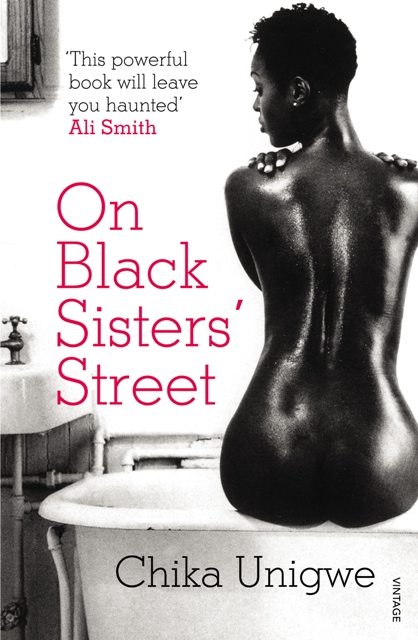
On Black Sisters' Street by Chika Unigwe

  • Paperback: 304 pages
  • Publisher: Vintage

That Nigeria is a failed state is no longer in question.  However, a major consequence of that is the organized exodus of Nigerian girls and women to Western Europe, where they are promised exciting jobs but end up trapped in brothels run by their own nationals - Nigerian “Madams”.

"Black Sisters' Street" by Chika Unigwe is a fictional account of four such women - Sisi, Efe, Ama and Joyce - each of whom left Nigeria for Belgium, with dreams of a better tomorrow, only to find themselves working as prostitutes in the red light district of Antwerp, or "Black Sisters' Street" named for the inordinately large number of African woman that work the street.  To tell you that none of the four went to Belgium voluntarily or that they didn't expect to be prostitutes would be to mislead the reader...however...what makes one angry is the fact that these girls felt it necessary to leave their homes, parents (in some cases, children) and enter this sordid industry only because they could barely make ends meet in their home country.  It is sad these girls had to take up a job that stripped them of all self-respect just so that they could be respected back home in Nigeria.

The character sketches of the four girls are detailed and intimate and yet, at the end of the book, none of them feels like a 'best friend', for despite the tiny details - how they dressed, their family lives, their thoughts, dreams and so on - one really doesn't get to "know" them well. For that matter, even though the girls live togther, they are strangers even to each other until one tragic event brings them together.

Unigwe's prose is clear and calm - although some terrible things take place in the book, the reader doesn't feel weighed down by it.  Unigwe is also skilled at introducing into the narrative issues that are typical to Nigerian society like polygamy,sexism, belief in superstitions, tribal divisions and so on, using just a single reference or a passing comment, leaving the reader with a fleeting but precious sort of cultural snapshot.

I also love her descriptions of Nigeria - from the chewing-gum pink walls of the sitting room in Ama's house (and yes, I know they have them, I've seen them in just about every Nigerian house in a Nollywood movie!) to the streets of Lagos in Joyce's story- her writing with its rich detail, truly entertains and informs.

"Lagos streets were rutted,gutted and near impassable,yet they were jam-packed with cars: huge air-conditioned jeeps driving tail to tail with disintigrating jalopies whose fault exhaust pipes sentout clods of dark smoke making the air so thick with pollution that a constant mist hung over the city and the bit of sky that one could see was sullied with dirt."


We get to know some of the girls better than the others.  The story mostly revolves around Sisi, a college graduate who was unable to find a job in Nigeria because she didn't have the right "connections", however, it is Joyce's story that moved me the most, perhaps because it was the saddest and also, of the four girls, she was the only one tricked into going to Antwerp.   To tell you more would be to give much of the story away and I certainly don't want to do that. 

When Chika Unigwe was asked why she wanted to write about Nigerian prosititutes in Antwerp, she had this to say:

Curiosity. The first time I saw the girls in lingerie behind their windows, I was stunned.  Coming from Nigeria where prostitution is very much underground, it was a cultural shock on a massive scale. I had never seen anything like it before. Then when I was told that a great majority of the African prostitutes in Antwerp were Nigerian girls from Benin City, I knew I had to write about it. The statistics are mind boggling. There is a new crop of middle class families cropping up in Benin City, mostly headed by women whose daughters are in Europe

I'm so glad she did (write about it), the novel does much to make us pay attention to that society that we do everything to ignore, also, it was interesting to see Europe - the destination for so many people's hopes and dreams - through the eyes of these four Nigerian girls. I appreciated that while Unigwe reveals to us that three of the girls did indeed travel to Antwerp while fully aware of what the job entailed, the background stories ensure we don't blame them...it's easy to see how girls like Ama, Sisi and Ete are pressured into taking up these jobs, if anything. it makes you angry at a society that sits back and allows these girls to sacrifice their bodies in order to put meals on the table.

Lastly, but not importantly, I noticed a few digs against Ghanaians in the book...would someone be able to tell me if there is friendly rivalry between the citizens of these two countries?

"Ama spied two Ghanaian guests going back for a second helping rice and smirked to Sisi that surely, surely Nigerians cooked better, made tastier fried rice than Ghanaians.  (People who threw whole tomatoes in sauces couldn't really cook, could they?) And both women agreed that Ghanaians were just wannabe Nigerians."


 An award-winning short story writer, Chika Unigwe, 34, was born in Enugu, Nigeria, and now lives in Belgium with her husband and four children.

Tuesday, December 29, 2009

Half the Sky: Turning Oppression into Opportunity for Women Worldwide


Category: Political Science - Political Freedom & Security - Human Rights; Political Science - Political Process - Political Advocacy; Social Science - Women's Studies
Format: Hardcover, 320 pages
Publisher: Knopf
ISBN: 978-0-307-26714-6 (0-307-26714-8)

Pub Date: September 8, 2009
Price: $34.00

How you respond to husband-and-wife Pulitzer Prize winners Nicholas Kristof and Sheryl WuDunn's book "Half the Sky" is likely to depend on two variables: what you think about activism in general and how you view activists from developed, western countries working to help the less fortunate in developing worlds. Some people see the latter as an unnecessary interference in third world matters, but I happen to think that wherever help can be obtained, that is where it must be sought!

In their book "Half the Sky: Turning Oppression into Opportunity for Women Worldwide" the authors argue that the key to economic progress in the world lies in unleashing women's potential. The book then goes on to provide scores of examples of women whose futures seemed bleak and yet, when they were given a helping hand, they rose to the occasion and pulled not only themselves out of dire poverty, but also their families and in some instances, the whole neighborhood! The authors titled their book after an old Chinese proverb that says "Women hold up half the sky." It's time that people around the world recognize the full implication of that wise proverb and work together to ensure that women everywhere are able to rise to their fullest potential so that we all can benefit from the contributions they will make to global society.

The book also provides helpful information on how to help oppressed women...

Here are some ways (borrowed from the Oprah.com)

Make girls smarter. Many pregnant women living in poverty don't get enough iodine, so their fetuses' brains do not develop properly. Their children routinely lose ten to 15 IQ points—particularly the girls, for reasons not fully understood. The solution: Iodize salt, at the cost of a couple of pennies per person per year. To contribute, go to Helen Keller International (HKI.org).

Support a woman's business. With a microloan of $50, a woman can start a business, producing income she can use to feed her children and send them to school. To make a loan, go to Mercy Corps (MercyCorps.org) or BRAC (BRACUSA.org), two groups helping women around the world.

Keep a girl in school. A girl who gets an education will have fewer children, earn more money, and be able to help her younger siblings. One excellent support program operates in Cambodia, where uneducated girls are at great risk of being trafficked into brothels. For $10 a month, you can keep a girl in school through American Assistance for Cambodia (CambodiaSchools.com), or for $13,000, you can build an entire school that will revolutionize life in a village forever.


If you don't have money to give, here are some ways yo can help them for free!
Join the Half the Sky movement.Spread the Word
The best way to fight poverty and injustice is to educate women and girls. All you have to do is log on to Facebook or your favorite social networking site!


GlobalGivingWatch This Video Watch
Never underestimate the power of a girl. Watch this video and e-mail it to everyone you know. Then, learn more about The Girl Effect.


Join the Half the Sky book clubStart a Half the Sky Book Club
At the heart of Nicholas Kristof and Sheryl WuDunn's book is the belief that women hold up half the sky—and that the injustices of the world can be stopped when all women and children are educated and empowered. Get discussion questions from Nick and Sheryl and more with Mercy Corps' book club.

Kristof and Dunn have put together a remarkable book, one that will surely be remembered as one of the most important books of the decade. Kristof has said that if the great moral struggle of the 19th century was the abolition of slavery and that of the 20th century racial equality, then that of the 21st century would be gender equality. The riveting story-telling, sobering statistics and practical will leave you with no choice but to sit up and pay attention...it's time to pick up the gauntlet and do our part for women, start by buying a copy (or two) of this game-changing book, I know you won't regret it!


Wednesday, August 19, 2009

Woman at Point Zero by Nawal al Saadawi; Shanghai Girls by Lisa See and Lions Head, Four Happiness by Xiaomei Martell


Nawal El Saadawi is a psychiatrist in Egypt and once, while researching a piece for neurosis amongst Egyptian women she had the opportunity to visit some women in prison, one of whom, Firdaus, stood out so much that after Sharai had finished interviewing her she felt compelled to write her (Firdaus')story. Because she took artistic license with some of the details this is not a true biography but because it is stunningly close to what Firdaus suffered, it truly hits you in the gut

Firdaus was born into a peasant home in Egypt. From a young age she realized that being born a girl was a curse. Women were just property that men owned....chattel. Even their bodies didn't belong to them, but to the men that "kept" them. She was only a little girl when her Uncle's hands would steal to her thighs as she worked on kneading dough for the family meal, and then, when she was not much older she was given in marriage to a grotesquely-ugly man in his '60's who used her for his pleasure and violently beat her when he was in a sour mood. When she ran away she was used again by the man who befriended her and not just that, he allowed his friends to use her too.

After what she had thrust upon her it's no wonder she wandered into prostitution and although that bought her independence all she really wanted to do was to get a job and become a "respectable" person. She soon learned, however, that is far better to be a brazen prostitute than a helpless saint and goes back into prostitution, until she is imprisoned and put to death for a murder that i won't go into here for fear of spoiling your enjoyment of the book.

"Woman At Point Zero" is only 108 pages long, more of a nouvella than a novel, but it packs a punch. Even though the woman is guilty of murder none of us can think of her as a criminal...as her crime is borne of anger at her lifelong mistreatment at the hands of men

Told mostly in the first person, the narrative voice with its rhythm, pace and patterns of repetition, convey an urgency and passion that kept my attention rooted to the book (I read the book, cover to cover, it in about 90 mins or so). The book was written more than 30 years ago but the fact that it continues to resonate with women readers of today shows us that for many women in the world freedom and independence are simply words and nothing that they have truly experienced.


Category: Fiction - Literary
Format: Hardcover, 336 pages
Publisher: Random House
Pub Date: May 26, 2009
Price: $28.95


"SO often we're told the woman's stories are unimportant. After all, what does it matter what happens in the main room, in the kitchen, or in the bedroom? Who cares about the relationships between mother, daughter and sister? A baby's illness the sorrows and pains of childbirth, keeping the family together during war, poverty or even in the best of days are considered insignificant compared with the stories of men, who fight against nature to grow their crops, who age battles to secure their homelands, who struggle to look inward in search of the perfect man. " Pearl Louie in "Shanghai Girls" by Lisa See, pg 228

I hate to argue with the protagonist but I think women make infinitely interesting characters because of their ability to endure and bear physical and mental agony despite their delicate appearances. "Shanghai Girls" is a story of two sisters. Pearl and May are ‘beautiful girls’ — models for advertising and calendar posters — but when their father loses not only the family money but also the girls’ savings, he sets them up in arranged marriages with a pair of Chinese brothers from America and so begins the girls' epic journey across the Pacific to America (not an easy feat in those days because the Americans had no interest in taking Chinese people). The story goes on to trace their lives in America so irrevocably different from the High society and glamorous lives they lived in Shanghai and how they walk the tight rope between maintaining their Chinese identity and, yet being afraid of being overly Chinese because of all the discrimination that people from China were exposed to.

This is a truly lovely book...beautiful family drama, multi-dimensional characters and prose that is rich with emotion and replete with everything you need to know about Chinese immigrant families in Los Angeles in the'40s and '50s. Although some parts of the book drag a little, See is such a brilliant narrator of history that you soon get caught up with interrogation games at Angel Island,(like Ellis Island but the immigration processing station in San Francisco Bay Communist witch hunts in in L.A., illegal citizenship and "paper sons", the lure of Hollywood and the importance of proving one's Chinese identity during America's war with the Japanese. If you like historical fiction, you might like this one. I don't think it compares favorably with her previous two novels though.


Author: Martell, Xiaomei
Format: Paperback
Pages: 240
Publication date: 1 April 2009

Food-oirs or food memoirs are are everywhere these days. When I visited our local bookstore recently I was agape at the large space provided to this very popular sub-genre and I can see why...more than anything it is the sight, smell and sound of food that engages so many of our senses. Any wonder then that many of us look at the world through food? Food also teaches us so much about culture. For instance, when I travel my impressions seem to start and end with the food. While my friends are busy clicking photos of monuments, buildings etc, I am most likely noting down recipes or trying the local food because it teaches me so much about the people.

"Lion's Head, Four Happiness" is a sweet account of Xiaomei Martell's childhood in China during the turbulent years of Mao's Cultural Revolution. She was born in 1964 on the borders of the Mongolian steppes. The youngest of four daughters - her name translates as 'Little Sister'. Her family had few material goods.There was a lot of rationing of food in those days and this brought out the creative side of Chinese women because they had to plan the menus carefully.

Unlike most novels set in the time of Mao, politics is peripheral in this one, and understandably so as a child's knowledge of what was going on at that time would be limited. Instead, the readers are treated to a host of Chinese kid memories, like playing "pig toes" with her friends (a game requiring dexterity and coordination); riding on the back of her mother's bicycle reading the revolutionary slogans (her first lessons in literacy as the author likes to call it) and the festivities of the Chinese New Year, especially the making and eating of "jiaozi" or Chinese dumplings. Birthdays, although special, were not celebrated...at the very most the birthday girl or boy would be treated to an extra egg, or a peach if it was in the summer.

The interesting title also happens to be the name of Xiaomei's favourite Chinese dish from the south whose origins can traced back to the sixth century. The Lion's heads were generously-sized meatballs and ‘Four Happiness’ refers to the qualities attributed to the meatballs - affluence, health, harmony, and joyfulness.

All in all this is an enjoyable read...I enjoyed the recipes and the casual way she presented them. Might try making the Chinese tea eggs some day....they sound tasty!