Thursday, January 18, 2007

The Good Earth by Pearl S. Buck

# Paperback: 368 pages

# Publisher: Washington Square Press; (September 15, 2004). First published: 1931

Music to listen to as you read: (clicking on the links takes you to the mp3 recording)

Autumn Moon Over a Quiet Lake
(composed in the 1920's by Lu Wencheng)

Slow Liu Ban
(composed by Jiang Nan)

An Dun part 2


With gratitude to Angela in Europe for reading this book with me and for the wonderful discussion that ensued via e-mail. Thanks, Angela, you made the rereading of this book so enjoyable with your fresh perspective and insights.


Introduction:

What can one say, I wonder, about Pearl Buck's immensely popular and well read novel that hasn't already been said? I read "The Good Earth" when I was in Grade 10 and remember it being such a powerful story that when booklogged announced her Classics Challenge, I felt bound to do a re-read. I am not finding it all that powerful this time around which certainly lends credence to the theory that a book speaks differently to you depending upon what
stage of your life you read it in, but it is no less enjoyable and still very,very moving in parts.

Synopsis:

The story in a nutshell, centers around Wang Lung, a peasant living in abject poverty in the Chinese north in the early part of the 20th-century. When he reaches a marriageable age, O-Lan, a slave girl from the rich Hwang House is given to him as a bride.Together they toil his land and build a family and with her resourcefulness and his hard labor Wang Lung slowly becomes a prosperous landowner, even buying out the lands once owned by the great Hwang family.

Wang Lung's fortunes change more than once, and as he acquires more wealth you see his priorities start to change - he dresses like a rich man, sends his sons to school (he himself was illiterate); he buys a concubine (Lotus) and builds her her own quarters with her own slaves; he starts to find fault with his wife, O-Lan "...who plodded in silence . . . her features were too large . . . and her feet were large and spreading." (her feet had not been bound); he no longer toils the land himself but employs men to work on his fields. While his attitude to everything changes the one thing that appears to remain a constant in his life, is his love for the land, his appreciation of it and the awareness that he would have been nothing had it not been for "The Good Earth".


What I liked about the novel:

The narrative is simply written and very easy to read. The language employed is quaint and sweet. It's the kind of novel you could read anywhere, but, be warned, its impact can send you reeling. Pearl Buck writes about ancient China like none of her contemporaries, I'm sure there were Chinese writers also writing about China in that period, but sometimes local writers do not describe social customs and traditions in detail (they expect it is understood). Pearl Buck knew she was writing for an American audience and writes in glorious detail taking the reader into the heart of the place sharing the customs, tradtions, history and the thinking of the time (the 1920's)

What I learned:

I was most appalled by the gender inequality and how women were treated. In 20-century China, women were not daughters, they were borne simply to be a man's slave, they were even referred to as "slave" or "maid".

"...she was a like a faithful, speechless serving maid, who is only a serving maid and nothing more. And it was not meet that he should say to her, "why do you not speak"? It should be enough that she fulfilled her duty"

Along with this serfdom they had to put up with foot binding, a husband's many concubines and looking after his extended family's every whim, it certainly made feel so lucky to be born a woman in this era and this part of the world. I cannot help but question, however, if much has changed for the women of China. If you have read Xinran's book "The Good WOmen of China" you will know why I ask.


Also, I was most impressed with the filial piety practised by the Chinese. As much as Wang Lung hated his uncle (his father's brother) he was compelled to look after him and his family until they died, providing for all their needs, like food, lodging and even their recreational smokes.

Conclusion:

I think Pearl Buck meant the land to serve as a metaphor for one's value system, one's traditions. As long as Wang Lung stayed close to the land and tended to it himself, he was a morally upright man, but the minute he strayed away from it or handed over the tending to outsiders, his morals started to waiver. I think Wang Lung always knew that deep down inside and that's why he clung to his land

update: Les from Lesley's Book Nook has a wonderful, wonderful review of the same book. Check it out!


Monday, January 15, 2007

Guru, गुरू: This is not a review


Went to see Mani Ratnam's "Guru" last evening (with apologies to sasgirl, I'll explain later). It had its World Premier at the Elgin Theatre in Toronto, Thursday night and just about everybody was talking about it. I had been listening to its super soundtrack all month long and was eager to see how the songs had been picturised for the screen, I also wanted to see Abhishek Bachchan play the role of a country bumpkin- turned- big industrialist. I had heard whispers that he had done an outstanding job and wasn't disappointed. He plays Guruchand Desai (whose story bears an uncanny likeness to that of Reliance Industries founder Dhirubhai Ambani, although the "Guru" camp forcefully denies it) from a young man of 16 years with huge ambitions to make it big even if it meant sometimes using morally questionable means to get his way, to an established,wealthy industrialist of 60 years and he (Abhishek Bachchan) truly does an outstanding job.

He was required to put on weight for the role and like a true actor he manufactured for himself a splendid potbelly which he took great pride in showing off through the movie. Sujatha, Guru's supportive wife, was played by Aiswarya Rai and I was so grateful they played down the glamor and made her look like any young village belle. It became easy to relate to her and definitely made her role more believable.


(pic courtesy: India FM)

Unfortunately, with my limited knowledge of cinema, I cannot wax eloquent about the storyline,cinematography or even the photography, but I will say this is an inspiring movie....Abhishek Bachchan's powerful performance will wow you and his rousing speech at the end will inspire all young entrepreneurs to go forth with their dreams. Aiswarya's quiet and dignified performance will also earn laurels I am sure. Their love scenes, although playful are very endearing and beautiful to watch.

With regard to the song picturisations (the real reason I went to see the movie), I enjoyed what Ratnam did with "Barso Re" and "Ek Lo, Ek Muft", but I think AR Rehman's beautiful "Tere Bina" could have used much better treatment. Anyone here seen it? Agree? Disagree?

Since this is just a blather and not a review, I feel it incumbent upon me to point you to a proper review - so rollerblade to Brangan's blog "Blogical Conclusion" to read his terrific and detailed review. I'm also waiting for Motorama to write his, but because he wasn't completely floored by the movie, I have the feeling he might deny us the pleasure. :)

Thursday, January 11, 2007

Ten Things I Love That Begin With "B"


(Vintage Bollywood Poster from thehotspotonline)

Ten Things I Love That Begin With "B"

Orange Blossom Goddess aka Heather was assigned "L" by Stefanie and Heather assigned me the letter "B".

1.Books: When I look up the letter "B" in the visual dictionary of my mind, the first thing I see is books! For bookish me, "B" has to be synonymous with books!

2.Bombay: Ok, so it now called "Mumbai" but I will always think of it as Bombay. It's the city I grew up in. It nurtured me for the first 24 years of my life and so holds a very special place in my heart, and before I get too mushy, I had best move on to the next "B"!

3.Beaches: I grew up walking distance from a beach (Juhu Beach on the Arabian Sea) and because it was always there, I took it for granted. Little did I know that one day I would have to drive for several hours just to feel the sand between my toes.

4.Boxers: Nnooo, not the underwear, not even the people indulging in the sport of boxing, but the dogs! I love how strong, courageous and noble they seem. Great police dogs!

5.Bollywood!: What can I say, except, that to watch movies out of Bollywood is my favorite waste of time. I love them!!!

6.Birthdays: I love birthdays, there's such a positive energy that surrounds the birthday girl or boy, everyone's smiling, favorite things are being baked or cooked, there are hugs, wishes, cake to eat, candles to blow out, presents...

7.Blue: my favorite color (I love green also) - I love it in all shades - aqua, cornflower, ice blue, robin's egg blue, turquoise....you name it. For other blue lovers, here's a quiz you can take: What Color Blue Are You? I'm Indigo - funky, unique, and independent.

8. Brides: Don't you just love brides? They look so pretty, starry-eyed,happy and resplendent in white. Back home, ofcourse, they wear beautiful red saris. Romance,love and giggles seem to surround them. No matter how much in a hurry I am, I will always stop if I see a bride (it's considered a good omen in some countries).

9. Blueberries: Sweet to eat and all those yummy anti-oxidants are so good for you!

10. Badminton: Rediscovered the game recently ...it keeps me fit and active (well, sorta) and since I play in a group of nearly 12 women, it's a great social activity as well.

Let me know if you would like a letter!

Sunday, January 07, 2007

Umrao Jaan Ada by Mirza Mohammad Hadi Ruswa

ISBN: 8172235070
Cover price: Rs. 295
Extent: 288 pages
Publishers: HarperCollins India

Translated from the Urdu by Khushwant Singh

Official Site for J.P. Dutta's "Umrao Jaan" the movie.


One evening in 1905, renowned Urdu poet Mirza Mohammed Hadi Ruswa was at a poetry evening with his friends when they heard someone say "wah,wah" ( urdu, to express appreciation at the recitation of a poem or ghazal) to a couplet that Ruswa had recited. Upon investigation they found that the voice belonged to none other than Umrao Jaan a famed courtesan of the early 20th century in the Princely state of Lucknow. She was retired and happened to be staying in an adjoining apartment. Ruswa persuaded the aging beauty to join them in reciting verses, where the last lines of one of her verses went something like this:

Who will listen to the tale of

my woeful heart?

Far and wide have I wandered on

the face of this earth

And I have much to impart.

Ruswa was intrigued, he asked Umrao Jaan if she would be willing to tell him her life story...she agreed and thus "Umrao Jaan Ada" ,perhaps the first great modern Urdu novel ,
was born. THe version I read has been ably
translated from the Urdu by Khushwant Singh.


The Courtesan:


Umrao Jaan practiced her trade somewhere in the middle half of the 19th-century in Lucknow. Like the Geisha of 19th-century Japan, she was well-versed in the arts (conversation, dance,poetry, literature etc.) and young nawabs (the sons of princes) were sent to these courtesans to learn all that a young aristocrat needs to know. For the most part, courtesans were respected but because they also handed out sexual favors to clients who paid generously, they were not considered to be part of the "respectable" Muslim class.


The Book:

The book is written in first person, to perhaps create the illusion of an autobiography . The author also employs a dialogue narrative where the courtesan and author, both grown old, reminisce, flirt with one another and quote ample verses from various ghazals (poems).

We get to read about Umrao's life right from the time she was kidnapped as a child and sold to a "kotha" house up until the time she meets the poet Mirza Ruswa. The descriptions of Nawabi Lucknow, the palatial, "haveli-type" houses, the beautiful Begums, the handsome Nawabs, the lavish style with which they lived, while not as beautiful or as evocative as Kyoto, Japan in Arthur Golden's 'Memoirs of a Geisha" are still very interesting to read .


Despite reserving some harsh words for others in her profession I thought Ruswa treats Umrao with a lot of empathy in the book, making her out to be a strong woman, rather than a "fallen" one. The fact that he lets her tell her own story and present her unique opinions on love, men, women, marriage etc. has made this a very strong female narrative and the last few chapters of the book where Umrao discusses age and beauty; the courtesan and love; the need for younger men by older women; men vs. women in love, all make for very profound reading and is probably the most powerful part of the book. However, as one other reviewer opined, the rest of the novel reads more like a Balzac novel with its details of traveling, descriptions of households, the finery ofclothes and decoration etc.

This novel will probably not hold everyone's interest, but if the position of women
amidst a patriarchal, feudal society interests you, this is the book for you.

I'd love to hear from anyone who has seen either or both the "Umrao Jaan" movies - what did you think of them?

Monday, January 01, 2007

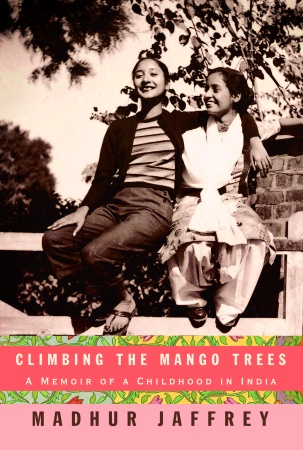
Climbing The Mango Trees: A Memoir of a Childhood in India


# Category:
Biography & Autobiography; Cooking - India; Cooking - History

# Format: Hardcover, 320 pages

# Price: $25.00

# Publishers: Knopf


When Madhur Jaffrey (famed cookbook author and actress ) was born in her grandmother's house in Delhi, her grandmother welcomed her into the world by writing "Om" (a Hindu sacred word) on her tongue after dipping her finger in honey, which the baby Madhur promptly licked clean,it was perhaps that little gesture which prompted her father to name her "madhur" which means, "sweet as honey" . . When you look at Madhur's achievements today in the cooking world, the same seemed highly prophetic -as she puts it, "I was left with honey on my palate and in my deepest soul".


"Climbing the Mango Trees" is the utterly delightful and charming story of Madhur's childhood in India. Madhur, her parents and her five siblings all lived in her grandfather's house in Delhi in a joint family amidst dozens of cousins (many times it was almost 40 of them sitting down to an everyday family meal). Madhur's father wasn't exactly happy to live under the domineering eye of his father, but tradition demanded that he did and all of them living together made for some very interesting family dynamics as those of us who have lived in joint families before will attest to.

Although the author and I are separated by at least a generation, I found so many things in her childhood that could have been taken from my own - the convent education; the tiffin box lunches; climbing the guava trees in our compound rushing the fruit to the kitchen where my mother would prepare plates of "Guava chaat" (diced ripe guavas seasoned with salt,pepper,ground roasted cummin seeds, chilli powder, lime juice and a little jaggery),and who could forget the toffeeman? The toffeeman or toffeewallah(a street vendor hawking sweets in an aluminium trunk which he would lug from house to house) was a permenant fixture of Madhur's childhood and mine, when he would visit our home my favorite thing to eat from among his appetizing wares was the candy pink coconut ice cut into chunky diamond squares - mmmmm, delicious; my mother, like hers, also believed in the power of almonds to nourish the brain and I had to eat almond sweets before every school exam! The similarities go on and on, but I will stop here to let you, the reader, discover for yourself these delicious childhood memories that Madhur Jaffrey so evocatively captures in this enchanting memoir.

(pic courtesy: rediff.com)
What I did not have in common with the author was living through the Partition of India (it was way before my time). In her book she explains how Delhi, her city, changed as her Muslim school friends left for Pakistan taking with them their fabulous kheema dishes (spiced ground meat) and making place for Punjabi refugees from Pakistan who arrived in Delhi with their tandoors (clay ovens) in which they baked a variety of bread and roasted succulent meat. As a result Delhi was the first city in India to boast of a tandoori restaurant- the famous "Moti Mahal" - a huge claim to fame when one considers how popular tandoori food is all over India, and indeed, all over the world.

Jaffrey's memoir which is infused with delicious associations with food, spiced with family gossip, peppered with family recipes (32 of them), seasoned with thoughtful and humorous observations and garnished with beautiful black and white pictures from the family album, makes you want to devour this book in a single sitting, but instead of gulping it down, try to savor it page by page, and you'll discover how sweet it is to see the past re-created through food.


Tuesday, December 26, 2006

Six Weird Things About Me - Meme

Yeay! I've been tagged by Bookfool. Thanks, Bookfool, this is a fun meme!


The Rules: Each player of this game starts with the “6 weird things about you”. People who get tagged need to write a blog of their own 6 weird things as well as state this rule clearly. In the end, you need to choose 6 people to be tagged and list their names. Don’t forget to leave a comment that says “you are tagged” in their comments and tell them to read your blog.


6 weird things about me:
(since this is mostly a book blog, I'm going to restrict my weirdness to books/rading material)

1.I cannot read a book that has a torn or stained cover - I just cannot do it.

2.I don't read the preface of a book until I am almost halfway through the book.

3.I generally read magazines backwards, starting with the last article first.

4.When I am about to start a new read, I take great pleasure in creating the right mood for the book. For instance, if it's a book set in Morocco, I will play Moroccan music, visit a Moroccan restaurant a couple of times, read a few Moroccan blogs, light some frankencense in the study...I love immersing myself in the culture that the book is going to take me to.

5.When onboard a train, bus or plane, I have to look at the titles of books that fellow-commuters are reading even if it means staring. I can't seem to help myself!

6. I love bookstores, but I can't spend too long in one or I get claustrophobic - guess that rules out ever working in one! ;)

I know I'm supposed to tag 6 people, but it's a busy time so I'll say, if you like this meme, consider yourself tagged!


Thursday, December 21, 2006

An Indian Christmas Card

Merry Christmas and Happy Holidays Everyone!
Have a wonderful,wonderful time and see you after Christmas!