I just have to a give a plug to the Toronto Women's Bookstore. It is my mission to support them as much as I can because I appreciate their mission to give a voice to women writers, especially marginalized women, including women of colour, First Nations women, lesbians, disabled women, Jewish women, and other groups of women.
Aside from that, they also have a wonderful selection of books, lots of speaker events, book launches and evenings of readings and poetry. Do check them out!

Monday, May 16, 2005
Saturday, May 14, 2005
Book Review: Bound Feet & Western Dress by Pang-Mei Natasha Chang
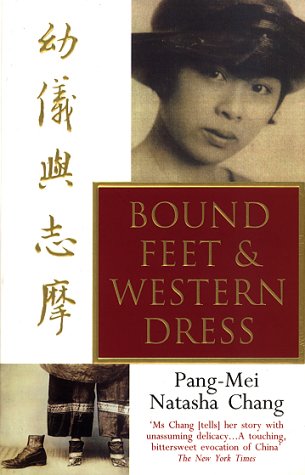
The author, Pang-Mei Natasha Chang was a Chinese studies major at Harvard when to her great surprise, her great aunt's name popped up in a textbook. This makes her curious enough to want to talk to her aunt Yu-i about her life in China. This results in a very poignant memoir of her very Chinese aunt who grew up in China in the early part of the 20th century where filial piety and duty towards one's husband and then one's sons came above and before everyone and everything else in a woman's life. The first chapter, aptly titled, "A Woman is Nothing", tells it all.
Take for instance, the tradition of foot binding.
Great-Aunt Yu-I describes the pains of foot binding in detail. She explains the breaking of the bones in the foot, the removal of bloody bandages, the soaking, the rewrapping and tightening of the bandages. The process began when Yu-I was three years old. When her brother saw the pain Yu-I was in, he insisted that his mother stop the painful binding, but the mother worried that without bound feet, no man would marry Yu-i. Bound feet are not only considered beautiful like a lotus flower, but they also serve to control women and keep them confined to their houses.
Another way they controlled women was to keep them ignorant. Although Yu-I was a keen learner she found few opportunities to gain an education.
Anyway, as Pang-Mei continued to interview her aunt, she found to her great astonishment, that her eighty-three-year-old aunt had once been married to Hsu Chih-mo, China's preeminent modern poet and had suffered the anguish of enduring what is considered China's first Western-style divorce. The reason the marriage didn't work was because Hsu Chih-mo wanted a Western-thinking woman with modern ideals, but who would remain subservient to him and his parents. Little did he realize that 'bound feet and western dress' did not mix. Also, all Chinese women at that time had to accept their husband's concubines without a fuss or without showing any kind of jealousy because along with disobeying his parents, not being able to bear him sons, commiting adultery, being repulsively sick, talking too much and commiting theft, being jealous was one of the seven recognized grounds for divorce!
Yu-i's story does end happily enough, in that, she makes a life for herself in Shanghai and goes on to become the Vice-President of the Women's Bank before she has to immigrate to the US to escape the Cultural Revolution.
Friday, May 13, 2005
Shadow Cities by Robert Neuwirth

Picture of a slum in Bombay
From "The Current" at CBC.ca:
Here in North America, affordable housing is a cause celebre to activists, a bargaining chip for politicians and almost impossible to find for those who need it. And squatters, well, depending on whom you talk to, they're either anarchists, criminals or just a nuisance.
Robert Neuwirth found that it's a very different story in the big cities of the developing world. He went to live in the burgeoning and bustling squatter cities in the sprawling metropolises of Rio de Janeiro, Nairobi, Mumbai and Istanbul. He rented his temporary homes from other squatters, ate in their restaurants and used their latrines. His new book, Shadow Cities: A Billion Squatters, A New Urban World, chronicles his experiences in these illegal settlements among the fastest-growing urban communities in the world.
Also read what Boing Boing had to say about his book here
WorldChanging also has a very informative piece on Neuwirth's book here.
Wednesday, May 11, 2005
Everything Bad is Good for You by Steven Johnson

Well, I'm always telling my daughters how they shouldn't waste their time watching TV or playing video games and that they should be reading instead and then along comes a book (brought to my attention by my teenager) that tells us that playing video games is actually good for us. After I got over the shock, I delved more into what the author and social critic, Steven Johnson, was saying and I have to admit *gasp* that I actually agree with quite a big chunk of his argument that pop culture could be brain candy to a certain extent.
Here's an extract from a review of his book in "The NewYorker" written by Malcolm Gladwell of "Blink" and Tipping Point" fame:
As Johnson points out, television is very different now from what it was thirty years ago. It’s harder. A typical episode of “Starsky and Hutch,” in the nineteen-seventies, followed an essentially linear path: two characters, engaged in a single story line, moving toward a decisive conclusion. To watch an episode of “Dallas” today is to be stunned by its glacial pace—by the arduous attempts to establish social relationships, by the excruciating simplicity of the plotline, by how obvious it was. A single episode of “The Sopranos,” by contrast, might follow five narrative threads, involving a dozen characters who weave in and out of the plot. Modern television also requires the viewer to do a lot of what Johnson calls “filling in,” as in a “Seinfeld” episode that subtly parodies the Kennedy assassination conspiracists, or a typical “Simpsons” episode, which may contain numerous allusions to politics or cinema or pop culture. The extraordinary amount of money now being made in the television aftermarket—DVD sales and syndication—means that the creators of television shows now have an incentive to make programming that can sustain two or three or four viewings. Even reality shows like “Survivor,” Johnson argues, engage the viewer in a way that television rarely has in the past:
Johnson develops the same argument about video games. Most of the people who denounce video games, he says, haven’t actually played them—at least, not recently. Twenty years ago, games like Tetris or Pac-Man were simple exercises in motor coördination and pattern recognition. Today’s games belong to another realm. Johnson points out that one of the “walk-throughs” for “Grand Theft Auto III”—that is, the informal guides that break down the games and help players navigate their complexities—is fifty-three thousand words long, about the length of his book. The contemporary video game involves a fully realized imaginary world, dense with detail and levels of complexity.
What I didn't like however was what he had to say about books. He denounced books as being a solitary, isolated pastime where kids didn't have a chance to interact with their peers through the process. No? How about book groups? Or school competitions like "Battle of the Books"? I think those are f ine ways for children to discuss books together, don't you?
In the author's words:
Books are also tragically isolating. While games have for many years engaged the young in complex social relationships with their peers, building and exploring worlds together, books force the child to sequester him or herself in a quiet space, shut off from interaction with other children. . . .
But perhaps the most dangerous property of these books is the fact that they follow a fixed linear path. You can’t control their narratives in any fashion—you simply sit back and have the story dictated to you. . . . This risks instilling a general passivity in our children, making them feel as though they’re powerless to change their circumstances. Reading is not an active, participatory process; it’s a submissive one.
Bah, I say!
Tuesday, May 10, 2005
Book review: Journey from the Land of No by Roya Hakakian

"Journey From the Land of No", is a beautifully written coming-of-age story about a young Iranian-Jew's attempt to find her authentic self at a time of cultural closing and repression in Iran.
Not only does the author tell the story of what it was like to grow up Jewish in Iran on the brink of the revolution, but she also introduces her readers to a cast of colorful and eccentric characters that were a part of her life in Iran. Mrs. Moghadam, Roya's school principal, left a lasting impression on me. Her fiery lectures to the young women are not to be missed. The language is fierce, but delightful because it evokes such strong feelings in the reader. After reading one of those lectures I knew exactly how frustrated and suffocated Roya and her classmates must have felt under that repressive regime.
A good read!

Monday, May 09, 2005
Book Review: Vikas Swarup's Q & A

Vikas Swarup "Q & A"

If you have a penchant for Bollywood movies, you will
enjoy this book because it reads just like a story out
of Bollywood. The protagonist, Ram Mohamed Thomas, is
a poor waiter who emerges as the winner of a billion
rupees in the "Who Will Win a Billion" show. But
instead of seeing his prize money he sees the inside
of a cell, for according to popular logic, how can a
poor, virtually illiterate orphan boy know the answers
to 12 tricky questions on a game show unless he has
cheated?
To prepare his defense, the protagonist's lawyer
conducts a lengthy interview with him to assess how he
got all 12 answers right despite being a barely
educated, penniless waiter, and in doing so, we the
readers are treated to Ram's life story in 12
wonderful chapters during which we conclude that Ram
has drawn on a wealth of street wisdom and life
lessons enabling him not just to win a quiz show but
to win the struggle against itself.
This is a delightfully told yarn, at once funny and
sad and sometimes employing a highly exaggerated style
which is necessary when you consider that the
protagonist and his chums are huge Bollywood fans. The
writer does a wonderful job of taking the reader on a
trip through the underbelly of India introducing the
readers to a whole host of colorful characters which
inlude street urchins, pimps, dacoits, slum dwellers,
Taj Mahal tour guides and even a princess. I
thorougly enjoyed this book and was almost sad when I
came to the last page.
Sunday, May 08, 2005
Welcome to my Library!!!
Just a little cozy home for book lovers and the occasional movie watcher. I might also include music album reviews from time to time. I hope you will stop by often to read my reviews and share your comments. I am not a terribly fast reader; you will find that I average between 3-4 books on a good month. I am also a great fan of audio books. My favorite genres? I would have to say South Asian Literature and Contemporary Fiction. However, I also enjoy History, Neuroscience and Memoirs in small doses. Hope to hear from some of you soon!
I am not how to explain my love for reading; this little extract from Marion Keyes' book "Watermelon", perhaps explains it the best:
"Then we wandered around a bookshop for a while. My
adrenaline started pumping any time I was within about
a hundred yards of a bookshop. I loved books nearly as
much as I loved clothes. And that is saying something.
The feel of books and the smell of them. A bookshop
was like an Aladdin's cave for me. Entire worlds and
lives can be found just behind that glossy cover. All
you had to do was look."
Subscribe to:
Posts (Atom)