Showing posts with label Refugees. Show all posts

Friday, April 09, 2010

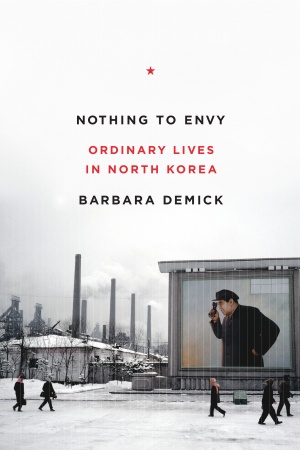
Nothing to Envy: Ordinary Lives in North Korea by Barbara Demick

For the most part North Korea remains a dark, inscrutable place. Journalists, tourists and AID agencies are allowed in but with severe restrictions. They are usually not allowed beyond Pyonyang, the Potemkin village-like capital, and they (especially journalists) are assigned "minders" whose job is to make sure no unauthorized conversations or reporting take place. When Barbara Demick moved to Seoul as a correspondent for the Los Angeles Times, her job was to cover both the Koreas, but as no contact was permitted with the North Korean people she took to talking to North Koreans who had defected to South Korean and in time a picture of real life in the Democratic People's Republic of Korea began to emerge which she put into words for articles written for the Los Angeles Times.

Eventually after seven years of conversations with North Koreans, she decided she would tell their stories in a book titled "Nothing to Envy: Ordinary Lives in North Korea" -  a title inspired by a North Korean children's song which boasts that the N.Korean people have nothing to envy of the rest of the world.  Nothing could be further from the truth as Demick very ably describes in this beautifully-written narrative of life in the Hermit Kingdom.

For the book she focuses on people that came from a place called "Chonglin", N.Korea's third-largest city and one of the places that were hardest hit by the terrible famine of the mid-1990's. It is also almost entirely closed to foreigners.

Funnily enough, North Korea hasn't always been this hopeless. In its early history, the Democratic People's Republic of Korea was actually considered a success case in economic development. In the 1960s, the "Korean economic miracle" referred to the steel plants and electrified transport networks of the DPRK, but as South Korea, China (1980) and even Vietnam (1990) embraced market reforms the chasm between North Korea and its neighbors grew wider...South Korea grew richer while its neighbor to the North kept getting poorer.

Also, all through the '70's fertilizers, pharmaceuticals, X-ray machines and more were coming at a low or no cost from Moscow, East Berlin and Prague.With the collapse of the Soviet Union and Eastern Bloc 20 years ago there was a sharp decline in Soviet aid and credit, which could not be replaced by the less advanced Chinese, thus the North’s economy was in free fall...

The country’s electricity supply collapsed. Factories went silent. Salaries went unpaid. Food disappeared. Families foraged for grass, and ground the barks of pine trees into a flour substitute in hopes of staving off death. Corpses piled up. Animals that might have provided food disappeared; even frogs were hunted to near extinction.

However, "People did not go passively to their deaths, when the public distribution system was cut off, they were forced to tap their deepest wells of creativity to feed themselves. They devised traps out of buckets and strings to catch small animals in the field, draped nets over balconies to snare sparrows."

By 1996, North Korea was in the grip of one of the deadliest famines in modern times. Much of Demick's book is devoted to that time period when an immobile, totalitarian country was transformed into a place of "wandering swallows" (children whose parents had died or gone off to find food) stealing fruit and hunting frogs; middle-aged women who had never worked before bartering skills for food in the black markets; college-educated women wading half-naked across the Tumen River to sell themselves into arranged marriages with Chinese farmers; family patriarchs making sure that the food gets to the younger members of the family first often going raving mad before a quiet, hideous death from starvation.

Demick, (through the eyes of six ordinary North Koreans including a female doctor, a pair of star-crossed lovers, a factory worker and an orphan) describes the harrowing toll of mass hunger on the basic institutions and infrastructure of North Korean life. Its tales of mass starvation, brutal political repression, citizens working long days  followed by hours of ideological training at night; gulags; neighbour spying on neighbour, and a communist regime which seemed intent to blame the “American imperialist bastards,” for having created the famine by imposing blockades on North Korea does not make pretty reading, but you will be riveted because the rationalist in you will keep asking if this post-apocalyptic scenario really could have happened...in this modern day and age...where new reporting has scaled new heights...can a place like North Korea actually exist? How do they exist? How do they keep their population so ignorant?

The truth of the matter is that North Korea sadly is a place where transistor radios were/are tuned into domestic services only, the only country on earth not connected to the world wide web, no mobile phones, also, a rigorous system of passes largely forbade internal travel.  North Korea manages to seal its inhabitants off from any outside influences, while at the same time inculcating a belief that North Korea is a paradise.

While North Korea may not have been a paradise, defectors had very mixed successes when they arrived into South Korea.   It is not easy for people earning less than a dollar per month be integrated into the world's thirteenth-largest economy.  A good deal of propaganda on both side of the DMZ is devoted to how North and South Koreans are the same (one people, one nation), but after 60 years of separation the differences between the people are significant.  South Korea is one of the most technologically advanced countries in the world while people in North Korea don't have access to the internet.  North Korea has been frozen culturally and economically for the last 50 years so even the languages are no longer the same.  South Koreans pepper their Korean with a lot of English slang words. Physically too, the people have grown apart with the average 17-year old South Korean boy being atleast 5 inches taller than his North Korean compatriot!

For all the support provided by the South Korean government, defectors often find it hard to settle down in their new homeland. It is not easy for somebody who's escaped a totalitarian country to live in the free world.  Defectors have to rediscover who they are in a world that offers endless possibilities.  Choosing where to live what to do, even which clothes to put on in the morning can be utterly paralyzing for people who've had decisions made for them by the state their entire lives. They are also desperately lonely when they first arrive in SK and have a hard time understanding South Korean etiquette, often mistaking sympathy for condescension.  Defectors are also nagged by the impermanence of their situation.  Many fled with the conviction that Kim Jon-il's regime was close to collapse and that within a few years they would be back "home".  Sadly, it's 2010 now and that still hasn't happened.   Many left parents and children behind whom they will probably never see again in this lifetime.   If that is not depressing, what is?  Finally, the qualities most prized in South Korea are height, fair skin, affluence, prestigious degrees, designer clothes and English-language proficiency.  And these qualities are precisely those that the newly arrived defector lacks which accounts for a low self-esteem, making it virtually impossible for them to shine in social or professional settings.

Some might question Demick’s heavy reliance on the accounts of defectors, but because much of North Korea is so impenetrable there is no other way to tell these stories. She explains that she corroborated the stories with publicly-reported events and cross-checked the accounts with reports by nongovernmental organizations and other defectors.  One can only hope that one day North Korea will be open and we will be able to judge for ourselves what really happened there.

In closing I really must commend Demick for this wonderful expose on the world's last totalitarian regime.  She writes with such sensitivity, grace,skill  and novelistic detail you will be completely drawn into the lives of these poor, unfortunate people.  As with all good writers, she leaves herself out of the picture and takes us into the minds of her subjects until they no longer are the grey-clad people marching in unison that we see on TV, but people like you and I with dreams, hopes and desires.

Sunday, January 03, 2010

Little Bee by Chris Cleave


Category: Fiction
Format: Hardcover, 288 pages
Publisher: Bond Street Books
ISBN: 978-0-385-66530-8 (0-385-66530-X)

Pub Date: February 10, 2009
Price: $29.95

The Bible tells us Jesus Christ gave up his life for humankind and indeed, being prepared to give up one's life has become the greatest expression of love between lovers, a parent and child and sometimes even best friends. Having said that, however, I'd like to ask you this: what is the biggest sacrifice you would make, not for a friend, a lover or even a family member, but for a stranger, someone you don't know, someone you will gain nothing from?

Now that's a tough one, isn't it?

Some people are driven to altruistic lengths to help a stranger in need. Many will donate money and time, or both. Some will make radical donations of a healthy kidney or liver to to people in need. Buddhists are well known for a ritual where they take on other people's sufferings, but all these actions, wonderful as they are, are usually premeditated and the giver has had time for prepare himself or herself for this sacrificial gift. Would we be as giving if we're taken by surprise and with an urgency that leaves no room for thinking or planning?

"Little Bee" is the story of two such strangers and how their fates intertwine one fateful summer's day in Nigeria. The central theme of the story examines how despite deep-seated convictions, life unfairly places a disproportionate emphasis on the decisions we make in split seconds.

Other prominent themes in the book include asylum seekers, the state of detention centers in the UK and issues a challenge to its readers to ponder why the word "refugee" has become such an ugly word in today's parlance. For instance, why is it that in late 60's and even early '70's defectors from the then USSR, or other European communists state were cheered on and even celebrated as heroes, but today we balk at having to share our resources with their countrymen. Why do we treat refugees as criminals, locking them away until their cases can be heard? Why do their cases take so long to hear?

The novel is a bittersweet one and told in two voices (the two main female protagonists that we spoke of earlier in the review). This works well because the two women are from opposite sides of the great class divide and by hearing both their voices the reader gets a dual perspective instead of just one. About the characters, I am not sure I could be friends with any of them in real life, but they made for great character studies!

So, to summarize, this is a novel that is sad and yet funny; serious and yet light-hearted; heavy and yet it's only a wisp of a novel...overall a lovely reading experience!

This novel is called "The Other Hand" in the UK and in India and the rest of the sub-continent. Anyone know why novels are sometimes given different titles in different parts of the world?

Monday, November 12, 2007

From The Land of Green Ghosts by Pascal Khoo Twe


HarperCollins, Canada Pages: 336; $17.50(CAN)
Genre: non-fiction, memoir, adventure,Burma

The 2002 winner of the Kiriyama Book Prize

I remember reading one time that memoirs are our modern fairy tales, where a child through sheer grit, determination and a fairy godmother/godfather escapes his/her evil destiny and emerges triumphant.

In Pascal Khoo Thwe's case, his demons were not wicked witches or ogres but poverty, dictatorship, sickness, starvation and war but he overcame them all and escaped Burma to study at the University of Cambridge—the first Padaung tribesman to do so.
Khoo Thwe tells the story of his wonderful tribal childhood and his daring escape in his amazing memoir "From the Land of Green Ghosts" .


Padaung women
Picture courtesy:anoexorcism


Pascal Khoo Thwe had a childhood few can boast of having. He grew up in a remote, (part-Christian, part-animist, with elements from the Buddhist religion) tribe in the remote hills of a tribal Shan state. His grandmother on his father's side belonged to a remote hill-tribe, the Padaung, most famed for its 'giraffe-necked' women. Infact, in 1930 his grandmother joined a troupe of Padaung women who toured England in a circus freak show. The author’s grandfather was a powerful tribal leader, the last one of the clan. Thwe goes on to introduce readers to some of the traditions, cultures and delicacies enjoyed by his tribe - including a recipe for smoked pigeons with marijuana sauce!


In the central portion of his book Khoo Thwe describes his attempts to enter the Catholic priesthood and his days as a student of English literature in Mandalay. In Mandalay, Pascal came up against some of the hard political realities of living under regime of General Ne Win which put him on the dangerous path of a guerilla fighter in the movement for democracy. Also in Mandalay, while working as a waiter at a famous Chinese restaurant he had a chance encounter with Dr. John Casey, a celebrated Cambridge professor. The two shared a fascination with the writings of James Joyce and struck up a scholarly correspondence. This chance encounter was to change Pascal's life.


In 1988, the year that pro-democracy demonstrations ignited by economic instability and political oppression led to the massacre of hundreds by the Burmese security forces, and the declaration of martial law, Pascal joined the resistance against the SLORC dictatorship, and was forced to flee from his home. Eventually he joined the Karenni rebels in a camp near the Thai-Burma border and his escape through Thailand to the United Kingdom was with the help of Dr. John Casey who used his contacts to get him out of Burma and into Cambridge on a scholarship...

This is a fascinating, and at times, harrowing story, but it must be read, not just for the adventure aspects of the story and the brutality inflicted by Burma's repressive regime on its people, especially on its minority ethnic groups of which Khoo Twe is one, but also for the beautiful imagery that Khoo Twe creates when he writes about his Padaung village and its beautiful people. Also, for anyone that has left his home to live in a country other than his own, let me just share with you what John Casey told Pascal Khoo Te when he felt extremely lonely and isolated in this new strange land. "Don't forget that being an exile is one of the hardest things there is. The ancient Greeks thought that exile was a sort of death. Hold on to your traditions and your faith. Remember what your faith means to the Padaung and your family. You are bound to be disorientated. In a way you are luckier than many undergraduates you will be mixing with in that you know exactly what your traditons are. Most of them don't. You're a Catholic and a tribesman, you will have had hugely more experiences than your peers. I think you should write down your life experiences and all that you can remember about your tribe" pg 279-280

Very sound advice...when I first came to this country (Canada) I was told to do the same thing to cure my homesickness and it worked.
Oft late I've aquired an insatiable appetite for books on Burma. Recently I read Emma Larkin's "Finding George Orwell in Burma" and next, I hope to read "The River of Lost Footsteps: Histories of Burma by Thant Myint-U.