Friday, June 17, 2005

Book Review: Franklin Foer's "How Soccer Explains the World"

I have often thought that here in Ontario, June to August shouldn't really be called the 'summer' months, but 'soccer' months and what better way to celebrate this crazy frenzied season than by reading Franklin Foer's book, "How Soccer Explains the World: An Unlikely Theory of Globalization".

Franklin Foer,staff writer at the New Republic, took six months off from his job to tour the soccer capitals of the world. He had a great idea and that was to write a collection of essays using soccer as a tool for analyzing the culture and politics of various societies.

From attending soccer games all around the world, keeping up to date on all the soccer news and interviewing fans and soccer players from every club and division that he possibly could, he found that soccer mirrored the world in amazing ways and pondered if soccer could explain the theory of globalization.

Critics of globalization have been concerned that the spread of a global consumerism would wipe out local cultures and homogenize the entire world, but Foer returned convinced that globalization has not and will not soon wipe away local institutions and cultures. On the contrary, he suspects the opposite has happened: In response to the threat of global integration, local entities have launched counterattacks that are successful but "not always in such a good way."

The Washington Post explained it like this in their review of the book:

Soccer, at its best, shows how this might work. For Foer, the sport demonstrates that "you could love your country — even consider it a superior group — without desiring to dominate other groups or closing yourself off to foreign impulses."

Regarding the "not so good ways" that locals respond to globalism, Foer found much to worry about. The world of soccer can be quite ugly. In Serbia, for example, fans of Red Star Belgrade became, as he puts it, "Milosevic's shock troops, the most active agents of ethnic cleansing, highly efficient practitioners of genocide."

Foer argues that the gruesome antisocial fan behavior that occurs when soccer is at its worst is counterbalanced in other places where the sport plays a role in creating a more humane order. The most interesting and unlikely of these is Iran. During the Islamic Revolution of 1979, women were prohibited from attending soccer games at Tehran's 120,000-seat stadium.

But, as Foer tells it, this ban never fully took effect, with some women sneaking into the facility dressed in men's clothes. Pressed by female soccer fans, the ruling Iranian clergy issued a new fatwa in 1987 that allowed women to watch games on television, though the ban on attendance remained in place.

This compromise could not survive the jubilation that followed the Iranian national team's successful capture of a World Cup berth in 1997. The team itself was at least to some extent a participant in the liberal global order: Its coach was a Brazilian who wore a necktie, an accessory that the ruling clergy considered a European imposition. But the victory celebration and its aftermath were even more important. Foer reports that many of the younger celebrants were women, some of whom danced with uncovered heads. Further, at the official celebration at the stadium, when women were denied entrance they mounted a demonstration. Ultimately they broke through the police barriers and joined the mass victory party.

Foer compares this "football revolution" to the Boston Tea Party. He notes that the event will "go down as the moment when the people first realized that they could challenge their tyrannical rulers." As the United States looks for ways to encourage liberalism within Islam, an event such as this deserves attention.

U.S. exceptionalism is nowhere more evident than in soccer. As a commercial enterprise, soccer largely has failed here. Foer does not really offer an explanation of this failure. Rather, he contents himself with a different argument: a class analysis of the attractiveness of the sport to yuppie parents. He argues that middle-class and professional parents reject American football as too violent, baseball as too stressful and basketball as ghetto-tainted. They choose soccer because it can "minimize the pain of competition while still teaching life lessons." Maybe, but Foer does not provide enough evidence on this to be convincing.

As interesting as this book is (and very much of reads like a travelogue), I don't think the title is merited because Franklin Foer never really gets around to explaining exactly how soccer explains the world.

Monday, June 13, 2005

Book Recommendation: "Never Let me Go" by Kazuo Ishiguro

If you want to be captivated by Kazuo Ishiguro's new, intense, compelling but complex novel, stop here and read no furthur, however, if surprises are not your style then let me start by directing you to a review of this book by the UK Guardian.

I read this book on the weekend and I found the subject matter to be right up my alley, after all, as a student of the Life Sciences, it was part and parcel of my course in University for three whole years!

I, myself, will desist from writing a detailed review because it is impossible to do so without giving away the book's secrets. I will say however that it is the story of three people, who as children, appeared to be leading absolutely normal lives in a sort of a boarding school in England. It is only as you venture furthur into the story that you realize all is not what it seems and that there is something very different about these three individuals...

Sunday, June 12, 2005

Book Review: Mao's Last Dancer by Li Cunxin


Li Cunxin in Glen Tetley's "Rite of Spring". Pic. courstesy: Mao's Last Dancer

THis is the heartwarming story of Li Cunxin(pronounced
Shwin-Sin) and his rise to fame from abject poverty through ballet.

Li Cunxin grew up on a commune in the Qindao region of northern China in the 1960s when Mao Zedong ruled the country. Under Mao's rule the peasants were so poor that starvation was a daily fact of life for them. There is one scene in the book where Cunxin describes digging rat holes in the hope of finding their peanut store. Many people on Li's commune had to eat the bark of trees to keep from starving.

But Li Cunxin's life changed dramatically the day a delegation from Madame Mao's Beijing Dance Academy arrived at his school searching for potential ballet students to use to furthur Mao's cultural propoganda. He was whisked away to the ballet school in Beijing, where although he got enough food to eat, the hours of practice, the living conditions and the parroting of Mao's Red Book were very tough. He was only 11 years old when he left and missed his family dreadfully.


This is what Li had to say about his school years:

"We squandered a lot of precious time on propaganda. We even stopped doing ballet classes for a few days because Mao had made a new saying and we had to study it over and over, chew it, regurgitate it - it's incredible the amount of time we wasted. And for so many years we were afraid to be seen practising our dancing rather than studying Mao's Red Book, because then people would think you were politically unbalanced".

Li was 18 years old when a cultural delegation from the US offered him a scholarship to the Houston Ballet Academy. Whilst there he realized that America was not the demon the Chinese regime made it out to be and he revelled in the freedom offered by the country. On his second trip to the US he defected (something that didn't go down very well with the Chinese govt. at all). To show their displeasure, Cunxin wasn't allowed back in to China to see his family for over 9 years.

In 1987 Li Cunxin married fellow dancer Mary McKendry, a Queenslander and in 1995, they moved to Melbourne to dance with the Australian Ballet Company. According to The Australian's dance critic Lee Christofis, Li was one of the best ballet dancers that Australia's ever had.

Li's autobiography, "Mao's Last Dancer" won the 'Book of the Year Award' in Australia. A children's version of the book has just been released. For anyone reading his memoir, his childhood in China, the culture shock of his arrival in the West - where people left restaurant tips of more than his father earned in a year - and the drama of his defection are the obvious highlights. His style of writing is simple and, structurally, I liked the way he interspersed the whole story with fables; it helped me to understand Chinese culture, values and principles better.

For more pictures of Li Cunxin, here

For an interview with Li Cunxin, here


Saturday, June 11, 2005

Mark Jacobson's 12,000 Miles in the Nick of Time

      Ever despaired that your teens and preteens were stuck in a cultural wasteland of TiVO, Xbox, McDonalds, Coke and MTV? Well, you're not alone. Author and columnist Mark Jacobson felt the same way about his three kids and decided to offer them an antidote in the form of a trip around the world---not to theme parks and other sites that most tourists would go oooh and aaahhh over, but to sites that would normally make one wince, like the burning ghats in Varnasi, India, the genocide museum in Cambodia and so on. Although I missed the general travel chatter and cultural observations that one usually finds in a travel memoir, I found myself enjoying his philosophical meanderings about family and its place in the world. All in all, I found it a good read and laugh-out-loud funny in places.

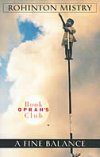
      Book Review: A Fine Balance by Rohinton Mistry

      A Fine Balance is a fine, fine book! Not only has Rohinton Mistry crafted a whole set of very interesting characters for this book, but also, he brings the horrors of the Emergency period alive. I was only 10 years old or so when the government of India declared a state of emergency in India and I was always aware of the adults talking in hushed tones about horrible things that were happening all around them. I am glad to have finally been able to read about the atrocities that went on during that period---dark and dismal as they no doubt were, it is important to know what went on because history forgotten can be history repeated.


      Although this is a work of fiction, it is in some way a documentary covering caste violence, exploitations of the poor, extortion, organized begging, life in city slums, forced sterilisation as a method of population control, Hindu versus Muslim clashes, and a government so corrupt and brutal with the poor it defies words.

      Back to the characters---Mistry has chosen to draw a majority of his characters from the lower middle class to the poor of India and in doing so, has shown us what poverty is and what wretched lives of toil and abuse poor people must live and yet they have the endurance to take on the next day. I just felt sorry that after building his characters up so much, he makes them all come undone at the end.

      To sum up, this novel is both a commentary on the political and social environment of the time as well as a beautiful tragedy.

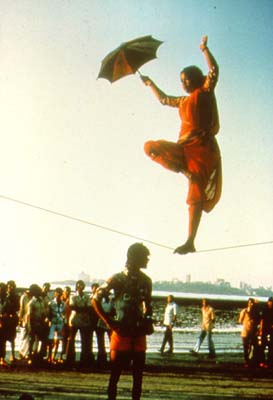
      A note about the cover: It is a picture taken by Dario Mitidieri and shows a girl being balanced on a pole the other end of which rests on someone's thumb. This is a common feat among Indian street acrobats and can also be seen in some Indian circuses. There is a wonderful scene in Rohinton Mistry's book which describes the performance of one of these street acrobats, aka. Monkey Man. India's street acrobats also perform other daring, dangerous feats. Just to give you a taste, here's a small excerpt from travel writer Margaret Deefholts article "Wallahs".

      "Mumbai's street activity runs the gamut from the whimsical to the horrific, and I am catapulted from one to the other without warning. Barely a hundred metres from Laxmibai's cow, I find myself on the perimeter of a small crowd watching a family of ragged street acrobats. The father ties his baby son to a three-metre bamboo pole and while his wife beats a small drum, he walks a rope strung between two portable wooden struts, with the pole balancing on his head. The child dangles five metres above the concrete pavement. The onlookers clap and toss coins into a bowl.

      The crowd disperses and the woman discreetly breast-feeds the baby while her husband counts the take. He says something to his wife, and she laughs, smacks his shoulder, and says, "Aarey, hut ja!" ("Get on with you!") He lights a beedi and hunkers down on his haunches, his face expressionless as he stares into the middle distance. The baby wails as the mother draws him away from her breast and lays him on her lap. The father gently strokes the child's head. In another 10 minutes or so, he will once again risk his son's life for a handful of coins."


      .


      Pic courtesy: Mary Ellen Mark (1998)

      Thursday, June 09, 2005

      Orange Prize for Fiction announces 2005 winner

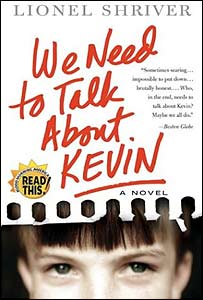
      ...And the winner is, "We need to talk about Kevin" by American writer, Lionel Shriver.

      :


      Broadcaster Jenni Murray, who chaired the judging panel, said: "We Need To Talk About Kevin is a book that acknowledges what many women worry about but never express - the fear of becoming a mother and the terror of what kind of child one might bring into the world.

      The most controversial book on the shortlist for the coveted Orange prize, open only to female authors, Shriver's novel has opened up a debate about women who resent the way in which motherhood restricts their lives.

      The author told the BBC that the brutal candour in her story of a mother who feels despair and a lack of interest in a difficult child touched a nerve with mothers who had, at some point, felt a similar way.

      An excerpt from the Daily Mail review:

      A career woman who loathes motherhood ("a son was born, and I felt nothing") and a wilful child full of disdain for his parents. These are the forces that collide at the heart of this controversial novel, which has created a storm of debate in America.

      Can a mother really despise her offspring - and what effect does that have on the child?

      Harrowing, tense and thought provoking, this is a challenge to every accepted parenting manual you've ever read.

      Wednesday, June 08, 2005

      Kira-Kira wins 2005 Newbery Award


      Kira-Kira Posted by Hello

      How the Newbery Award came to be:

      The Newbery Medal is awarded annually by the American Library Association for the most distinguished American children's book published the previous year. On June 21, 1921, Frederic G. Melcher proposed the award to the American Library Association meeting of the Children's Librarians' Section and suggested that it be named for the eighteenth-century English bookseller John Newbery. The idea was enthusiastically accepted by the children's librarians, and Melcher's official proposal was approved by the ALA Executive Board in 1922. In Melcher's formal agreement with the board, the purpose of the Newbery Medal was stated as follows: "To encourage original creative work in the field of books for children. To emphasize to the public that contributions to the literature for children deserve similar recognition to poetry, plays, or novels. To give those librarians, who make it their life work to serve children's reading interests, an opportunity to encourage good writing in this field."

      The Newbery Award thus became the first children's book award in the world. Its terms, as well as its long history, continue to make it the best known and most discussed children's book award in this country.

      "Kira-Kira," by Cynthia Kadohata, received the 2005 John Newbery Award.